Schweizer Spechte
Profil Wikipedia Vogelwarte BirdLife ZH ornitho.ch bird-song.ch Xeno-Canto BirdID NABU YouTube
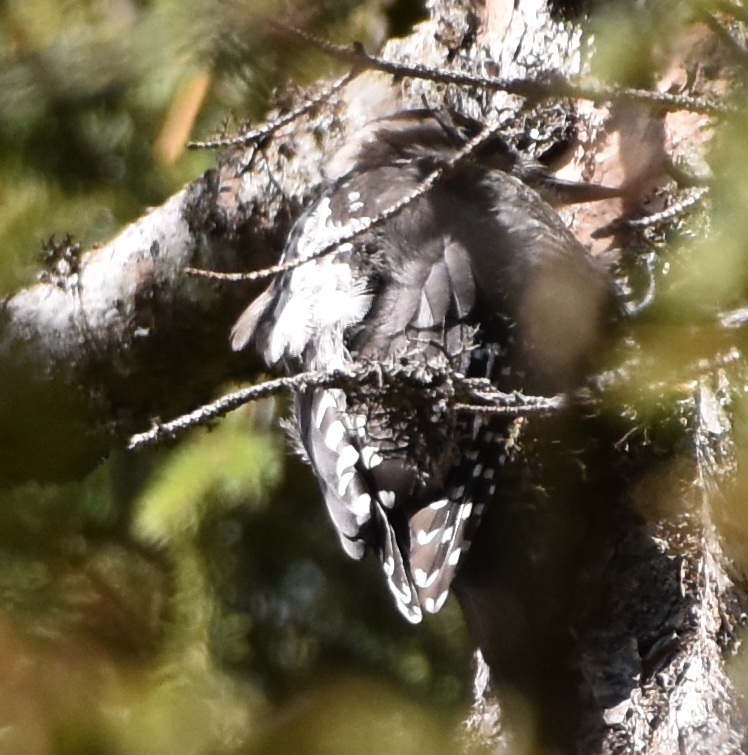
Wahrscheinlich Dreizehenspecht, Ammler Höhenweg. 2021-08-02 16:16:40 Ammler Höhenweg
Zuerst beobachtet in 🇨🇭 an 2021-08-02.
Beschreibung
Behavior: Der Borkenkäferspezialist bevorzugt ungepflegte Fichtenwälder mit reichlich Totholz. [Portrait]
Allgemein: Deutschland: Brut-, Jahresvogel, Wintergast RL 2
Verhalten:
Die Anwesenheit des heimlichen Dreizehenspechts wird oft übersehen. Er ist wenig scheu und fliegt kaum weg, wenn man sich ihm nähert. [Portrait]
Vokalisierung:
 Drumming powerful and slow, with each beat clearly distinguishable. Most similar to Black Woodpecker but not as long (1 - 1.4 seconds). Accelerated ending (just the last few beats). [Link]
Saisonales Verhalten
Jahresvogel Brut: 05-10 - 07-20Weitere Infos at Vogelwarte.ch
Weitere Infos
Physikalische Details
Körperlich: Länge=21-22 cm, Flügelspanne=32-35 cm, Gewicht=57-74 gHabitate: Wald
Vokalisierung
Gesang: Fast drumming, constant volume, longer than great spotted woodpecker's. Behavior:Der Borkenkäferspezialist bevorzugt ungepflegte Fichtenwälder mit reichlich Totholz. [Portrait]
Gesang Eigenschaften:
Melody: einfach rhythmisch, schnell, Frequency: low (1-3 KHz) Special sounds: trommeln
♫ Quelle: XENOCANTO XC627431 dreizehenspecht drumming.mp3 (Trommeln)

Behavior:
Der Borkenkäferspezialist bevorzugt ungepflegte Fichtenwälder mit reichlich Totholz. [Portrait]
Rufe:
Contact call similar to Great Spotted, but deeper and softer. Not very vocal. [Link]
Behavior: Seine unauffälligen Rufe sind nicht laut und tönen ähnlich wie jene des Buntspechts. [Portrait]
XC498796 Dreizehenspecht call.
♫ Quelle: XENOCANTO XC498796 Dreizehenspecht call.mp3 (Ruf)

Ruf Eigenschaften: Trommeln Ruf Melodie: einfach rhythmisch, langsam, Frequenz: low (1-3 KHz),
Vollprofil

Buntspecht in Wildert. 2024-08-31 10:29:52 Wildert
Zuerst beobachtet in 🇨🇭 an 2020-04-12.
Beschreibung
Allgemein: Häufigste Spechtart in der SchweizAllgemein: Deutschland: Brut-, Jahresvogel
Vokalisierung:
It's frequent drumming is easily recognized by its short duration. [Link]
Saisonales Verhalten
Jahresvogel Brut: 04-11 - 07-20Weitere Infos at Vogelwarte.ch
Weitere Infos
Physikalische Details
Körperlich: Länge=22-23 cm, Flügelspanne=34-39 cm, Gewicht=70-100 gHabitate: Wald
Ähnliche Arten
Gesang oder Rüfe ähnlich wie: Ringdrossel.Vokalisierung
Gesang: Song: Other: ‘Drumming’ is the sound that Great Spotted Woodpeckers make by hammering their bills against dead wood 10-20 times over 2-3 seconds. The sound resonates in the dead wood and can be heard over large distances. This drumming acts as an advert and is used by Great spotted Woodpeckers and other woodpecker species instead of a song. [From the GardenBird web site]Nabu: Manchmal, bei strahlendem Sonnenschein, fangen die Spechte schon im Dezember an zu trommeln. [NABU Vogel des Jahres 1997]
Call: Nabu: Das bekannteste Geräusch des schwarz-weißen Spechtes ist aber wohl sein kurzes, aber häufiges Trommeln. [Link]
 In a sonogram I can see about 13 taps in just over half a second, but you can never distinguish so many.
It's short but intense, and the second half trails off,
especially contrasted with the constant drumming of the three-toed woodpecker. [[Listen here.]]
Gesang Eigenschaften:
Melody: nicht musikalisch, schnell, Frequency: low (1-3 KHz) Special sounds: trommeln Singing season: 01-01 - 06-30
In a sonogram I can see about 13 taps in just over half a second, but you can never distinguish so many.
It's short but intense, and the second half trails off,
especially contrasted with the constant drumming of the three-toed woodpecker. [[Listen here.]]
Gesang Eigenschaften:
Melody: nicht musikalisch, schnell, Frequency: low (1-3 KHz) Special sounds: trommeln Singing season: 01-01 - 06-30
♫ Quelle: XENOCANTO XC625181 buntspecht drumming.mp3 (Trommeln)

Rufe:
Typically it lasts 0.5 seconds, sometimes slightly longer. Contact call frequently hear throughout the year. A short hiccup "kek", sometimes in series. When excited this may escalate into a trill. [Link]
1:
General: A chirping (that I couldn't associate in my mind with a woodpecker), repeated at somewhat irregular intervals of about a second2023: klang in bird-song.ch Quiz wie eine lauter Haussperling
Call: Nabu: Der häufigste Ruf ist ein kurzes und spitzes „kix“. Ist ein Buntspecht aufgebracht, etwa durch einen Artgenossen, kann man ein schnelles Schnarren hören. [Link]
Great spotted woodpecker call
♫ Quelle: XENOCANTO XC200059 Great spotted woodpecker call.mp3 (Ruf)

2: No details but a Xeno-Canto recording. - but really OWN_VIA_BIRDNET
Birdnet 1937 - Great Spotted Woodpecker xxxx, also heard drumming - Great Spotted Woodpecker - Fehraltorf.
♫ 2021-08-14 09:57:28 Quelle: BirdNet 20210814_095728 birdnet 1937 - Great Spotted Woodpecker xxxx, also heard drumming - Great Spotted Woodpecker - Fehraltorf.mp3 Fehraltorf (Trommeln)
FOK3 - ein Specht trommelt, welcher war das, ein Buntspecht? Dazu eine Zilzalp, evtl Zaunkönig, und unser Kursleiter, der das Trommeln erklärt.
♫ 2025-03-22 09:08:40
 Quelle: Zoom H2n Schweiz (Trommeln)
Trommeln während ein Buntspecht ruft, im Wildert.
♫ 2024-08-31 09:31:25 Wildert (Trommeln)
Birdnet 1937 - Great spotted woodpecker, heard slow drumming - Not analyzed - Fehraltorf.
♫ 2021-08-14 09:57:28 Quelle: BirdNet 20210814_095728 birdnet 1937 - Great spotted woodpecker, heard slow drumming - Not analyzed - Fehraltorf.mp3 Fehraltorf (Trommeln)
Ruf Eigenschaften: Ruf Melodie: einnotig, langsam, Frequenz: 1-8 KHz,
Vollprofil

Vogelwarte Mittelspecht. Quelle: VOGELWARTE
Vogelwarte Mittelspecht.jpg
🔍
Never observed (yet!)
Beschreibung
Allgemein: Deutschland: Brut-, JahresvogelHabitat:
Der Mittelspecht ist ein Habitatspezialist, der bei uns hauptsächlich ehemalige Mittelwälder mit zahlreichen Alteichen besiedelt. Der Bestand ist gefährdet und langfristig wird er sich nur halten können, wenn grossflächige Wälder mit der Eiche als Hauptbaumart bestehen bleiben. [Link]
Saisonales Verhalten
Jahresvogel Brut: 04-11 - 06-20Weitere Infos at Vogelwarte.ch
Weitere Infos
Physikalische Details
Körperlich: Länge=20-22 cm, Flügelspanne=33-34 cm, Gewicht=50-80 gHabitate: Wald
Vokalisierung
Gesang: No details but a Xeno-Canto recording. Gesang:Im Gegensatz zu anderen Spechten trommelt der Mittelspecht nur sehr selten. [Link]
Song is a series of short, mewing and nasal "peeaa peeaa peeaa ", where each syllable quickly rises in pitch, but the overall phrase is fairly constant. [Link]
Gesang Eigenschaften:
Frequency:
♫ 2024-04-07 13:50:00 (Gesang)

Rufe:
Contact and alarm call consists of a series of short "kitt" sounds, where the first syllable is clearer and distinctly in a higher pitch than the rest of the phrase. Seldom drums. [Link]
Stattdessen ist in der Brutzeit das klagende Quäken zu hören, womit der Mittelspecht sein Revier markiert. [Link]
XC624229 Mittelspecht call.
♫ Quelle: XENOCANTO XC624229 Mittelspecht call.mp3 (Ruf)

Ruf Eigenschaften: Ruf Melodie: einfach rhythmisch, langsam, Frequenz: 0-4 KHz,
Vollprofil

Vogelwarte Weissrückenspecht. Quelle: VOGELWARTE
Vogelwarte Weissrueckenspecht.jpg
🔍
Never observed (yet!)
Beschreibung
Allgemein: Da es selten zu sehen ist, habe ich wenig beschrieben.Allgemein: Deutschland: Brut-, Jahresvogel, Wintergast RL 2
Habitat:
The White-backed Woodpecker is the largest and rarest of the black and white woodpeckers. Since a few years only, individual breeding pairs have been observed in the east of Switzerland. Because of its special habitat requirements – natural forests with a great number of dying and dead trees – the occurrence of the White-backed Woodpecker is limited to remote and inaccessible forests. It has secretive habits and is most likely observed during the courtship period. [Link]
Vokalisierung:
Drumming noticeably longer and more powerful than Great Spotted, with accelerated ending (similar to Three-toed Woodpecker but faster). [Link]
Weitere Infos
Physikalische Details
Körperlich: Länge=24-26 cm, Flügelspanne=38-40 cm, Gewicht=99-112 gHabitate: Wald Vollprofil
Profil Wikipedia Vogelwarte BirdLife ZH ornitho.ch bird-song.ch Xeno-Canto BirdID NABU YouTube

Schwarzspecht in Wildert Naturschutzgebiet. 2024-12-18 14:30:58 Wildert
Zuerst beobachtet in 🇨🇭 an 2020-10-21.
Beschreibung
Allgemein: Bisher gehört und später gesehen aber nie gut fotografiertAllgemein: Deutschland: Brut-, Jahresvogel
Aussehen und Identifizierung:
 The black woodpecker (Dryocopus martius) is a large woodpecker that lives in mature forests across the northern Palearctic. It is the sole representative of its genus in that region. Its range is expanding. It does not migrate. [Link]
Habitat:
The black woodpecker is mainly found in forested regions, with a preference for extensive, mature woodland, including coniferous, tropical, subtropical and boreal forests. It is very widespread throughout mountainous and lowland forests. It is more likely to occur in marginal woods near human habitations during the non-breeding season. [Link]
Vokalisierung:
Most sounds diagnostic and very far reaching. Drumming very powerful and long (1.8 - 3 sec.) with slightly falling intensity and accelerated ending. Each beat clearly distinguishable as in Tree-toed Woodpecker, but duration much longer. [Link]
Saisonales Verhalten
Jahresvogel Brut: 04-01 - 07-20Weitere Infos at Vogelwarte.ch
Weitere Infos
Physikalische Details
Körperlich: Länge=45-57 cm, Flügelspanne=64-68 cm, Gewicht=290-370 gHabitate: Wald
Vokalisierung
Gesang: No details but a Xeno-Canto recording. Gesang: Beide Geschlechter ähnlich Grünspecht aber klangvoller. „klückklückklück“ 10-20 Laute. Die „klück“ werden etwas von unten heraufgeholt, vor allem gegen den Schluss zu. Häufiger hört man „kliüüh“ von am Stamme sitzenden Vogel. Bei Platzwechsel ruft er „krükrükrü“.
[Link]
Song a quick series of "klee" calls resembling Green Woodpecker, but with a purer tone and upward infliction at end of each syllable. [Link]
Gesang Eigenschaften:
Frequency:
Beide Geschlechter ähnlich Grünspecht aber klangvoller. „klückklückklück“ 10-20 Laute. Die „klück“ werden etwas von unten heraufgeholt, vor allem gegen den Schluss zu. Häufiger hört man „kliüüh“ von am Stamme sitzenden Vogel. Bei Platzwechsel ruft er „krükrükrü“.
[Link]
Song a quick series of "klee" calls resembling Green Woodpecker, but with a purer tone and upward infliction at end of each syllable. [Link]
Gesang Eigenschaften:
Frequency:
♫ Quelle: XENOCANTO XC554337 Black woodpecker song.mp3 (Gesang)
Rufe:
Drumming: Flight call a characteristic resonant trill "krrreekrrreekrrreekrrree". A characteristic short, sharp and plaintive "keeaaa" with descending pitch often uttered when excited. A few slower drawn-out introductory calls before the phrase gets going is diagnostic. [Link] 1: General: A loud unearthly call on a single unwavering note.
Erschrenkender Ruf
♫ Source as noted in xeno-canto: Recordist Bodo Sonnenburg 2021-10-11 07:26 Latitude 52.2333 Longitude 13.8365 Location Oder-Spree (near Storkow (Mark)), Brandenburg Country Germany Elevation 40 m Quelle: XENOCANTO XC679746 - Black Woodpecker - Dryocopus martius.mp3 (Gesang?)

2: Describe drumming here, cf to other peckers!
XC553023 Black woodpecker drumming.
♫ Quelle: XENOCANTO XC553023 Black woodpecker drumming.mp3 (Trommeln)
3: No details but a Xeno-Canto recording.
XC549818 Black woodpecker flight call.
♫ Quelle: XENOCANTO XC549818 Black woodpecker flight call.mp3 (Flugruf)
Ruf Eigenschaften: Ruf Melodie: einnotig, langsam, Frequenz: 1-8 KHz,
Vollprofil

Vogelwarte Grauspecht. Quelle: VOGELWARTE
Vogelwarte Grauspecht.jpg
Zuerst beobachtet in 🇨🇭 an 2025-03-22.
Beschreibung
Allgemein: Deutschland: Brut-, Jahresvogel RL 2Verhalten:
Der Grauspecht gehört mit dem Grünspecht zu den «Erdspechten», die ihre Nahrung vorwiegend auf dem Boden suchen. Obwohl er fast so gross ist wie der Grünspecht, ist der heimlicher lebende Grauspecht ungleich schwieriger zu lokalisieren. Am ehesten verrät er sich durch die fallende, etwas melancholisch wirkende Rufreihe. Über seine Lebensweise ist vergleichsweise wenig bekannt. [Link]
Vokalisierung:
Mostly heard during the breeding season. [Link]
Saisonales Verhalten
Jahresvogel Brut: 04-20 - 07-29Weitere Infos at Vogelwarte.ch
Weitere Infos
Physikalische Details
Körperlich: Länge=25-26 cm, Flügelspanne=38-40 cm, Gewicht=120-160 gHabitate: Wald
Vokalisierung
Gesang: Drumming in lieu of song. Fast, constant, somehow less harsh than great and middle spotted woodpeckers. Gesang:Deutlich abfallende Tonreihe. 4-10 Töne. Absinken beginnt
gewöhnlich erst mit dem dritten oder vierten Ton und wird etwas langsamer.
Klingt etwas klagend (moll). Vor allem gegen den Schluss. Kann nachgepfiffen werden. (beim Grünspecht nicht )
[Link]
Song similar to Green Woodpecker, but general tone is soft and melancholic. Phrases consists of series of 5-8 clear notes falling both in pitch and intensity, and with diagnostic ritardando at the end. Short "kek" uttered if excited. Rarely drums. [Link]
Gesang Eigenschaften:
Melody: einfach rhythmisch, schnell, Frequency: 0-4 KHz Special sounds: trommeln
♫ Quelle: XENOCANTO XC552636 Kleinspecht drumming.mp3 (Trommeln)

1: In the FOK course, Christina said he sounds like he's running out of gas, which is a great description.
XC623125 grauspecht call.
♫ Quelle: XENOCANTO XC623125 grauspecht call.mp3 (Ruf)

2: No details but a Xeno-Canto recording.
XC628962 Grauspecht drumming.
♫ Quelle: XENOCANTO XC628962 Grauspecht drumming.mp3 (Trommeln)

Ruf Eigenschaften: Ruf Melodie: einfach rhythmisch, langsam, Frequenz: high (3-9 KHz),
Vollprofil

Elster im Baum nah bei einem Grünspecht, den ich gehört aber nicht gesehen habe. 2025-05-08 18:06:57 Wald Fehraltorf
Zuerst beobachtet in 🇨🇭 an 2020-11-08.
Beschreibung
Allgemein: In the FOK course, Tom mentioned that his nephew said it should be called the Buntspecht, since it has so many colors.Allgemein: Da es v.a. Ameisen frisst, trommelt es nicht viel, so weit ich mich erinnere, daher ist es hier nicht beschrieben. Xenocanto hat auch nichts.
Allgemein: Deutschland: Brut-, Jahresvogel RL V
Aussehen und Identifizierung:
Der Grünspecht fällt neben dem laut lachenden Balzruf auch durch den wellenförmigen Flug auf, bei dem er die Flügel zwischen zwei Schlagphasen ganz an den Körper anlegt. Neben dem Wendehals ist er unter den Spechtarten Europas am stärksten auf Ameisen spezialisiert. Er besitzt eine mehr als 10 Zentimeter lange Zunge, die klebrig und an der Spitze mit Widerhaken versehen ist. [Link]
Saisonales Verhalten
Jahresvogel Brut: 04-11 - 07-20Weitere Infos at Vogelwarte.ch
Weitere Infos
Physikalische Details
Körperlich: Länge=31-33 cm, Flügelspanne=40-42 cm, Gewicht=150-220 gHabitate: Wald
Vokalisierung
Gesang: Spooky laugh. Gesang:Helles Lachen. Weiche, oft leicht abfallende Tonreihe. Variabel in Lautstärke und Silbenzahl. je nach Stimmung. Wenn abfallend dann vom Anfang der Rufreihe an. Auch dreisilbig „kiäckkiäckkiäck“.
[Link]
Song similar to Grey-headed Woodpecker, but not as soft and fluty. Each phrase consist of a series of short "klee", with a laughing quality. Pitch drops slightly throughout the phrase, but not as markedly as in Grey-headed, and tempo is fairly constant (no ritardando). [Link]
Gesang Eigenschaften:
Melody: nicht musikalisch, langsam, Frequency: 1-6 KHz
Rufe:
Short "kek" calls when excited and in flight. Drumming of 1.5 seconds duration with decelerating tempo, but not often heard. Another call is similar to Black Woodpecker; a series of resonant "klit-klit-klit-klit-klit-klit", but is less clear, has a more determined start and has less obvious rising pitch at the end of each syllable. [Link]
Unheimliches Lachen.
XC627157 Grünspecht laughing call.
♫ Quelle: XENOCANTO XC627157 Gruenspecht laughing call.mp3 (Ruf)

Ruf Eigenschaften: Ruf Melodie: einnotig, langsam, Frequenz: high (3-9 KHz), Spezielle Klänge: absteigend.
Vollprofil

Kleinspecht am Baum wo wir mehrere Specht gesehen habe. 2024-05-31 07:58:53 Frauenfeld Allmend
Zuerst beobachtet in 🇨🇭 an 2021-01-16.
Beschreibung
Allgemein: Bisher gesehen aber nicht gehört!Allgemein: Deutschland: Brut-, Jahresvogel, Wintergast RL V
Aussehen und Identifizierung:
The smallest European woodpecker. ... From its small size and its habit of spending most of its time in the tops of tall trees in woods and parks, this little woodpecker is often overlooked, but if sighted on a trunk
it may at once be identified by the broad barring on the wings and narrower bars across the lower back. [Link]
Der Kleinspecht ist der Zwerg unter den europäischen Spechten.
Er macht sich im Frühjahr mit hohen Rufreihen und gleichmässigen Trommelwirbeln bemerkbar. [Link]
Habitat:
As above: spend(s) most of its time in the tops of tall trees [Link]
Vokalisierung:
Frequently drums in quite long series. Much longer than Great Spotted, and without ritardando. [Link]
Saisonales Verhalten
Jahresvogel Brut: 04-20 - 06-20Weitere Infos at Vogelwarte.ch
Weitere Infos
Physikalische Details
Körperlich: Länge=14-15 cm, Flügelspanne=25-27 cm, Gewicht=17-25 gHabitate: Wald
Vokalisierung
Gesang: Drumming in lieu of song. Fast, constant. Gesang Eigenschaften: Melody: einfach rhythmisch, schnell, Frequency: 0-4 KHz Special sounds: trommeln♫ Quelle: XENOCANTO XC552636 Kleinspecht drumming.mp3 (Trommeln)
Rufe:
Most common call a series of merlin-like "ke-ke-ke-ke-ke-ke" given at fairly stable pitch, and less hoarse than Merlin. Differs from Wryneck in lacking marked rise and fall in pitch, and being less plaintive. [Link]
1:
Vogelwarte wie oben..hohe Rufreihen
XC625101 Kleinspecht call.
♫ Quelle: XENOCANTO XC625101 Kleinspecht call.mp3 (Ruf)

2: No details but a Xeno-Canto recording.
Ruf Eigenschaften: Ruf Melodie: einfach rhythmisch, schnell, Frequenz: high (3-9 KHz),
Vollprofil