Kulturland-Exkursion Maienfeld

Wikipedia: Icterine warbler Quelle: WIKIPEDIA
1200px-Hippolais_icterina2.jpg
🔍
Never observed (yet!)
Beschreibung
Allgemein: Gesucht in Kaltbrunnenriet - in Juni 2022 nicht gefunden.Allgemein: Deutschland: Brut-, Zugvogel
Etymologie:
 Ihren Namen [Spötter] tragen sie, weil sie in ihren Gesang den anderer Vögel nachahmend aufnehmen („spotten“). [Link]
It referred to a small bird mentioned by Aristotle and others and may be onomatopoeic or derived from hupo,"under", and laas, "stone". [Link]
Ihren Namen [Spötter] tragen sie, weil sie in ihren Gesang den anderer Vögel nachahmend aufnehmen („spotten“). [Link]
It referred to a small bird mentioned by Aristotle and others and may be onomatopoeic or derived from hupo,"under", and laas, "stone". [Link]
Aussehen und Identifizierung: Yellow belly, brown back, very similar to melodious warbler. Sometimes has the punky ruffled head feathers.
Aussehen und Identifizierung: Ebird: Distinctive features include longish, daggerlike bill, long primary projection in the wings, and square tail. Told from similar Melodious Warbler by usually conspicuous pale wing panel, longer wings, and marginally shorter bill. Usually difficult to see when singing except during song flights, when long wings are apparent. Found in tall forest with oaks and birch, mixed forest, gardens, and parks. [Link]
Geographie:
 Es gibt nur 100-150 Paare in der Schweiz, darum steht es auf der Rote Liste CH as stark gefährdet - und ist sicher schwierig zu finden. [Link]
Saisonales Verhalten
Präsenz: 05-01 - 09-15Weitere Infos
Physikalische Details
Körperlich: Länge=13 cm, Flügelspanne=20-24 cm, Gewicht=10-15 gHabitate: Landwirtschaft
Vokalisierung
Gesang: Short bits 4-8 notes, sometimes with a little pause, overall a greenfinch feel. Some whoops, some chucks like a great tit, some bits like a house sparrow, even a meow. BirdLife Schweiz says full of vigor, includes some mis-tones and creaky calls; eBird says Song is fast, loud, and melodious with lots of mimicry.Can sing low (2k) or high (10k) Gesang:Sein lauter, lebhafter und variabler Gesang setzt sich aus flötenden, zwitschernden und nasalen Tönen sowie Imitationen anderer Vogelarten wie Drosseln, Meisen, Schwalben oder Pirol zusammen. [Scheint mir aus Segmente von ~2 Sekunden zu bestehen.] [Link]
 Song very virtuous and varied. Most similar to Marsh Warbler, but timbre and attack harder and more powerful. Tempo varied with many pauses, but includes longer, and more flowing sequences than Marsh Warbler. Song frequently interrupted by characteristic, nasal, high-pitched squeaks unlike Marsh Warbler. Master of mimicry. Imitations are often repeated several times before changing to melodious motifs or more "noisy" phrases. [Link]
Gesang Eigenschaften:
Melody: improvisiert melodisch, schnell, Frequency: 2-10 KHz Special sounds: Mimikry
Song very virtuous and varied. Most similar to Marsh Warbler, but timbre and attack harder and more powerful. Tempo varied with many pauses, but includes longer, and more flowing sequences than Marsh Warbler. Song frequently interrupted by characteristic, nasal, high-pitched squeaks unlike Marsh Warbler. Master of mimicry. Imitations are often repeated several times before changing to melodious motifs or more "noisy" phrases. [Link]
Gesang Eigenschaften:
Melody: improvisiert melodisch, schnell, Frequency: 2-10 KHz Special sounds: Mimikry
Vollprofil
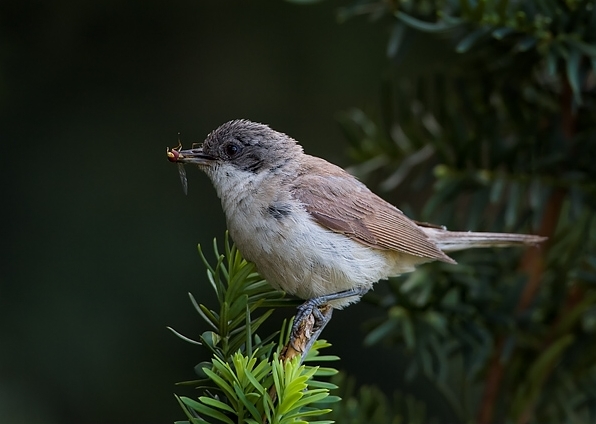
Wikipedia: Lesser whitethroat Quelle: WIKIPEDIA
Sylvia_curruca_1_%28Martin_Mecnarowski%29.jpg
Zuerst beobachtet in 🇨🇭 an 2023-05-27.
Beschreibung
Allgemein: Wollte diese in Klettgau suchen 2023, bin darüber gestolpert bei Bad Vilbel, Deutschland.Allgemein: Deutschland: Brut-, Zugvogel
Saisonal:
Nach ihrer Ankunft im April oder Mai verrät sich diese rastlose und geschickt durch das Geäst hüpfende Grasmücke am ehesten durch ihren Gesang. Das eintönige Klappern ist weithin hörbar und hat ihr den deutschen Artnamen eingebracht. Das Männchen versucht, ein im Revier erscheinendes Weibchen durch Vorausfliegen zu einem Wahlnest zu locken. [Link]
Saisonales Verhalten
Präsenz: 04-01 - 10-07 Brut: 05-21 - 08-09 Migration rein: 04-01 - 05-31 Migration raus: 07-29 - 10-07Weitere Infos at Vogelwarte.ch
Weitere Infos
Physikalische Details
Körperlich: Länge=12-13 cm, Flügelspanne=16-20 cm, Gewicht=10-14 gHabitate: Landwirtschaft
Vokalisierung
Gesang:Song typically consists of two parts. An indistinct chattering and warbling, subsong-like part similar to [common] Whitethroat, which is usually followed by a dry, fast and rattling trill. The trill carries much further than the chattering part. May be difficult to identify if trill is omitted. [Link]
Gesang:  Klappernd. (Müllerchen) An Berglaubsänger erinnernd. Klappertöne (5-8) Aber oft mit leisem schwatzendem Vorgesang, der fehlen kann. Kann auch an Sumpfmeise erinnern, doch sind bei dieser die Klappertöne mehr von oben her angeschlagen.
[Link]
Song typically consists of two parts. An indistinct chattering and warbling, subsong-like part similar to Whitethroat, which is usually followed by a dry, fast and rattling trill. The trill carries much further than the chattering part. May be difficult to identify if trill is omitted. [Link]
Gesang Eigenschaften:
Melody: einfach rhythmisch, langsam, Frequency: 3-5 KHz Special sounds: Triller
Klappernd. (Müllerchen) An Berglaubsänger erinnernd. Klappertöne (5-8) Aber oft mit leisem schwatzendem Vorgesang, der fehlen kann. Kann auch an Sumpfmeise erinnern, doch sind bei dieser die Klappertöne mehr von oben her angeschlagen.
[Link]
Song typically consists of two parts. An indistinct chattering and warbling, subsong-like part similar to Whitethroat, which is usually followed by a dry, fast and rattling trill. The trill carries much further than the chattering part. May be difficult to identify if trill is omitted. [Link]
Gesang Eigenschaften:
Melody: einfach rhythmisch, langsam, Frequency: 3-5 KHz Special sounds: Triller
♫ Quelle: XENOCANTO XC652419 - Lesser Whitethroat - Sylvia curruca - song.mp3 (Gesang)

Rufe:
„tze“ oder „tett“
[Link]
Warning call a hard "check" similar to Blackcap but slightly softer. [Link]
BirdID says: Warning call a hard "check" similar to Blackcap but slightly softer
♫ Quelle: OTHER 575779 (Ruf)
Ruf Eigenschaften: Ruf Melodie: einnotig, langsam, Frequenz: 2-7 KHz, Spezielle Klänge: stottern/kieseln.
Vollprofil

Bank swallow. 2024-01-26 15:58:58 Thailand
Zuerst beobachtet in Thailand an 2024-01-26.
Beschreibung
Geographie: Dieser Vogel erscheint jenseits grossen Meere in Kontinenten : Europa, Nordamerika, Südamerika, Afrika, Asien.Allgemein:
Die Uferschwalbe (Riparia riparia), auch Rheinschwalbe genannt, ist eine Vogelart aus der Familie der Schwalben (Hirundinidae). Es werden mehrere Unterarten unterschieden.
[mehr]
Deutschland: Brut-, Zugvogel RL V
Saisonales Verhalten
Präsenz: 03-23 - 10-18 Brut: 05-01 - 09-07 Migration rein: 03-23 - 06-09 Migration raus: 07-10 - 10-18Weitere Infos at Vogelwarte.ch
Weitere Infos
Physikalische Details
Körperlich: Länge=12 cm, Flügelspanne=26-29 cm, Gewicht=11-16 gHabitate: Nassgebiet
Vokalisierung
Gesang: Fast raspy one-noter. Gesang:Song a primitive improvisation on the contact call. [Link]
Gesang Eigenschaften:
Melody: nicht musikalisch, schnell, Frequency: 1-7 KHz Special sounds: Raspel
♫ Quelle: XENOCANTO XC344092 - Sand Martin - Riparia riparia - raspy song but note, does not sing often.mp3 (Gesang)

Rufe:
Contact call a mono- or disyllabic "trrrrt". Similar to House Martin but more raucous and less crisp, with less rolling r's, and with stable pitch throughout. Alarm call similar to House Martin; a sharp plaintive "tseep", but somewhat purer and more drawn. [Link]
No details but a Xeno-Canto recording.
XC659747 - Sand Martin - Riparia riparia - noisy call recorded in Sweden.
♫ Quelle: XENOCANTO XC659747 - Sand Martin - Riparia riparia - noisy call recorded in Sweden.mp3 (Ruf)

Ruf Eigenschaften: Gesang Frequenz: ,
Vollprofil
Profil Wikipedia eBird Vogelwarte BirdLife ZH ornitho.ch bird-song.ch Xeno-Canto BirdID NABU YouTube

Girlitz in Levanto. 2024-05-30 06:15:49 Levanto
Zuerst beobachtet in 🇨🇭 an 2020-06-14.
Beschreibung
Allgemein: Ich bin mir nicht sicher, ob die Aufnahmen unten Girlitz sind...kontrollieren.Allgemein: Deutschland: Brut-, Zugvogel
Saisonales Verhalten
Jahresvogel Brut: 04-20 - 08-18 Migration rein: 03-01 - 05-01 Migration raus: 09-17 - 11-06Weitere Infos at Vogelwarte.ch
Weitere Infos
Physikalische Details
Körperlich: Länge=11 cm, Flügelspanne=20-23 cm, Gewicht=11-14 gHabitate: Siedlung
Vokalisierung
Gesang: Weird hectic song, and you'll probably hear them but not see them, which is a shame, because they're a colorful yellow bird. The song seems to defy description - described variously as the jingling of a bunch of keys, like crushing glass or the pouring of broken glass (the German Wikipedia refers to a nickname 'Glasscutter'), the sound of a cork twising in a bottle (Thomas Seilnacht on digitalefolien.ch), and one source I can no longer find talked about a ruined cassette tape. A Portuguese web site aptly calls it 'a high-pitched and fast rambled sum of indistinctive elements', and U. Cornell's ebird.org calls it frantically fast, oiseaux-birds.com 'a prolonged, wheezy, chirping', beautyofbirds.com 'a buzzing trill'. Der Gesang des Girlitz ... ist nicht so melodisch wie der des verwandten Kanarienvogels [auch Kanariengirlitz genannt]. Er wurd schon mit 'einem schnell zürückgespulten Kassentenrekorder' verglichen oder als 'hastig quitschend' bezeichnet. [Link]Das Gesangsrepertoire umfasst über 50 komplexe Silben, die in einem sehr schnellen Tempo und einer sehr stereotypen Reihenfolge eigene Lieder bilden. Starke Variationen finden sich im Übergang von einer Tour (zusammenhängenden Abfolge von Silben, also (Teil-)Strophe) in eine andere (Modulation). Das Gesangsrepertoire ist unter den Stieglitzartigen (Carduelinae) einzigartig.[1] Zudem umfasst es eine variable Menge an Silben, die auch im Gesang anderer Vögel verwendet werden. Es konnte bewiesen werden, dass die Komposition des Repertoires geographisch variiert. [Wikipedia setzt sich ernsthaft mit dem Gesang auseinander]
Gesang: Song a hectic, jingling, continuous trill, like the pouring of broken glass. The highest notes are constantly modulated to form vague motifs. Timbre comparable to Corn Bunting. [Link]
Gesang Eigenschaften:
Melody: singt 5-19 Sekunden, sehr schnell, Frequency: 4-10 KHz
Der Gesang des Girlitz ... ist nicht so melodisch wie der des verwandten Kanarienvogels [auch Kanariengirlitz genannt]. Er wurd schon mit 'einem schnell zürückgespulten Kassentenrekorder' verglichen oder als 'hastig quitschend' bezeichnet. [Link]Das Gesangsrepertoire umfasst über 50 komplexe Silben, die in einem sehr schnellen Tempo und einer sehr stereotypen Reihenfolge eigene Lieder bilden. Starke Variationen finden sich im Übergang von einer Tour (zusammenhängenden Abfolge von Silben, also (Teil-)Strophe) in eine andere (Modulation). Das Gesangsrepertoire ist unter den Stieglitzartigen (Carduelinae) einzigartig.[1] Zudem umfasst es eine variable Menge an Silben, die auch im Gesang anderer Vögel verwendet werden. Es konnte bewiesen werden, dass die Komposition des Repertoires geographisch variiert. [Wikipedia setzt sich ernsthaft mit dem Gesang auseinander]
Gesang: Song a hectic, jingling, continuous trill, like the pouring of broken glass. The highest notes are constantly modulated to form vague motifs. Timbre comparable to Corn Bunting. [Link]
Gesang Eigenschaften:
Melody: singt 5-19 Sekunden, sehr schnell, Frequency: 4-10 KHz
♫ Quelle: XENOCANTO XC637940 - European Serin - Serinus serinus - song, recorded in France.mp3 (Gesang)

Rufe:
Ringing trill also used as contact call, with slightly falling pitch "trrilrlitlitlit". Alarm call a short, redpoll-like "weee-eeet", with an accented high-pitched middle part. [Link]
XC938311 - European Serin chirpy flight call - Serinus serinus.
♫ Quelle: XENOCANTO XC938311 - European Serin chirpy flight call - Serinus serinus.mp3 (Flugruf)

Ruf Eigenschaften: Flugruf Ruf Melodie: einnotig, langsam, Frequenz: medium (1-5 KHz),
Vollprofil

Paar bei Colonia de Sant Pere, Mallorca - MerlinBirdID suggests eurasian linnet or less likely cirl bunting. 2022-04-15 15:36:36
Zuerst beobachtet in Mallorca an 2022-04-15.
Beschreibung
Allgemein: Deutschland: Brut-, Jahres-, Zugvogel, Wintergast RL VEtymologie:
 Herkunft: von der Hanf-Pflanze (Cánnabis), deren Samen zu seiner Nahrung gehören [Link]
Aussehen und Identifizierung: Rote Stirn, Bauch; Kopf grau, Kinn weiss.
Aussehen und Identifizierung:
The summer male has a grey nape, red head-patch and red breast. Females and young birds lack the red and have white underparts, the breast streaked buff. [Link]
Saisonales Verhalten
Jahresvogel Brut: 04-20 - 08-18 Migration rein: 03-01 - 05-10 Migration raus: 09-17 - 11-15Weitere Infos at Vogelwarte.ch
Weitere Infos
Physikalische Details
Körperlich: Länge=13 cm, Flügelspanne=21-25 cm, Gewicht=15-22 gHabitate: Landwirtschaft
Vokalisierung
Gesang: General: Ähnlich wie ein Rohrsänger aber nur kurze Segmente mit klaren Pausen.Song: Nabu: Sein Gesang umfasst trillernde, kurze und musikalische pfeifende Laute, unter anderem „piUU“, „trrüh“ und „tu-ki-jüüh“. [Link]
Song:
 Gesang ist fast Rohrsänger-artig, relativ hoch und zirpend. Manchmal mit kleinen Pausen. bird-song Aufnahme where kurz, llll mhllll [Link]
Gesang: Gesang für mich ähnlich wie Grünfink.
Gesang ist fast Rohrsänger-artig, relativ hoch und zirpend. Manchmal mit kleinen Pausen. bird-song Aufnahme where kurz, llll mhllll [Link]
Gesang: Gesang für mich ähnlich wie Grünfink.
Gesang:
Song a varied, sweet stream of contact calls, mimicry and trills with a staccato feel. [Link]
Gesang Eigenschaften:
Melody: stereotypisch melodisch, schnell, Frequency: 2-7 KHz Special sounds: Mimikry
♫ Quelle: XENOCANTO XC705526 - Common Linnet - Linaria cannabina cannabina - song, recorded in England.mp3 (Gesang)

Rufe:
Flight-call a quick and "bouncing" "gig-gig" or "tchett-tchett". Most often disyllabic utterances, while Twite seems to vary more the number of syllables. Tone harder and more bouncing. Most easily recognized by the frequently interwoven, disyllabic contact calls. [Link]
No details but a Xeno-Canto recording.
XC910816 - Common Linnet call - Linaria cannabina.
♫ Quelle: XENOCANTO XC910816 - Common Linnet call - Linaria cannabina.mp3 (Ruf)

Ruf Eigenschaften: Gesang Frequenz: ,
Vollprofil
Profil Wikipedia Vogelwarte BirdLife ZH ornitho.ch bird-song.ch Xeno-Canto BirdID NABU YouTube

The most common yellowhammer dialects shown at the yellowhammers.net project - so cool! Most Swiss dialects shown on their map are XlB. In my own recordings so far, I hear (and on the sonograms see) a pause after the initial phrase rather than a higher note. I'd like to follow that further. Quelle: OTHER
Yellowhammers.net dialect graphs.jpg
Zuerst beobachtet in 🇨🇭 an 2020-05-26.
Beschreibung
Allgemein: Deutschland: Brut-, Jahres-, Zugvogel, Wintergast RL VPersönlich gemerkt: Habe ihn im Fehraltorfer-Wald endlich gesehen als er von einem Baum in die Spitze eines anderen geflogen ist.
Etymologie: Ich dachte, es ist komisch, dass diese Vögel auf deutsch Ammer und Englisch Hammer heissen. Hammer scheint gar nicht logisch und Ammer ist nicht klar. Die Wikpedia Seite für Bunting auf Englisch sagt The genus name Emberiza is from Old German Embritz, a bunting.[6] The origin of the English "bunting" is unknown. - also Ammer ist nur eine andere Ausspracher von Embritz.
Etymologie:
Sie werden lautmalerisch mit tsr, zik oder zrk umschrieben. [Link]
Verhalten: Vogelwarte.ch: besiedelt am liebsten Kulturlandschaften mit Hecken, Obstgärten, Äckern und Wiesen. Bei uns im Wald am Rand von einem Ackerfeld gehört. Die Brust weist ein Muster aus, das mich etwas an Drossel erinnert, obwohl sie anscheinend gar nicht eng verwandt mit den sind.
Saisonales Verhalten
Jahresvogel Brut: 04-15 - 09-05 Migration rein: 01-05 - 12-05 Migration raus: 01-06 - 02-20Weitere Infos at Vogelwarte.ch
Weitere Infos
Physikalische Details
Körperlich: Länge=16 cm, Flügelspanne=23-29 cm, Gewicht=25-36 gHabitate: Landwirtschaft
Vokalisierung
Gesang: Stakkato 2-Noten-Sequenz wird 10-12 mal wiederholt, mit Pause oder höhere Note und Pfiff am Ende. In der Schweiz höre ich (und andere) meistens den XlB-Dialekt, was Pavel Pipek vom yellowhammers.net Projekt erklärt heisst eine Silbe mit hoher Note und lang gezogen (Xl) und am schluss eine tiefe Frequenz (B). Vogelwarte.ch schreibt: Bereits im zeitigen Frühjahr trägt das Männchen seinen einfachen Gesang vor: «Wie, wie, wie, wie hab ich dich lieb». Bolzari und Gygax in Vogelarten der Schweiz sind weniger poetisch aber hilfreicher mit der Beschreibung: vzizizizizizizi-düüüh. Gesang:Kurzes Liedchen. „ Wie wie wie hab ich dich liiieb“ Das „Lieb“ ist meist etwas tiefer, kann aber auch höher sein oder doppelt, dabei das eine höher und das andere tiefer. Sehr variabel!
[Link]
Song a series of 6-8 (or more) slightly ascending "tze" 's, rising in volume and ending on a sustained note, which may be lower or higher than the others. Often rendered as "little-bit-of-cheese-and-no-bread". Last note is often omitted, which may lead to confusion with Cirl Bunting. Timbre with prominent harmonics as in other bunting songs. [Link]
Gesang Eigenschaften:
Melody: einfach rhythmisch, schnell, Frequency: 4-8 KHz Singing season: 03-01 - 09-30 Dawn chorus start: 45 minutes before dawn.
Rufe:
„zick“ „zeck“
[Link]
Distinct contact call: A short and brittle "zeet", rich in harmonics. [Link]
No details but a Xeno-Canto recording.
Call recorded in UK, sounds typical to me, and spiced up by a yellowhammer in the background and several other birds
♫ Quelle: XENOCANTO XC444002 - Willow Warbler - Phylloscopus trochilus trochilus - call in UK, with yellowhammer in background.mp3 (Ruf)

Ruf Eigenschaften: Gesang Frequenz: ,
Vollprofil
Profil Wikipedia Vogelwarte BirdLife ZH ornitho.ch Xeno-Canto BirdID NABU YouTube
Paar bei Colonia de Sant Pere, Mallorca - MerlinBirdID suggests eurasian linnet or less likely cirl bunting. 2022-04-15 15:36:36
Zuerst beobachtet in 🇨🇭 an 2021-05-29.
Beschreibung
Allgemein: Deutschland: Brut-, Jahres-, Zugvogel RL 2Persönlich gemerkt: Als Anfänger, hätte ich gedacht, dies wäre eine Goldammer, da beide gelb mit braunen Details sind; BirdID meint sie sind kompakter. Das Männchen ist eher gelb und hat was für mich wie drei brauen Streifen im Gesicht aussehen. Die Goldammer hat kaum braun am Kopf. Das Weibchen ist weniger gelb und mehr braun. Siehe BirdID für gute Bilder und Beschreibung der Erkennungsmerkmale.
Saisonales Verhalten
Jahresvogel Brut: 04-20 - 09-07Weitere Infos at Vogelwarte.ch
Weitere Infos
Physikalische Details
Körperlich: Länge=15 cm, Flügelspanne=22-25 cm, Gewicht=21-29 gHabitate: Landwirtschaft
Vokalisierung
Gesang: biologie-wissen.info: sings beg Feb to mid July; me: long trill similar to yellowhammer Gesang: BirdID says song like yellowhammer with no ending. I see what they mean - it's more like 16 or so trilled repetitions of the same note, and no leap up to 'lieb' as in the German Goldammer mnemonic.Gesang:
Wie Goldammer, aber ohne das „lieb“.und etwas tiefer. Ähnlich Klappergrasmücke.
[Link]
Song variable, but can generally be described as a Yellowhammer phrase with no ending, or an Arctic Warbler with bunting timbre. Tempo also variable, but rhythm always even. [Link]
Gesang Eigenschaften:
Melody: einfach rhythmisch, schnell, Frequency: 3-6 KHz
Vollprofil

Bergpieper glaube ich. 2023-05-27 09:38:16 Amden Hinder Höchi
Zuerst beobachtet in 🇨🇭 an 2020-07-19.
Beschreibung
Allgemein: Saw in Toggenburg on our FOK weekend 2021.Allgemein: Deutschland: Zugvogel, Wintergast
Aussehen und Identifizierung:
wie ein grauer Fink. [Link]
Vokalisierung:
Similar to Rock Pipit. [Link]
Saisonales Verhalten
Jahresvogel Brut: 05-01 - 08-09 Migration rein: 03-01 - 05-10 Migration raus: 09-28 - 11-15Weitere Infos at Vogelwarte.ch
Weitere Infos
Physikalische Details
Körperlich: Länge=17 cm, Flügelspanne=24-29 cm, Gewicht=19-27 gHabitate: Berg
Vokalisierung
Gesang:Er singt überwiegend fliegend ein ein- bis zweisilbiges „zip“ oder „tsi tsi“. [Link]
Gesang: Monoton, GAR NICHT BERGIG. Tsilp tsilp, gleich note, wiederholt sich über 10+ Sekunden, leicht schneller aber nicht zu viel. [Link]
Meist drei nicht scharf abgesetzte lange Tonreihen. Singflug. Mittelteilstück rauer und geräuschhafter als bei obiger Art [Wiesenpieper]. [Link]
Song slightly more melodious, often with Tree Pipit like glissandi at end of phrase. [Link]
Gesang Eigenschaften:
Melody: einnotig, schnell, Frequency: 3-7 KHz
♫ Quelle: XENOCANTO XC716570 - Water Pipit - Anthus spinoletta - song, recorded in Spain.mp3 Spanien (Gesang)

Rufe:
„fist“, etwas rauer als bei obiger Art [Wiesenpieper].
[Link]
Contact call sharper and more drawn. [Link]
No details but a Xeno-Canto recording.
XC944412 - Water Pipit - Anthus spinoletta spinoletta - call.
♫ Quelle: XENOCANTO XC944412 - Water Pipit - Anthus spinoletta spinoletta - call.mp3 (Ruf)

Ruf Eigenschaften: Gesang Frequenz: ,
Vollprofil
Sumpfmeise / Marsh tit (Poecile palustris)

Sumpfmeise richtung Wildertweiher. 2024-09-09 08:12:48 Wald Fehraltorf
Zuerst beobachtet in 🇨🇭 an 2020-05-04.
Beschreibung
Allgemein: I see them occasionally at the Luppmen or our house, but maybe 1% as often as Kohlmeisen and Blaumeisen. BirdNet suggested a Wiesenmeise, but those are rare here and Sumpfmeisen not uncommon according to BirdLife ZurichAllgemein: Deutschland: Brut-, Jahresvogel
Etymologie:
Auch Nonnenmeise genannt - weil es auch eine Mönchmeise gibt? [Link]
Vokalisierung:
Most easily identified by sound. Especially in areas where plumage is less distinct compared to Willow Tit, like in Britain. [Link]
Saisonales Verhalten
Jahresvogel Brut: 04-01 - 06-29Weitere Infos at Vogelwarte.ch
Weitere Infos
Physikalische Details
Körperlich: Länge=11 cm, Flügelspanne=18-19 cm, Gewicht=10-13 gHabitate: Wald
Vokalisierung
Gesang: General: Higher-pitched than great tit, sometimes repetitive 1- and 2-note tunes like them, sometimes simple melodies, usually pure, sometimes chirpy or raspy.Song:
'Song: A simple one or two note call repeated in series. Usually rising slightly in pitch, and with a "liquid" quality.'. [Link] At bird-song.ch it's hl-rest-hl, or 7-8 2-noter swoops. bird-song.ch names lh-break-hl as a pistjä call and also has a series of 7 or 8 falling 'swoops'. [Link]
Gesang: Klapperlied - 6-8 Noten 'angeschlagen'
At bird-song.ch it's hl-rest-hl, or 7-8 2-noter swoops. bird-song.ch names lh-break-hl as a pistjä call and also has a series of 7 or 8 falling 'swoops'. [Link]
Gesang: Klapperlied - 6-8 Noten 'angeschlagen'
Gesang:
Klapperlied. Reihe (6-8) weich angeschlagene Töne mittlerer Höhe. Ähnlich der Klappergrasmücke aber weicher. (Sumpf ist weich) Oft auch Rufe wie „psja“ zu hören. Ziemlich scharf u. gepresst. [Link]
Gesang Eigenschaften:
Eselsbrücke 1-Noter, Sumpf laenger als Kohl Melody: einfach rhythmisch (hhmmlll), schnell, Frequency: 2-10 KHz
♫ Quelle: XENOCANTO XC727754 - Marsh Tit - Poecile palustris.mp3 (Gesang)

♫ Quelle: XENOCANTO XC778730 - Marsh Tit - Poecile palustris - the two-note song BirdID, recorded in France.mp3 (Gesang)
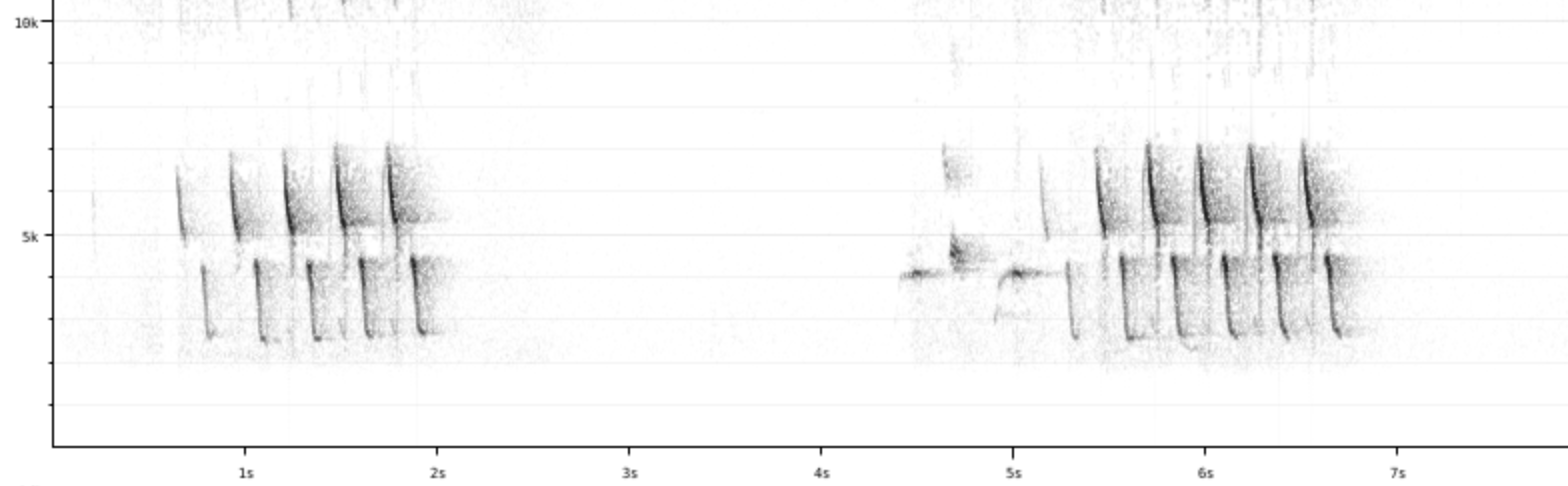
Rufe:
Most typical call an explosive, sneeze-like "pee-choo", starting high-pitched and ending on a lower note. . [Link] 1: Falling note, relatively long, sometimes repeated - like the pee below without the choo?
Call from Xeno-Canto
♫ Quelle: XENOCANTO XC594764 marsh tit call.mp3 (Ruf)
 'Swooping' call on the Luppmen
♫ 2020-10-21 08:38:51 Chiffchaff calls go up, marsh tit calls down! Quelle: BirdNet 20201021_083851 birdnet 1019 am Luppmen - Marsh tit - Fehraltorf.mp3 Luppmen (Gesang?)
2: BirdID (at Nord U.) says an explosive, sneeze-like "pee-choo",, similar to Blaumeise with clear note followed by rough ones, but hll
Call from Xeno-Canto
♫ Quelle: XENOCANTO XC733901 - Marsh Tit - Poecile palustris - pee-choo call, sometimes just pee - recorded in Germany.mp3 (Ruf)

Ruf Eigenschaften: Ruf Melodie: einnotig, langsam, Frequenz: 6-9 KHz, Spezielle Klänge: absteigend.
Vollprofil
Misteldrossel / Mistle thrush (Turdus viscivorus)
Profil Wikipedia Vogelwarte BirdLife ZH ornitho.ch bird-song.ch Xeno-Canto BirdID NABU YouTube

MerlinBirdId sagt Misteldrossel, weit weg im Naturschutzgebiet. Selten aber schon in Fehraltorf gesehen. 2025-01-20 16:57:25 Fehraltorf
Zuerst beobachtet in 🇨🇭 an 2020-05-07.
Beschreibung
Allgemein: After a long outing in the woods with no 'new' discoveries where I hoped there might be, I followed a woodpecker-like rattle deep into the woods, and eventually managed a clear view of a mistle thrush (German Misteldrossel) while standing directly under the tree where I heard it. I believe it was a pair, but I only got a picture of one. The breast has that checkerboard look that thrushes have.Allgemein: I initially saw them in the woods but later by Neschwil they came out of the woods into the fields to feed.
Allgemein: Deutschland: Brut-, Jahres-, Zugvogel
Saisonales Verhalten
Jahresvogel Brut: 03-23 - 07-29 Migration rein: 02-20 - 05-01 Migration raus: 08-29 - 11-15Weitere Infos at Vogelwarte.ch
Weitere Infos
Physikalische Details
Körperlich: Länge=27 cm, Flügelspanne=42-47 cm, Gewicht=100-150 gHabitate: Wald
Ähnliche Arten
Sieht ähnlich aus wie: Wiesenpieper.Vokalisierung
Gesang: Song:Die Stimme ist ähnlich wie die vom Pirol. [Link]Gesang ähnlich Amsel, aber eintöniger mit geringerem Tonumfang [auch kürzer, kein schnirpsliges Ende -- Bill] [Link]
Gesang: Gesang ähnlich dem der Amsel, aber weniger abwechslungsreich und melancholisch, fast weinerlich klingend. Meist von Tannenspitze aus.
[Link]
Song loud, far reaching and melodic. Most similar to Blackbird, but pitch is higher, phrases shorter (3-6 notes) and most notably, pauses between phrases are much shorter. All which gives the song a much more hurried feel than that of the Blackbird. Timbre is thinner and slightly shivering, and tonal range more limited. May have recurring favourite motifs, but does not repeat phrases like Song Thrush. Sometimes adds higher pitched parts and imitations. [Link]
Gesang Eigenschaften:
Melody: nicht musikalisch, schnell, Frequency: 2-9 KHz Special sounds: rasseln
Rufe:
Rufe:schnarrend „kerr“, daneben „tück-tück-tück“
[Link]
Other calls; a dry rattle, likened to the sound of a piece of wood drawn over a coarse comb, and a Fieldfare-like "chuck". [Link]
General: I mistook this one for a woodpecker the first time I heard it,
partly because BirdNet also did!
Rattle generated in vocal tract, not with the beak!
XC945811 - Mistle Thrush - Turdus viscivorus - call, sounds like drumming, mistook it for a woodpecker first time I heard this.
♫ Quelle: XENOCANTO XC945811 - Mistle Thrush - Turdus viscivorus - call, sounds like drumming, mistook it for a woodpecker first time I heard this.mp3 (Trommeln)
Ruf Eigenschaften: Ruf Melodie: nicht musikalisch, schnell, Frequenz: 2-9 KHz, Spezielle Klänge: rasseln.
Vollprofil
Ringdrossel / Ring ouzel (Turdus torquatus)
Profil Wikipedia Vogelwarte BirdLife ZH ornitho.ch bird-song.ch Xeno-Canto BirdID NABU YouTube
Ringdrossel - ich wollte unbedingt einen fotografieren, und dieser hat sicher frei. 2024-06-25 09:14:04 Mettmenalp, GL
Zuerst beobachtet in 🇨🇭 an 2021-06-27.
Beschreibung
Allgemein: Deutschland: Brut-, ZugvogelSaisonales Verhalten
Präsenz: 03-12 - 11-06 Brut: 04-20 - 07-20 Migration rein: 03-12 - 05-10 Migration raus: 08-29 - 11-06Weitere Infos at Vogelwarte.ch
Weitere Infos
Physikalische Details
Körperlich: Länge=23-24 cm, Flügelspanne=38-42 cm, Gewicht=92-138 gHabitate: Berg
Ähnliche Arten
Gesang oder Rüfe ähnlich wie: Buntspecht.Vokalisierung
Gesang: BirdID says Song a primitive, plaintive series of short phrases, often with only 1-2 syllables (I heard 2-3 in Amden, sometimes chirpy, sometimes less musical). Gesang:Habe mit dem Buntspecht verwechselt - Ringdrossel singt 2-3 Noten - hilft das? [Link]
Song a primitive, plaintive series of short phrases. Often with only one or two syllables. Interspersed with eerie, higher pitched sounds, reminiscent of Song Thrush. [Link]
Gesang Eigenschaften:
Eselsbrücke 3 Noten wie Ring-dross-el Melody: einfach rhythmisch, langsam, Frequency: 1-5 KHz
♫ Quelle: XENOCANTO XC721589 - Ring Ouzel - Turdus torquatus - song.mp3 (Gesang)

Rufe:
Alarm call a series of "chok-chok". Thicker and more resonant than Redwing. [Link]
No details but a Xeno-Canto recording.
XC942931 - Ring Ouzel - Turdus torquatus - clicky call.
♫ Quelle: XENOCANTO XC942931 - Ring Ouzel - Turdus torquatus - clicky call.mp3 (Ruf)

Ruf Eigenschaften: Gesang Frequenz: ,
Vollprofil
Trauerschnäpper / European pied flycatcher (Ficedula hypoleuca)
Profil Wikipedia Vogelwarte BirdLife ZH ornitho.ch bird-song.ch Xeno-Canto BirdID NABU YouTube

Erster Trauerschnaepper seit Jahren gesehn - im Wald nah beim Naturzentrum. 2024-09-14 17:03:29 Fanel/Chablais de Cudrefin und La Sauge
Zuerst beobachtet in 🇨🇭 an 2020-04-15.
Beschreibung
Allgemein: Deutschland: Brut-, Zugvogel RL 3Etymologie: Vögel mit viel schwarzem Gefieder werden in der Vogelnamensgebung gerne mit dem Wortzusatz „Trauer“ versehen. Denn durch dieses „Trauerkleid“ unterscheiden sie sich von verwandten Arten, die nicht schwarz gefärbt sind. [lbv.de]
Aussehen und Identifizierung:
Kleiner SW Vogel, Kopf schwarz mit weissem Punkt an der Stirn, Bauch weiss. Gesang gar nicht traurig! [Link]
Saisonales Verhalten
Präsenz: 04-01 - 10-18 Brut: 05-01 - 07-20 Migration rein: 04-01 - 05-31 Migration raus: 07-20 - 10-18Weitere Infos at Vogelwarte.ch
Weitere Infos
Physikalische Details
Körperlich: Länge=13 cm, Flügelspanne=21-24 cm, Gewicht=10-15 gHabitate: Wald
Vokalisierung
Gesang: Nice short melody, often with 2-note parts. Blackbird-like but little variation (though differs in dialect). Gesang:Song a pleasant, tuneful, simple but varied phrase. [Link]
Gesang Eigenschaften:
Eselsbrücke Schwarzer Kopf aber nicht traurig Melody: stereotypisch melodisch, schnell, Frequency: 3-10 KHz
♫ Quelle: XENOCANTO XC723965 - European Pied Flycatcher - Ficedula hypoleuca - song.mp3 (Gesang)

Rufe:
Alarm call a sharp, energetic "wit", often in combination with a short "tic"; "whit-tic". Typically starts with disyllabic notes being repeated 3-5 times, diminishing in pitch and intensity like an echo of the first two syllables. Occasionally throws in a quick diagnostic ascending scale excercise. Clear notes and well defined pauses between phrases. [Link]
XC918321 - European Pied Flycatcher one-note call - Ficedula hypoleuca.
♫ Quelle: XENOCANTO XC918321 - European Pied Flycatcher one-note call - Ficedula hypoleuca.mp3 (Ruf)

Ruf Eigenschaften: Ruf Melodie: einnotig, langsam, Frequenz: medium (1-5 KHz), Spezielle Klänge: aufsteigend.
Vollprofil
Grauschnäpper / Spotted flycatcher (Muscicapa striata)

MerlinBirdID meint Klapper-grasmuecke, was super waere. Denke selber es sieht aus wie ein Grauschnaepper, teilweise weil die Fluegel der KGM im Fotos etwas brauner waren. Mein Birdweather Geraet sagt, es hat GS gehoert. 2024-09-09 12:48:42 Wald Fehraltorf
Zuerst beobachtet in 🇨🇭 an 2020-06-03.
Beschreibung
Allgemein: Perches on limbs in forest to swoop for insects and return to perch, specifically heard in woods near Staldenweiher.Allgemein: Deutschland: Brut-, Zugvogel
Aussehen und Identifizierung: Heard in woods near Staldenweiher, seen at Kaltbrunnerriet. Has streaks on crown and breast, rather than spots. Medium brown on head and back, light colored belly. 'Pincette-shaped beak'.
Saisonal:
Auf Englisch heissen sie 'Flycatcher' und fressen tatsächlich vor allen Insekte,aber Wikipedia sagt 'ab Mitte Juli auch verschiedene Früchte' - was bestätigt das das Foto von 9. September 2024 ein Grauschnäpper sein kann. [Link]
Saisonales Verhalten
Präsenz: 04-20 - 10-07 Brut: 05-21 - 08-09 Migration rein: 04-20 - 05-31 Migration raus: 07-29 - 10-07Weitere Infos at Vogelwarte.ch
Weitere Infos
Physikalische Details
Körperlich: Länge=14 cm, Flügelspanne=23-25 cm, Gewicht=14-20 gHabitate: Siedlung
Vokalisierung
Gesang: High (6-8 KHz?) short sound repeated every half to 5 seconds. Gesang: Gesang 'unauffällig' - zirp x 2-3, mal steigender tWITGesang:
Song a primitive, slow series of various buzzing and very high pitched sounds. No recurring phrases. [Link]
Gesang Eigenschaften:
Melody: einfach rhythmisch, langsam, Frequency: 6-8 KHz
Rufe:
The discreet calls often goes unnoticed. Most calls high pitched with a buzzing, "electric" timbre. Alarm call a sharp, drawn "tzreeeee-check", with the second syllable abruptly clipping the sound. [Link]
General: To me something between a one-note and an extremely simple melody, namely med-med chk-hi-med-med, with a very irregular speed, not at all like a metronome.Call:
Most calls high pitched with a buzzing, "electric" timbre. [Link]
KLingt für mich bisher wie alle 1-notige Rufe.
♫ Quelle: XENOCANTO XC656714 - Spotted Flycatcher - Muscicapa striata.mp3 (Gesang?)

Ruf Eigenschaften: Ruf Melodie: einnotig, langsam, Frequenz: 4-7 KHz, Spezielle Klänge: unregelmässig rhythmisch.
Vollprofil
Braunkehlchen / Whinchat (Saxicola rubetra)
Profil Wikipedia Vogelwarte BirdLife ZH ornitho.ch bird-song.ch Xeno-Canto BirdID NABU YouTube
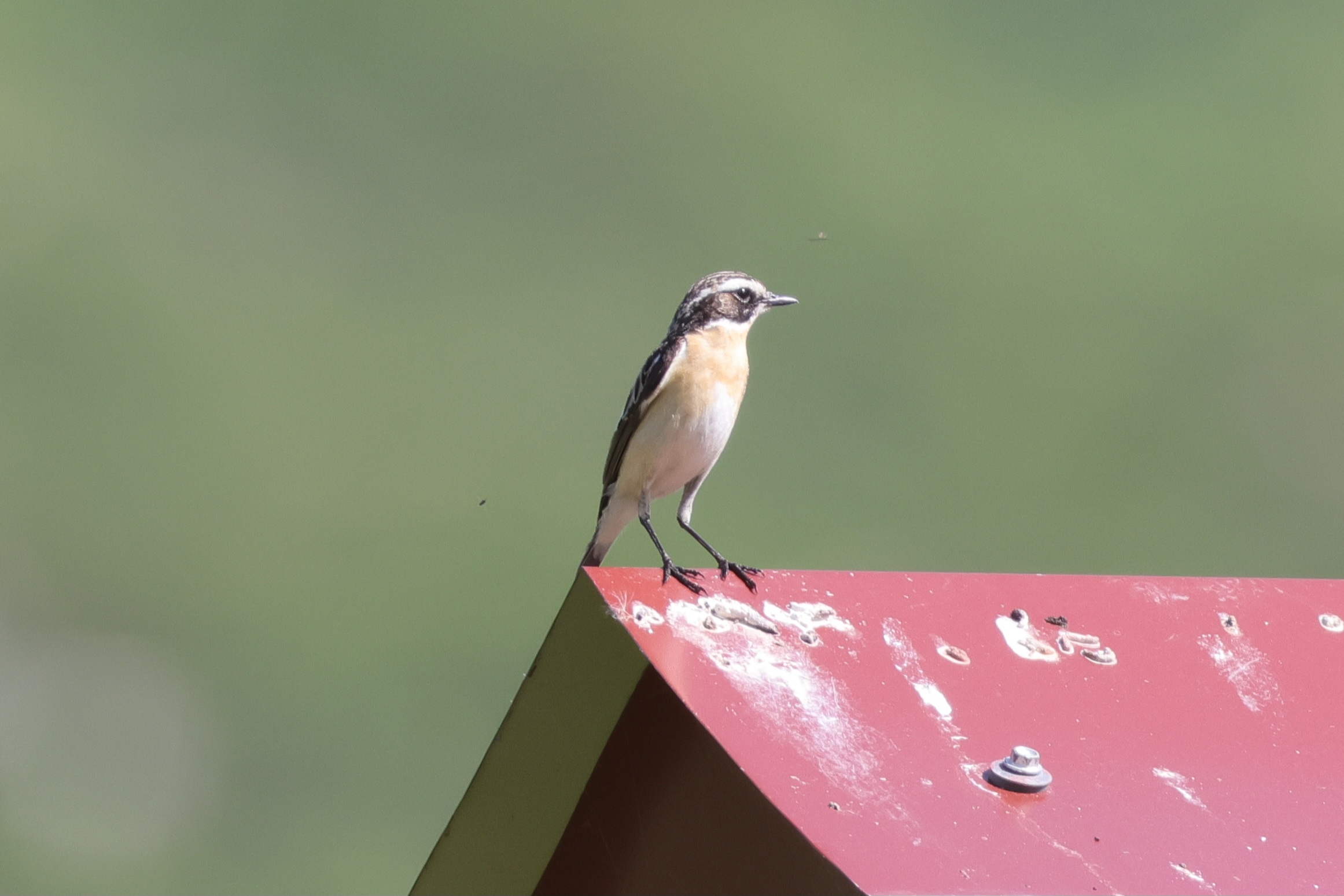
Whinchat aka Braunkehlchen in Andermatt. 2025-06-14 09:58:09 Andermatt
Zuerst beobachtet in 🇨🇭 an 2020-05-07.
Beschreibung
Allgemein: Die bauen ein Nest auf dem Boden auf einer Wiese oder Feld und brauchen relativ lang bis die Jungen flugge sind, darum hoffe ich, dass sie weitergezogen sind. Da Felder selten so lang ungestört bleiben im Mittelland, sind sie immer mehr in höheren Lagen zu finden.Allgemein: Deutschland: Brut-, Zugvogel RL 3
Persönlich gemerkt: Diesen Vogel haben wir paarweise in einem Rapsfeld entdeckt. Von weitem konnte man nur etwas orange Farbe entdecken. Ich habe ihn 2 Tage später im gleichen Feld gesucht und bin um das ganze Feld gelaufen. Erst am Ende habe ich ihn gesehen: am Anfang, sicher 100m von mit entfernt und um 2 Ecken. Da habe ich dieses Foto gemacht und in Büchern, Apps und Internet nach seiner Identität gesucht. Als ich ein sehr ähnliches Bild auf ornitho.ch gefunden habe, wo er auch auf einer Rapspflanze drauf sitzt, sah ich es als bestätigt, dass es ein Braunkelchen war.
Vokalisierung: The "peeu"-sound is depper and more resonant than similar sounds by Wheatear and Stonechat. [Link]
Saisonales Verhalten
Präsenz: 03-20 - 10-15 Brut: 05-10 - 08-10 Migration rein: 03-20 - 05-15 Migration raus: 07-20 - 10-15Weitere Infos at Vogelwarte.ch
Weitere Infos
Physikalische Details
Körperlich: Länge=12 cm, Flügelspanne=21-24 cm, Gewicht=14-19 gHabitate: Landwirtschaft
Vokalisierung
Gesang: General: Der Gesang (bei Vogelwarte.ch) klingt für mich ähnlich wie eine Mönchsgrasmücke, aber nur in sehr kurzen Phrasen.Song:
Gesang hat zwei Teile wie erster und dritter vom Hausrotschwanz. Steigend, fallend. [Link]
Gesang:
Gesang:
Kurzes (3-7 Töne) Liedchen mit 1-2 Kreischlauten, (ähnlich der Mittellaute b. Hausrotschwanz) variabel. Ahmt auch andere Vögel nach.
[Link]
Song variable with lots of mimicry. The short phrases starts with dry, rattling or sneering trills, followed by clear whistling notes and expert mimicry. More varied, both in tone and tempo, than both Stonechat and Wheatear. [Link]
Gesang Eigenschaften:
Melody: improvisiert melodisch, schnell, Frequency: high (3-9 KHz) Special sounds: Mimikry
Rufe:
„teck, teck“ (ähnlich wie wenn man zwei Steine zusammen schlägt)
[Link]
Contact call resembles many of it relatives. A short, soft "peeu", followed by a hard "check" (like hitting two rocks together). [Link]
No details but a Xeno-Canto recording.
XC732132 - Whinchat - Saxicola rubetra - call - chirp, click.
♫ Quelle: XENOCANTO XC732132 - Whinchat - Saxicola rubetra - call - chirp, click.mp3 (Ruf)

Ruf Eigenschaften: Gesang Frequenz: ,
Vollprofil
Gartenrotschwanz / Common redstart (Phoenicurus phoenicurus)

Vogelwarte zeigt, dass der Gartenrotschwanz eher im Tessin und in Wallis gesehen wird Quelle: VOGELWARTE
Vogelwarte Gartenrotschwanz Dichte 2013-2016.png
Zuerst beobachtet in 🇨🇭 an 2020-04-27.
Beschreibung
Allgemein: Deutschland: Brut-, ZugvogelPersönlich gemerkt: I'd only seen them in Locarno - but I liked them! Later in our FOK expediton to cultural areas around Maienfeld, they were quite common. Also heard many near Frankfurt and Mainz.
Persönlich gemerkt: I'd only seen them in Locarno - but I liked them! Later in our FOK expediton to cultural areas around Maienfeld, they were quite common. Also heard many near Frankfurt and Mainz.
Aussehen und Identifizierung: Red-orange belly with white further down, grey back and head, black beard up to eyes with white eyebrows
Wo finden?: In Locarno in 2020, they were often hidden in trees but also visible on powerlines. In 2021 one sang every morning at 5:00 in a gingko tree next to our room in Casa Egner.
Saisonales Verhalten
Präsenz: 03-20 - 10-25 Brut: 05-01 - 07-15 Migration rein: 03-20 - 05-07 Migration raus: 07-15 - 10-25Weitere Infos at Vogelwarte.ch
Weitere Infos
Physikalische Details
Körperlich: Länge=14 cm, Flügelspanne=20-24 cm, Gewicht=11-19 gHabitate: Siedlung
Vokalisierung
Gesang: I though I had these guys figured out after hearing them in Locarno several times, but they're hard to get a handle on! At BirdID they are described the first two parts of a three-part song like this: 'an ascending single note, immediately followed by a trill', whereas in Locarno I heard an initial high-low-high-low, sometimes without the final low, perhaps also a quick middle note, and no trill. Then a relatively short blackbird or warbler-like tune of maybe 5-8 notes. Listening to more recordings at XenoCanto has completely confused me now! BirdID also says the song is similar to the black redstart, which I sometimes hear at XenoCanto, but never did in Locarno! They also note a similarity to the Lesser Whitethroat (Klappergrasmücke), which I hope to hear in Maienfeld. Gesang:Fängt immer mit denselben 3 Tönen an, einem „dih dede“, wobei das dih etwa ein bis zwei Töne höher liegt. Dann folgt eine kurze Strophe mehr oder weniger reine Töne. Das Ganze ist ziemlich individuell.
[Link]
Song distinct, with three parts: First an ascending single note, immediately followed by a trill, then concluding with a squeaky, rattling improvisation that usually contains some mimicry. [Link]
Gesang Eigenschaften:
Melody: stereotypisch melodisch, langsam, Frequency: high (3-9 KHz) Special sounds: Mimikry Singing season: 04-01 - 07-31 Dawn chorus start: 80 minutes before dawn.
♫ 2021-05-10 05:07:35 Locarno (Gesang)
Rufe:
„Füid-tack“ das füid ähnlich dem des Fitislaubsängers, das tack schnalzend. (wie wenn man die Zunge schnell vom Gaumen abzieht)
[Link]
Alarm call a slightly drawn, Willow Warbler-like "huit" with a rising pitch, followed by a short, soft "tuc". [Link]
At least in French, this is called the huit call. Not very consistent in tone from one note to another. Some stick to 3-4 or 3-4.5 KHz, others 2.5-5.5.
XC551707 - Common Redstart - Phönicurus phönicurus.
♫ Quelle: XENOCANTO XC551707 - Common Redstart - Phoenicurus phoenicurus.mp3 (Gesang?)
 XC146715 common redstart huit call.
♫ Seine-et-Marne, Île-de-France recorded by Julien Rochefort - perhaps this isn't a good example as he writes 'An independent juvenile. Its calls are quite irregular. Difficult to distinguish from Phylloscopus collybita, when they don't insert the "tec tec" calls between "huit ...... huit"! But it was really a phoenicurus phoenicurus juvenile, easy to see, perched 15m from me.' Quelle: XENOCANTO XC146715 common redstart huit call.mp3 (Ruf)
 XC560039 - Common Redstart - Phönicurus phönicurus phönicurus.
♫ Quelle: XENOCANTO XC560039 - Common Redstart - Phoenicurus phoenicurus phoenicurus.mp3 (Alarmruf)
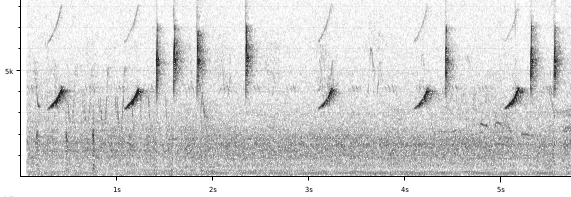
Ruf Eigenschaften: Kontaktruf Ruf Melodie: einnotig, langsam, Frequenz: 2-5 KHz, Spezielle Klänge: aufsteigend.
Vollprofil
Steinschmätzer / Northern wheatear (Oenanthe oenanthe)
Profil Wikipedia Vogelwarte BirdLife ZH ornitho.ch Audubon AllAboutBirds Xeno-Canto NABU YouTube

Male northern wheatear, photo by Andreas Trepte - Own work, CC BY-SA 2.5 Quelle: WIKIPEDIA
Wikimedia Steinschmaetzer_Northern_wheatear_male.jpg
Zuerst beobachtet in 🇨🇭 an 2021-07-29.
Beschreibung
Geographie: Dieser Vogel erscheint jenseits grossen Meere in Kontinenten : Europa, Nordamerika, Afrika, Asien.General: I thought after seeing these at over 2700 meters that they must be a typical mountain bird (and in the FOK Zurich materials they were in the mountain section), however Wikipedia explains that such a stony landscape is the key, whether that is high or not:
Geography:
The northern wheatear is a migratory insectivorous species breeding in open stony country in Europe and east across the Palearctic with footholds in northeastern Canada and Greenland as well as in northwestern Canada and Alaska. It nests in rock crevices and rabbit burrows. All birds spend most of their winter in Africa. ... Miniature tracking devices have recently shown that the northern wheatear has one of the longest migratory flights known - 30,000 km (18,640 miles), from sub-Saharan Africa to their Arctic breeding grounds.[15] [Link]Strangely the residence and migration maps differ greatly by source: in Wikipedia the northern wheatear spends winter in subsaharan Africa, while the authoratitive Kosmos-Vogelführer shows some in northern Africa like Morocco. Most other sources agree with Wikipedia and Sub-Saharan Africa.
Allgemein: Deutschland: Brut-, Zugvogel RL 1
Etymologie: I thought the German name Steinschmätzer, presumably stone kisser (no one explains it, oddly enough) to be much more logical than the English northern wheatear. I was greatly amused to look it up and find it to be a 'folk etymology of "white" and "arse"' (Wikipedia).
Etymologie:
The genus name Oenanthe is derived from the Greek oenos (οίνος) "wine" and anthos (ανθός) "flower". It refers to the northern wheatear's return to Greece in the spring just as the grapevines blossom. [Link]
Aussehen und Identifizierung: Hat einen böse aussehenden schwarzen Augenstreifen wie ein Red-backed shrike (den Nici Baiker im FOK Feldornithologiekurs als Zorro-look beschrieben hat). Auf Muottas Muragl habe ich beim Fliegen den typischen runden grauen Oval umgeben bei dunklen Federn gesehen, und bin so auf Steinschmätzer gekommen. Ich habe das schwarze T-Muster nicht gesehen, die überall erwähnt wird aber nie gezeigt - ich habe ein Foto erst über Google gefunden.
Geographie: In den FOK Unterlagen werden die Zugrouten von Alaska und von nordosten Kanada gezeigt, die beide für Winter nach Afrika ziehen. Die aus Alaska fliegen über Asien unglaubliche 15000 Kilometer! Die in Kanada haben es auch nicht leicht, da sie zuerst über den Atlantik nach Spanien fliegen!
Verhalten:
Herbert Steffny schreibt auch jetzt Anfang Mai wo die Neuntöter aus Afrika zureuckgekehrt sind, muss man nicht früh aufstehen um sie zu beobachten, weil sie selber warten bis es warm genug ist für die (leckeren) Insekten aktiv zu werden! [Link]
Vokalisierung:
Each phrase is often introduced by the "weet" sound, then followed by hastened, creaking, rattling and warbling sounds of 1-2 seconds duration. [Link]
Saisonales Verhalten
Präsenz: 03-23 - 10-27 Brut: 05-10 - 08-09 Migration rein: 03-23 - 05-31 Migration raus: 08-09 - 10-27Weitere Infos at Vogelwarte.ch
Weitere Infos
Physikalische Details
Körperlich: Länge=14-15 cm, Flügelspanne=26-32 cm, Gewicht=18-29 gHabitate: Berg
Ähnliche Arten
Sieht ähnlich aus wie: Neuntöter.Vokalisierung
Gesang:The Wheatear song consists of short phrases with marked pauses. Each phrase is often introduced by the "weet" sound, then followed by hastened, creaking, rattling and warbling sounds of 1-2 seconds duration. The "check" sound is also often included in the song. [Link]
General: I thought after seeing these at over 2700 meters that they must be a typical mountain bird (and in the FOK Zurich materials they were in the mountain section), however Wikipedia explains that such a stony landscape is the key, whether that is high or not: Geography:
The northern wheatear is a migratory insectivorous species breeding in open stony country in Europe and east across the Palearctic with footholds in northeastern Canada and Greenland as well as in northwestern Canada and Alaska. It nests in rock crevices and rabbit burrows. All birds spend most of their winter in Africa. ... Miniature tracking devices have recently shown that the northern wheatear has one of the longest migratory flights known - 30,000 km (18,640 miles), from sub-Saharan Africa to their Arctic breeding grounds.[15] [Link]Strangely the residence and migration maps differ greatly by source: in Wikipedia the northern wheatear spends winter in subsaharan Africa, while the authoratitive Kosmos-Vogelführer shows some in northern Africa like Morocco. Most other sources agree with Wikipedia and Sub-Saharan Africa.
Gesang:
Kurze, wechselvolle Strophe mit vielen unreinen Tönen. Meist von erhöhter Warte aus oder in kurzem Singflug vorgetragen.
[Link]
The Wheatear song consists of short phrases with marked pauses. The "check" sound is also often included in the song. [Link]
Gesang Eigenschaften:
Melody: improvisiert melodisch, schnell, Frequency: 2-6 KHz Special sounds: Raspel, rasseln
♫ Quelle: XENOCANTO XC730221 - Northern Wheatear - Oenanthe oenanthe - song recorded in France, just 2-3 notes, then long pause.mp3 (Gesang)

♫ Quelle: XENOCANTO XC764932 - Northern Wheatear - Oenanthe oenanthe - song recorded in Sweden with lots of whoops and swoops, about 2 seconds long, then 3-4 seconds pause.mp3 (Gesang)

♫ Quelle: XENOCANTO XC319898 - Northern Wheatear - Oenanthe oenanthe - song recorded in Scotland and includes creaking or rattling mentioned at Nord U BirdID.mp3 Schottland (Gesang)

♫ Quelle: XENOCANTO XC769228 - Northern Wheatear - Oenanthe oenanthe - song recorded in the Netherlands.mp3 (Gesang)

Vollprofil
Profil Wikipedia Vogelwarte BirdLife ZH ornitho.ch bird-song.ch Xeno-Canto NABU YouTube

Baumläufer, wahrscheinlich Gartenbaumläufer. 2022-07-18 08:58:32 Greifensee
Zuerst beobachtet in 🇨🇭 an 2020-10-16.
Beschreibung
Allgemein:Der Gartenbaumläufer (Certhia brachydactyla) ist eine Vogelart der Gattung der Eigentlichen Baumläufer (Certhia) aus der Familie der Baumläufer (Certhiidae). Er ist in weiten Teilen Mitteleuropas ein verbreiteter Brutvogel, der vor allem im Tiefland anzutreffen ist.
[mehr]
Deutschland: Brut-, Jahresvogel
Saisonales Verhalten
Jahresvogel Brut: 05-10 - 08-09Weitere Infos at Vogelwarte.ch
Weitere Infos
Physikalische Details
Körperlich: Länge=12 cm, Flügelspanne=17-20 cm, Gewicht=8-11 gHabitate: Wald
Ähnliche Arten
Sieht ähnlich aus wie: Waldbaumläufer.Vokalisierung
Gesang: It sounds to me like a 5-7 note song like 'five k low high higher', 'short song in the gar-DEN'. The individual notes have the same backward checkmark shape as the call. It's basically the same across Europe.The song of the nominate subspecies is an evenly spaced sequence of notes teet-teet-teet-e-roi-tiit. [Link]Its song is short, loud and rhythmic. [Link] [In comparison with the visually similar Eurasian treecreeper, it] has a clearer, louder more staccato contact call of ‘sreet’ or ‘sree’ and a short ‘wit’ during normal activity [Link]
Gesang: Kurz u. bündig! (Gartenwege sind kurz.) Tonreihe am Schluss ansteigend. „Hesch du gseh woni bi?
[Link]
Song diagnostic, and introductory notes often used singly when interacting. Full song starts with one or two staccato introductory notes, the first higher pitched than the second, followed by a rapid, ascending crescendo ending in a drawn-out, less pure "sree". The tone is loud and much more penetrating and clear than C. familiaris. [Link]
Gesang Eigenschaften:
Eselsbrücke 'Gar-ten-baum-LÄU-FER' Melody: stereotypisch melodisch (mlLh), langsam, Frequency: 4-7 KHz
[In comparison with the visually similar Eurasian treecreeper, it] has a clearer, louder more staccato contact call of ‘sreet’ or ‘sree’ and a short ‘wit’ during normal activity [Link]
Gesang: Kurz u. bündig! (Gartenwege sind kurz.) Tonreihe am Schluss ansteigend. „Hesch du gseh woni bi?
[Link]
Song diagnostic, and introductory notes often used singly when interacting. Full song starts with one or two staccato introductory notes, the first higher pitched than the second, followed by a rapid, ascending crescendo ending in a drawn-out, less pure "sree". The tone is loud and much more penetrating and clear than C. familiaris. [Link]
Gesang Eigenschaften:
Eselsbrücke 'Gar-ten-baum-LÄU-FER' Melody: stereotypisch melodisch (mlLh), langsam, Frequency: 4-7 KHz
♫ Quelle: XENOCANTO XC625133 - Short-toed Treecreeper - Certhia brachydactyla - song.mp3 (Gesang)

Rufe:
scharf „tiit, sri“ [Link]
Contact call very similar to C. familiaris. A thin "sreee" often repeated in an even rhythm, perhaps with slighly shorter pauses. Flight call a short and sharp "wit" used freely when moving about. Timbre recalls wet rubber-boots on vinyl flooring. Note that "mixed singers" of C. familiaris are not uncommon in areas where both species of treecreepers occur. [Link]
General: See the sonogram how the song may descend rapidly from 7Khz to and then climb from 5 to 5.75 KHz, a kind of reversed checkmark. However I find it hard to distinguish from a single note. I'm not a bird ;-(Call:
calls with a loud (Wikipedia says shrill) “tyt tyt” [Link]
A recording from Jorge Leitão in the Netherlands that I assume is the tyt tyt call.
♫ Quelle: XENOCANTO XC569503 - Short-toed Treecreeper - Certhia brachydactyla.mp3 (Gesang?)

Ruf Eigenschaften: Ruf Melodie: einnotig, langsam, Frequenz: 5-7 KHz,
Vollprofil
Profil Wikipedia Xeno-Canto BirdID NABU YouTube

Neuntöter im Apfelbaum beim Bauernhof Friedliweid. 2024-08-03 17:39:44 Friedliweid
Zuerst beobachtet in 🇨🇭 an 2021-05-29.
Beschreibung
Allgemein: Kulturland. Im Gebüsch an der Stillen Reuss.Allgemein: Deutschland: Brut-, Zugvogel
Persönlich gemerkt: Saw this masked bandit at Maienfeld. I was also told where to find it in the hedges at the Stille Reuss in Rottenschwil.
Kultur:
 The BirdLife Switzerland bird of the year of 2020, the red-backed shrike or Neuntöter, made a surprising appearance in the New York Times in May 2021 when a private collection of manuscript and books from the Brontë family was put up for sale. Among the books is father Brontë's copy of Thomas Bewick’s 'A History of British Birds,' which Jane Eyre leafs through in a scene in Charlotte's novel of the same name. [NY Times, 'A Lost Brontë Library Surfaces', by Jennifer Schuessler, May 25, 2021]
Etymologie:
Er spiesst Beutetiere oft an Dornen oder spitzen Seitenästen auf, um sie zu bearbeiten und zu zerteilen oder als Vorrat zu halten. Seinen Namen soll der Neuntöter dieser Eigenart verdanken: Man hat früher irrtümlicherweise angenommen, dass er immer erst neun Tiere aufspiesst, bevor er wieder eines verzehrt. [Link]
Saisonales Verhalten
Präsenz: 05-01 - 10-07 Brut: 05-10 - 08-09 Migration rein: 05-01 - 06-09 Migration raus: 07-20 - 10-07Weitere Infos at Vogelwarte.ch
Weitere Infos
Physikalische Details
Körperlich: Länge=17 cm, Flügelspanne=24-27 cm, Gewicht=25-35 gHabitate: Landwirtschaft
Ähnliche Arten
Sieht ähnlich aus wie: Steinschmätzer.Vokalisierung
Gesang: Reminds me a bit of a Rohrsaenger/Feldlerche with its short, varied bits. BirdID says Song surprisingly varied with many expert imitations of small passerines, interwoven with bell-like ringing and dry chirping sounds. May be confusing and hard to identify if bird not seen. Song not very loud, but phrases can be very long. 'May be confusing' - tell me about it! What's not confusing about trying to tell apart 422 species of Swiss birds! Gesang:Call a hard "check check" (like striking two rocks together), and a variable nasal "twee" Song surprisingly varied with many expert imitations of small passerines, interwoven with bell-like ringing and dry chirping sounds. May be confusing and hard to identify if bird not seen. Song not very loud, but phrases can be very long. [Link]
Gesang Eigenschaften:
Melody: singt 20 Sekunden oder länger, langsam, Frequency: medium (1-5 KHz) Special sounds: Mimikry
♫ Quelle: XENOCANTO XC570644 - Marsh Warbler - Acrocephalus palustris - song.mp3 (Gesang)

Vollprofil

Dohle-Paar wieder beim Fehraltorf Bahnhof-Parkplatz. 2025-03-19 09:08:59 Fehraltorf
Zuerst beobachtet in 🇨🇭 an 2022-05-21.
Beschreibung
Allgemein: Deutschland: Brut-, Jahres-, Zugvogel, Wintergast je nach Bundesland: RL V; RL 3Etymologie:
[Der deutsche Name der Dohle lässt sich bis auf das althochdeutsche tāha zurückverfolgen, wahrscheinlich eine lautmalerische Bezeichnung, die sich von den Rufen der Vögel ableitete. [Link]
Saisonales Verhalten
Jahresvogel Brut: 04-11 - 07-10 Migration rein: 02-01 - 04-01 Migration raus: 09-28 - 11-26Weitere Infos at Vogelwarte.ch
Weitere Infos
Habitate: SiedlungÄhnliche Arten
Gesang oder Rüfe ähnlich wie: Rabenkrähe.Vokalisierung
Gesang: No details but a Xeno-Canto recording. Gesang Eigenschaften: Frequency:♫ 2025-02-05 14:52:00 Schweiz (Gesang)
Rufe: Nabu: Ein hartes „kjack“ oder „schack“ sowie ein raues „tschräh“ hört man am häufigsten von der Dohle. Sie ist ein begabtes Stimmwunder und hat eine Vielzahl von Lauten und Imitationen auf Lager. [Link]
meist angenehm klingende, kurze Rufe: "kja", oft mehrfach wiederholt, härteres "kjack!" oder gezogenes "kjaar". [Link]
Strange tone, Almost barking or a gull cry.
XC604997 - Western Jackdaw - Coloeus monedula - call, recorded in England.
♫ Quelle: XENOCANTO XC604997 - Western Jackdaw - Coloeus monedula - call, recorded in England.mp3 (Ruf)

Ruf Eigenschaften: Ruf Melodie: einfach rhythmisch, schnell, Frequenz: 1-3 KHz, Spezielle Klänge: komisch.
Vollprofil
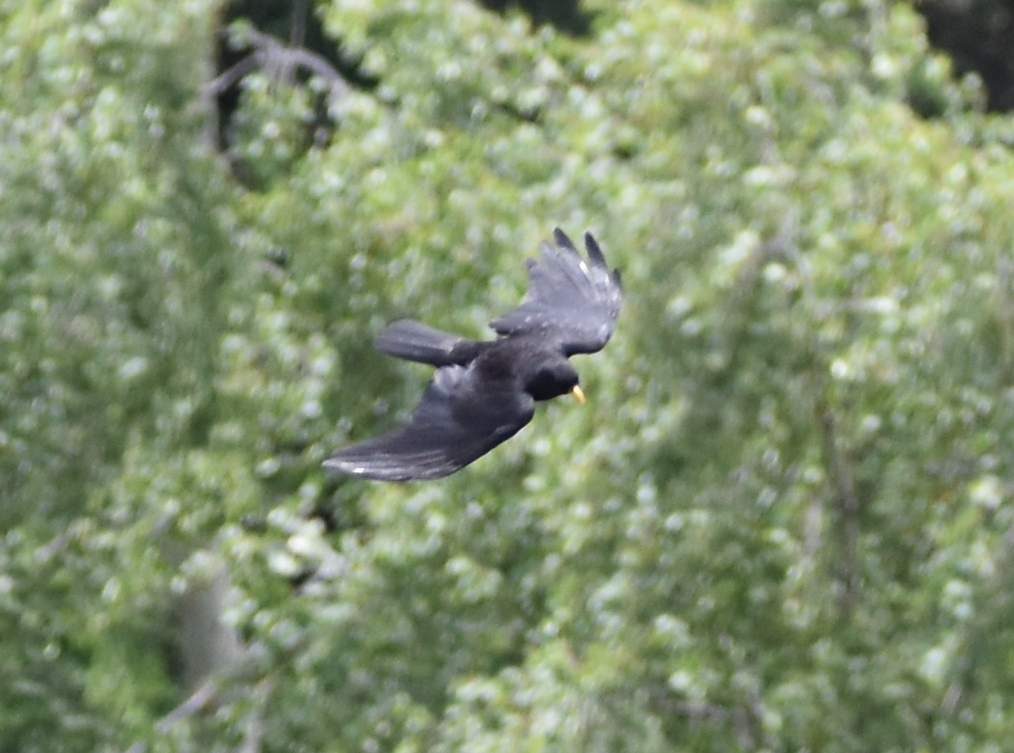
To identify probably alpendohle. 2022-05-22 12:42:04 Leuk
Zuerst beobachtet in 🇨🇭 an 2021-01-01.
Beschreibung
Allgemein: Als schwarzer Vogel mit gelbem Schnabel in den Alpen leicht zu erkennen. Ich habe sie auch in Schwanden (Ortsteil Thon) gesehen, direkt unter Vrenelisgärtli. Es heisst, bei Schnee fliegen sie tagsüber ins Tal aber abends wieder hoch.Allgemein: Alpendohlen gibt's von den Kanaren bis in den Himalayen. In der Schweiz. Man kennt sie in den Schweizer Bergen.
Allgemein: Deutschland: Brut-, Jahresvogel RL R
Etymologie:
[9][10] The English word "chough" was originally an alternative onomatopoeic name for the jackdaw, Corvus monedula, based on its call. [Link]
Vokalisierung:
Diagnostic and very different from Red-billed Chough. A sharp, quite high-pitched, whistling trill "chreeeee". Usually alternated with pure-toned high-pitched whistles, falling abruptly in pitch with a "clipping" ending. [Link]
Saisonales Verhalten
Jahresvogel Brut: 05-01 - 07-29Weitere Infos at Vogelwarte.ch
Weitere Infos
Physikalische Details
Körperlich: Länge=38 cm, Flügelspanne=75-85 cm, Gewicht=188-252 gHabitate: Berg
Vokalisierung
Gesang: Komischer Ton, ein Zirpen, oft in grossen Truppen. Gesang Eigenschaften: Melody: nicht musikalisch, langsam, Frequency: medium (1-5 KHz)Chirping, rather musical
XC512155 - Alpine Chough - Pyrrhocorax graculus - flight call recorded in Spain.
♫ Quelle: XENOCANTO XC512155 - Alpine Chough - Pyrrhocorax graculus - flight call recorded in Spain.mp3 Spanien (Flugruf)

Ruf Eigenschaften: Flugruf Ruf Melodie: einfach rhythmisch, langsam, Frequenz: 2-7 KHz,
Vollprofil
Familie Burhinidae (Triele, Haematopodidae – Austernfischer und Recurvirostridae – Säbelschnäblerverwandte):
Teichhuhn / Common moorhen (Gallinula chloropus)

Teichhuhn am Greifensee. 2022-01-27 14:06:40 Greifensee
Zuerst beobachtet in 🇨🇭 an 2021-02-12.
Beschreibung
Geographie: Dieser Vogel erscheint jenseits grossen Meere in Kontinenten : Europa, Nordamerika, Afrika, Asien.Allgemein: Gesehen auf dem Weg am Pfäffikersee nahe Wetzikon, als einer vom Schilf zu Schilf gelaufen ist. Später hat eine Praktikantin vom Naturzentrum dies als Teichhuhn identifiziert. Da unser Vogel den farbigen Schnabel nicht hatte, hat sie gemeint, es war wahrscheinlich ein Jungvogel. Ich hätte gesagt, die Beine waren kürzer, aber der Teichhuhn hat auf jeden Fall auch der kurze aufrecht gehaltene Schwanz den wir gesehen haben.
Allgemein: Deutschland: Brut-, Jahres-, Zugvogel, Wintergast RL V
Habitat:
Teichhühner nisten am liebsten im Dickicht am Rand von Teichen, Seen oder Flüssen und verraten sich meist nur durch ihre gutturalen Rufe. Im Winter sind sie leichter zu beobachten, da sie ihren deckungsreichen Lebensraum verlassen und auf Wiesen, in Parks oder an offenen Gewässern erscheinen. [Link]
Saisonales Verhalten
Jahresvogel Brut: 04-20 - 08-09 Migration rein: 03-01 - 05-01 Migration raus: 09-07 - 12-16Weitere Infos at Vogelwarte.ch
Weitere Infos
Physikalische Details
Körperlich: Länge=32-35 cm, Flügelspanne=50-55 cm, Gewicht=240-420 gHabitate: Nassgebiet
Vokalisierung
Gesang: No details but a Xeno-Canto recording. Gesang:Most typical is the territorial call (song); a sharp, loud and resonant "krrrr-ook" or "krrrk". [Link]
Gesang Eigenschaften:
Frequency:
♫ Quelle: XENOCANTO XC946631 - Common Moorhen call, like a quack - Gallinula chloropus.mp3 (Ruf)

Rufe:
Rich repertoire of loud calls and softer sounds. Other calls; a sharp, three or four-syllable "kekeke", and a soft "wep" sometimes drawn-out in a more mewing version. [Link]
Ruf Eigenschaften: Ruf Melodie: einnotig, langsam, Frequenz: medium (1-5 KHz), Spezielle Klänge: quaken.
Vollprofil

Kiebitze fliehen wenn ein Habicht darüber fliegt. 2021-10-24 13:31:52 Neeracherried
Zuerst beobachtet in 🇨🇭 an 2021-01-17.
Beschreibung
Geographie: Dieser Vogel erscheint jenseits grossen Meere in Kontinenten : Europa, Nordamerika, Afrika, Asien.Allgemein: Ein junger Habicht ist an einem verschneiten Januar-Tag in 2021 in einem Baum an der Bahnhofstrasse aufgetaucht.
Allgemein: Deutschland: Brut-, Jahresvogel
Aussehen und Identifizierung:
Ein Greifvogel, der zur Familie der Habichtartigen (Accipitridae) gehört. [Link]
Vokalisierung:
Series of short "ke-ke-ke-ke-ke". [Link]
Saisonales Verhalten
Jahresvogel Brut: 04-01 - 07-20Weitere Infos at Vogelwarte.ch
Weitere Infos
Physikalische Details
Körperlich: Länge=48-62 cm, Flügelspanne=135-165 cm, Gewicht=600-2000 gHabitate: Landwirtschaft Vollprofil

Sperber Paar im Naturschutzgebiet im Staldenweiher-Wald. 2024-08-04 18:33:32 Staldenweiher
Zuerst beobachtet in 🇨🇭 an 2021-02-06.
Beschreibung
Allgemein:Der Sperber (Accipiter nisus) ist ein Greifvogel und gehört zur Familie der Habichtartigen (Accipitridae). Die Weibchen sind fast doppelt so groß und schwer wie die Männchen. In der Jägersprache werden die Männchen Sprinz genannt (während bei allen anderen Greifvögeln für das Männchen die Bezeichnung Terzel verwendet wird).
[mehr]
Deutschland: Brut-, Jahres-, Zugvogel, Wintergast
Vokalisierung:
Series of short "ke-ke-ke-ke-ke", with rising pitch. [Link]
Saisonales Verhalten
Jahresvogel Brut: 05-01 - 08-09 Migration rein: 02-20 - 05-10 Migration raus: 08-18 - 11-06Weitere Infos at Vogelwarte.ch
Weitere Infos
Physikalische Details
Körperlich: Länge=28-38 cm, Flügelspanne=55-70 cm, Gewicht=110-342 gHabitate: Landwirtschaft
Vokalisierung
Gesang: No details but a Xeno-Canto recording. Gesang:Meist in Horstnähe zu hören. Eine Reihe von kurzen Einzellauten,
[Link]
Gesang Eigenschaften:
Frequency:
♫ Quelle: XENOCANTO XC818384 - Eurasian Sparrowhawk - Accipiter nisus - call, Brandenburg, Germany.mp3 (Ruf)

Rufe:
wie „gigigi“. Ähnlichkeit mit Wendehals, aber klarer und schneller. Schneller auch als Grünspecht und tiefer als Turmfalke. [Link]
Less resonant and less full than similar call of Goshawk, and much faster. Also a short "peeaaaa", shorter and more squeaky than Buzzard. [Link]
No details but a Xeno-Canto recording.
Ruf Eigenschaften: Gesang Frequenz: ,
Vollprofil

MerlinBirdID meint Rohrweihe. 2022-05-21 16:00:56 Leuk
Zuerst beobachtet in 🇨🇭 an 2022-05-21.
Beschreibung
Allgemein: Deutschland: Brut-, ZugvogelSaisonales Verhalten
Jahresvogel Migration rein: 03-12 - 06-09 Migration raus: 07-29 - 10-27Weitere Infos at Vogelwarte.ch
Weitere Infos
Physikalische Details
Körperlich: Länge=48-56 cm, Flügelspanne=115-130 cm, Gewicht=405-800 gHabitate: Landwirtschaft
Vokalisierung
Gesang: No details but a Xeno-Canto recording. Gesang Eigenschaften: Frequency:♫ Quelle: XENOCANTO XC884134 - Western Marsh Harrier - Circus aeruginosus - whooping, swooping call.mp3 (Ruf)

Rufe:
Call: A sharp "kwii-uuu" of about a seconds length, rapidly ascending in pitch, and ending on a falling tone. [Link]
No details but a Xeno-Canto recording.
Ruf Eigenschaften: Gesang Frequenz: ,
Vollprofil
Profil Wikipedia Vogelwarte BirdLife ZH ornitho.ch Xeno-Canto BirdID NABU YouTube
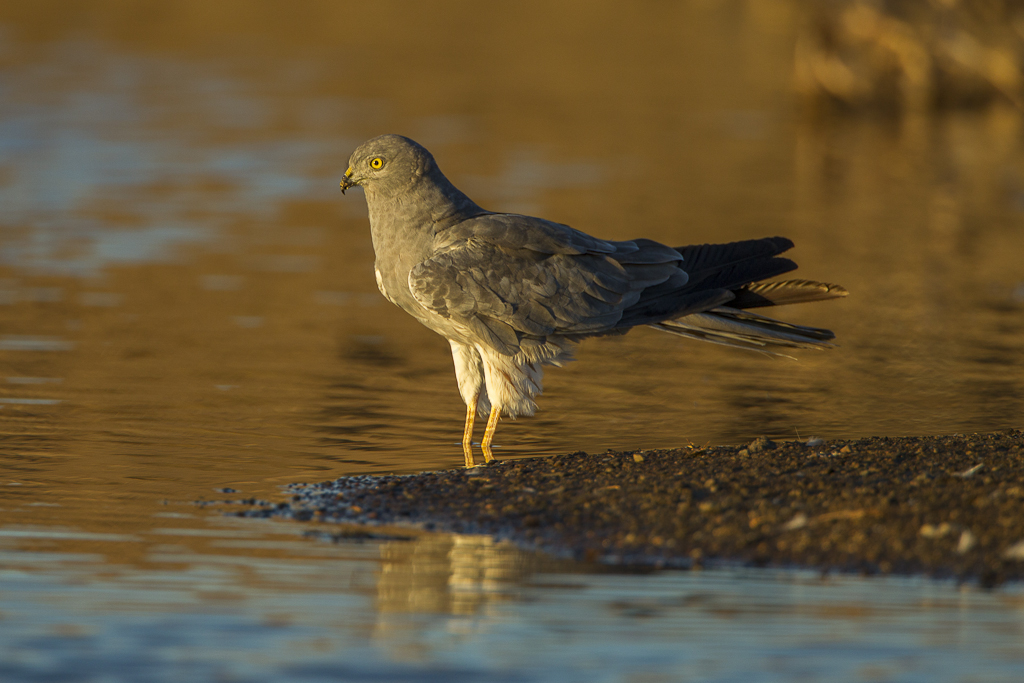
Wikipedia: Montagu's harrier Quelle: WIKIPEDIA
Montagu%27s_harrier_%28Circus_pygargus%29.jpg
🔍
Never observed (yet!)
Beschreibung
Allgemein: Deutschland: Brut-, Zugvogel RL 2Vokalisierung:
Quite similar to Hen Harrier. Seldom heard, even at breeding ground. Sharp "ke-ke-ke-ke", and various high-pitched whistling sounds. [Link]
Saisonales Verhalten
Präsenz: 04-01 - 10-07 Brut: 05-10 - 08-09 Migration rein: 08-01 - 08-09 Migration raus: 08-09 - 09-17Weitere Infos at Vogelwarte.ch
Weitere Infos
Physikalische Details
Körperlich: Länge=43-47 cm, Flügelspanne=105-120 cm, Gewicht=227-445 gHabitate: Landwirtschaft Vollprofil

Wikipedia: European honey-buzzard Quelle: WIKIPEDIA
1200px-Wespenbussard_European_honey_buzzard_Pernis_apivorus%2C_crop.jpg
🔍
Never observed (yet!)
Beschreibung
Allgemein: Deutschland: Brut-, Zugvogel RL VSaisonales Verhalten
Präsenz: 05-01 - 09-25Weitere Infos
Physikalische Details
Körperlich: Länge=52-60 cm, Flügelspanne=135-150 cm, Gewicht=360-1050 gHabitate: Landwirtschaft Vollprofil
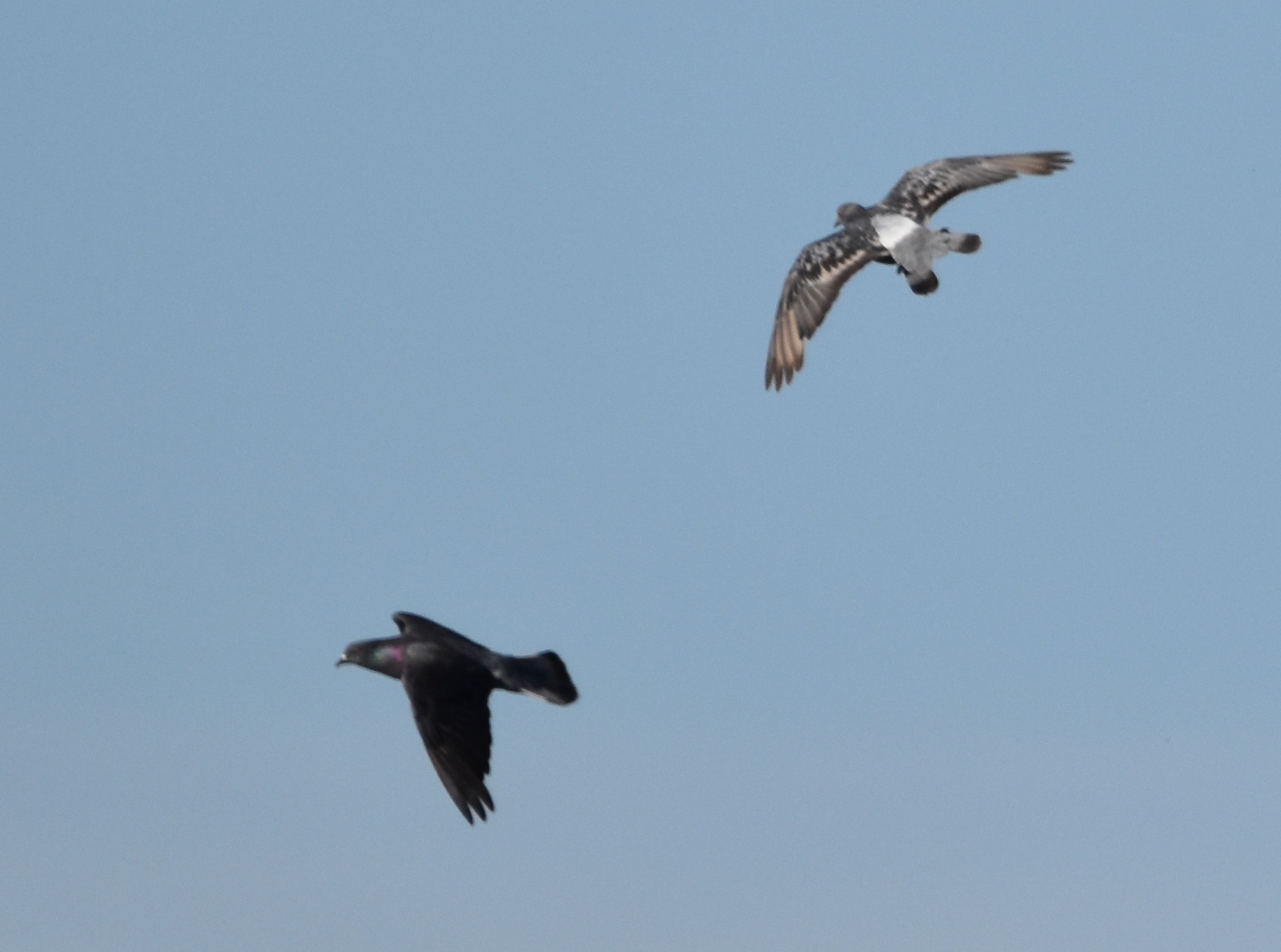
Stock dove, according to BirdID. 2022-07-18 08:15:10 Greifensee
Zuerst beobachtet in 🇨🇭 an 2021-05-29.
Beschreibung
Allgemein: Ich habe diese zum ersten Mal bewusst gesehen auf Mettmenalp.Allgemein: Deutschland: Brut-, Zugvogel
Saisonales Verhalten
Jahresvogel Brut: 03-23 - 09-17 Migration rein: 02-10 - 05-01 Migration raus: 08-09 - 10-27Weitere Infos at Vogelwarte.ch
Weitere Infos
Physikalische Details
Körperlich: Länge=32-34 cm, Flügelspanne=63-69 cm, Gewicht=250-350 gHabitate: Wald
Vokalisierung
Gesang: Song:Song a two-syllable, cooing. Much louder and more accentuated first syllable than in Feral Pigeon. First a short ascending "oooh", immediately followed by a short descending "oohh". Tone quite pure, mostly lacking the rolling quality of Feral Pigeon. [Link]Jede Note ein gleitender hlm, klingt wir hu-u-u [Link]
Gesang: „Huuh-hup“ . Das „huuh“ fast zweisilbig, erste Silbe höher, das „hup“ noch höher. Fast wie „Hooh ruck“
[Link]
Song a two-syllable, cooing. Much louder and more accentuated first syllable than in Feral Pigeon. First a short ascending "oooh", immediately followed by a short descending "oohh". Tone quite pure, mostly lacking the rolling quality of Feral Pigeon. [Link]
Gesang Eigenschaften:
Melody: einfach rhythmisch, langsam, Frequency: 0-1 KHz
Rufe:
Nur noch sehr selten zu hören!
[Link]
No details but a Xeno-Canto recording.
XC747105 - Stock Dove - Columba oenas - call, sounds almost like a growling dog.
♫ Quelle: XENOCANTO XC747105 - Stock Dove - Columba oenas - call, sounds almost like a growling dog.mp3 (Ruf)
Ruf Eigenschaften: Gesang Frequenz: ,
Vollprofil
.jpg)
Wikipedia European Turtle Dove (Streptopelia turtur). Quelle: WIKIPEDIA
Wikipedia European_Turtle_Dove_(Streptopelia_turtur).jpg
Zuerst beobachtet in 🇨🇭 an 2023-06-19.
Beschreibung
Allgemein:Die Turteltaube (Streptopelia turtur) ist eine Vogelart aus der Familie der Tauben. Das Verbreitungsgebiet umfasst weite Teile der westlichen und zentralen Paläarktis und reicht vom nördlichen Afrika, der iberischen Halbinsel und Großbritannien nach Osten über den Nahen und Mittleren Osten bis Nordwestchina und in die Mongolei. Im Mittelmeerraum ist die Turteltaube besonders häufig. Nach einer im Jahr 2007 veröffentlichten Studie der EU ist ihr Bestand jedoch in den letzten 25 Jahren um 62 Prozent zurückgegangen.[1] Der Bestandsrückgang wird auf veränderte landwirtschaftliche Anbaumethoden und den Rückgang der Erdraucharten zurückgeführt, die bei der Ernährung der Turteltauben eine große Rolle spielen. Zu den für den Bestandsrückgang verantwortlichen Faktoren gehört aber auch der Abschuss der Tauben insbesondere im Mittelmeerraum während der Zugzeiten.
[mehr]
Deutschland: Brut-, Zugvogel RL 3
Saisonales Verhalten
Präsenz: 04-11 - 10-07 Brut: 05-10 - 07-10 Migration rein: 04-11 - 06-20 Migration raus: 08-09 - 10-07Weitere Infos at Vogelwarte.ch
Weitere Infos
Physikalische Details
Körperlich: Länge=26-28 cm, Flügelspanne=47-53 cm, Gewicht=100-180 gHabitate: Wald
Vokalisierung
Gesang: Trilling coo. Gesang:Song: a deep, rolling, and slightly ascending cooing; "trrrrrrrrrrrrrrrrr trrr-trrrr" with variations in rhythm. Sometimes birds sticks to a phrase, but phrases varies between individuals. [Link]
Gesang Eigenschaften:
Melody: einnotig, langsam, Frequency: low (1-3 KHz)
Vollprofil
Profil Wikipedia Vogelwarte BirdLife ZH ornitho.ch Xeno-Canto BirdID NABU YouTube
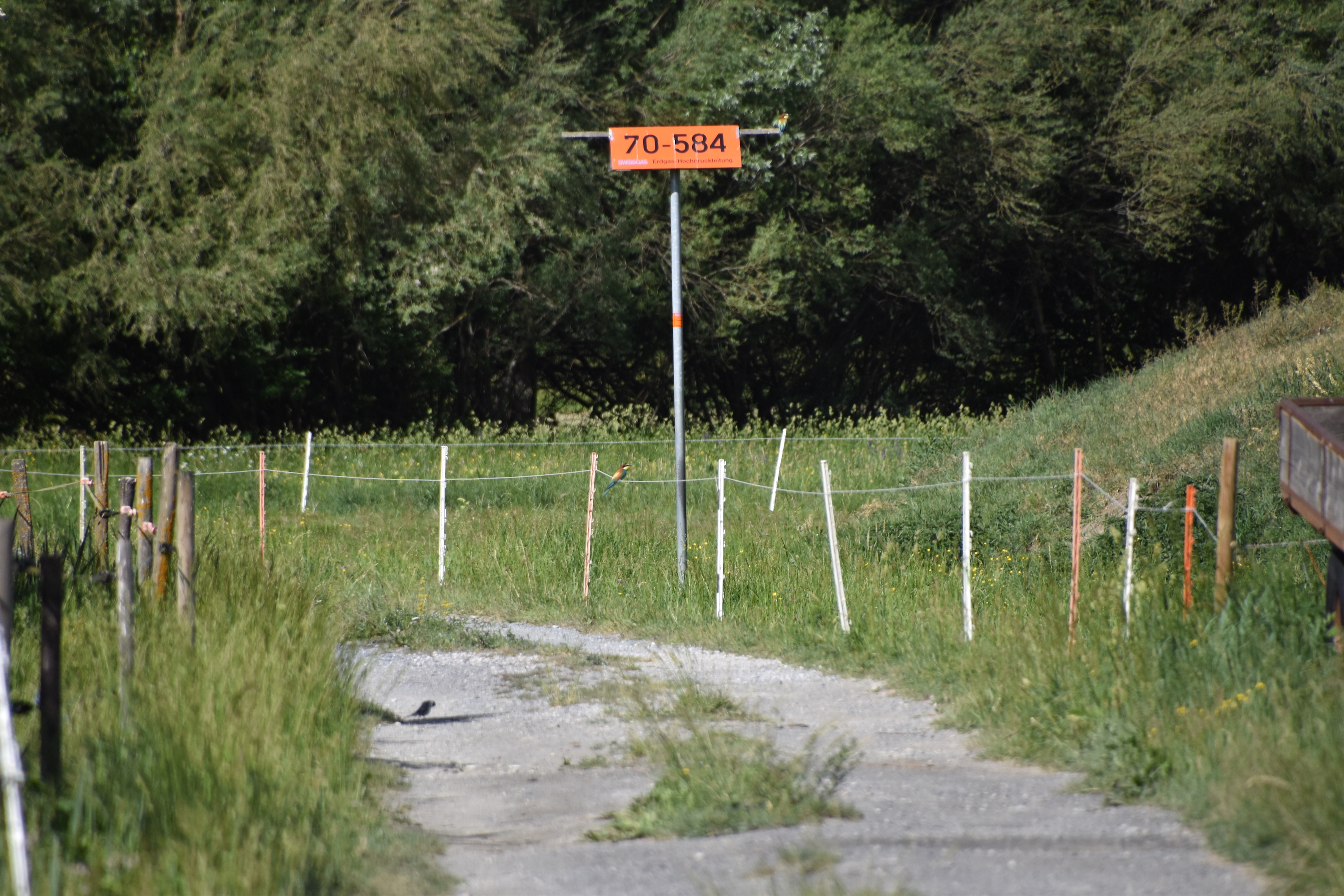
Die ersten Bienenfresser, die Jacqueline und ich gesehen haben in Leukerfeld. 2022-05-21 10:02:38 Leuk
Zuerst beobachtet in 🇨🇭 an 2022-05-21.
Beschreibung
Allgemein: Deutschland: Brut-, ZugvogelPersönlich gemerkt: Hoped to hear it and especially see it in Maienfeld (Kulturland-Exkursion) but didn't. It'll show up in Leuk in 2022!
Vokalisierung:
Quite vocal in all activities. [Link]
Saisonales Verhalten
Präsenz: 04-20 - 10-07 Brut: 05-21 - 08-09 Migration rein: 04-20 - 06-09 Migration raus: 07-20 - 10-07Weitere Infos at Vogelwarte.ch
Weitere Infos
Physikalische Details
Körperlich: Länge=27-29 cm, Flügelspanne=44-49 cm, Gewicht=44-78 gHabitate: Landwirtschaft
Vokalisierung
Gesang: BirdID says multi-syllabic, rolling phrases, although it often seems to be one syllable as well. Hope to hear it and especially see it in Maienfeld. Gesang Eigenschaften: Melody: einfach rhythmisch, langsam, Frequency: medium (1-5 KHz)Vollprofil
Profil Wikipedia Vogelwarte BirdLife ZH ornitho.ch bird-song.ch Audubon AllAboutBirds Xeno-Canto BirdID NABU YouTube

Wikipedia Kuckuck, Cuculus canorus. Quelle: WIKIPEDIA
Wikipedia Kuckuck, Cuculus canorus.jpg
Zuerst beobachtet in 🇨🇭 an 2021-05-04.
Beschreibung
Geographie: Dieser Vogel erscheint jenseits grossen Meere in Kontinenten : Europa, Nordamerika, Afrika, Asien.Allgemein: Deutschland: Brut-, Zugvogel RL V
Etymologie:
Auch in vielen anderen Sprachen, wie im Französischen (Coucou), Italienischen (cucú), Spanischen (cuco, manchmal cuclillo), Russischen (Kukuschka), Griechisch (koukoula), Englischen (Cuckoo), Polnischen (Kukułka), Ungarischen (kakukk) und Lateinischen (cuculus) wurde der Ruf lautmalerisch in seinen Namen integriert. [Link]
[2][3] The cuckoo family gets its common name and genus name by onomatopoeia for the call of the male common cuckoo. [Link]
Geographie:
 A common migratory bird across most of Europe and Asia, it regularly strays to the western Alaskan islands in late spring and early summer. [Link]
Saisonales Verhalten
Präsenz: 04-01 - 10-07 Brut: 05-01 - 07-20 Migration rein: 04-01 - 05-31 Migration raus: 07-10 - 10-07Weitere Infos at Vogelwarte.ch
Weitere Infos
Physikalische Details
Körperlich: Länge=32-34 cm, Flügelspanne=55-60 cm, Gewicht=95-140 gHabitate: Wald
Vokalisierung
Gesang: Two-noter Gesang:Männchen: Unverwechselbarer Ruf. Weibchen: im Frühling eine kichernde Rufreihe,
[Link]
Song: the well known disyllabic "cuck-coo" with emphasis on first note, and the second note a third lower than the first one. Also a harsh "tchaa tchaa", and a bubbly trill, reminiscent of Little Grebe, uttered by the female. [Link]
Gesang Eigenschaften:
Melody: einfach rhythmisch, langsam, Frequency: 0-1 KHz
Vollprofil
Profil Wikipedia Vogelwarte BirdLife ZH ornitho.ch Xeno-Canto BirdID NABU YouTube
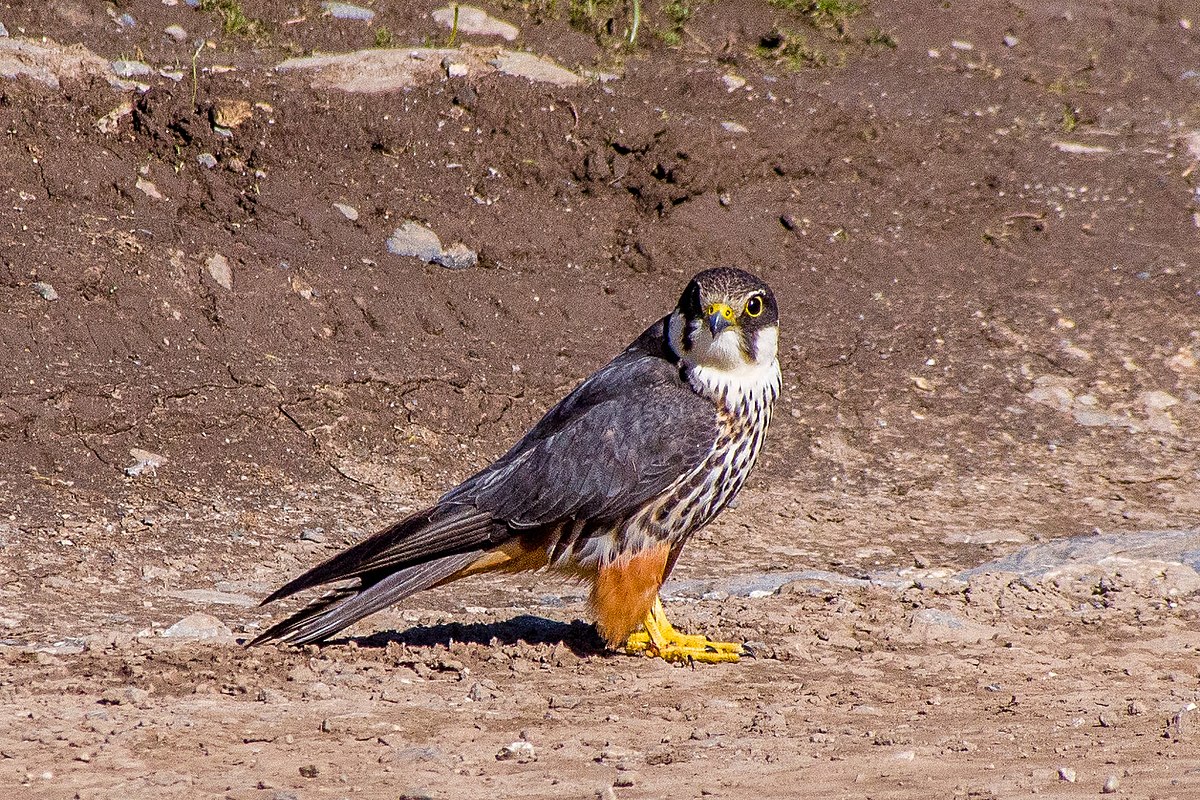
Wikipedia: Eurasian hobby Quelle: WIKIPEDIA
1200px-Eurasian_Hobby_%2814574008925%29_%28cropped%29.jpg
Zuerst beobachtet in 🇨🇭 an 2024-08-14.
Beschreibung
Allgemein: Deutschland: Brut-, Zugvogel RL 3Etymologie: Nabu: 2024 das erste Mal gehört nah beim Rosinli, aus der Ferne gesehen am Klingnauerstausee. [Link]
Vokalisierung:
Varied, but not very vocal. [Link]
Saisonales Verhalten
Präsenz: 04-01 - 10-27 Brut: 05-01 - 08-29 Migration rein: 04-01 - 06-20 Migration raus: 08-09 - 10-27Weitere Infos at Vogelwarte.ch
Weitere Infos
Physikalische Details
Körperlich: Länge=30-36 cm, Flügelspanne=82-92 cm, Gewicht=131-340 gHabitate: Landwirtschaft
Vokalisierung
Gesang: No details but a Xeno-Canto recording. Gesang Eigenschaften: Frequency:♫ 2024-08-14 13:57:00 Greater Fehraltorf (Gesang)
Rufe:
Calls when courting and at breeding ground. Most common sound a high-pitched "tew-tew-tew". Similar to Wryneck, but less pleading. Also a sneezing "ktcho". [Link]
General: About 20 single notes.
XC669704 - Eurasian Hobby - Falco subbuteo - call, about twenty peeps.
♫ Quelle: XENOCANTO XC669704 - Eurasian Hobby - Falco subbuteo - call, about twenty peeps.mp3 (Ruf)

Ruf Eigenschaften: Ruf Melodie: nicht musikalisch, langsam, Frequenz: low (1-3 KHz),
Vollprofil
Profil Wikipedia Vogelwarte BirdLife ZH ornitho.ch Xeno-Canto BirdID NABU YouTube

Wikipedia: Red-footed falcon Quelle: WIKIPEDIA
Falco_vespertinus_3_%28Martin_Mecnarowski%29.jpg
🔍
Never observed (yet!)
Beschreibung
Allgemein: Deutschland: ausnahmsweise Brutvogel, seltener ZugvogelSaisonales Verhalten
Präsenz: 04-20 - 10-07 Migration rein: 06-09 - 06-17 Migration raus: 08-18 - 10-07Weitere Infos at Vogelwarte.ch
Weitere Infos
Physikalische Details
Körperlich: Länge=29-31 cm, Flügelspanne=66-78 cm, Gewicht=130-197 gHabitate: Landwirtschaft Vollprofil

Turmfalke zwischen Fehraltorf und Mesikon. 2021-10-16 15:25:46 Fehraltorf
Zuerst beobachtet in 🇨🇭 an 2020-04-24.
Beschreibung
Allgemein: Oft seen in the fields around Fehraltorf, flapping away to stay in place.Allgemein: Deutschland: Brut-, Jahres-, Zugvogel, Wintergast
Saisonales Verhalten
Jahresvogel Brut: 04-20 - 08-29 Migration rein: 02-10 - 05-10 Migration raus: 08-18 - 11-15Weitere Infos at Vogelwarte.ch
Weitere Infos
Physikalische Details
Körperlich: Länge=32-35 cm, Flügelspanne=71-80 cm, Gewicht=156-252 gHabitate: Landwirtschaft
Ähnliche Arten
Gesang oder Rüfe ähnlich wie: Fahlsegler.Vokalisierung
Gesang: No details but a Xeno-Canto recording. Gesang Eigenschaften: Frequency:♫ 2026-04-28 15:13:38
 Quelle: Zoom H2n Schweiz (Gesang)
Rufe:
Turmfalke kann auch wie einen Specht tönen, scharf und relativ hoch [Link]
Most common call a fast series of short, high-pitched "ke-ke-ke". Much less raucous than Merlin or Peregrine. [Link]
Heard from in the air, about 6 notes per second (do I find them high??)
XC928672 - Common Kestrel - Falco tinnunculus - calls.
♫ Quelle: XENOCANTO XC928672 - Common Kestrel - Falco tinnunculus - calls.mp3 (Ruf)

Ruf Eigenschaften: Ruf Melodie: einnotig, schnell, Frequenz: 2-7 KHz,
Vollprofil

Buntspecht in Wildert. 2024-08-31 10:29:52 Wildert
Zuerst beobachtet in 🇨🇭 an 2020-04-12.
Beschreibung
Allgemein: Häufigste Spechtart in der SchweizAllgemein: Deutschland: Brut-, Jahresvogel
Vokalisierung:
It's frequent drumming is easily recognized by its short duration. [Link]
Saisonales Verhalten
Jahresvogel Brut: 04-11 - 07-20Weitere Infos at Vogelwarte.ch
Weitere Infos
Physikalische Details
Körperlich: Länge=22-23 cm, Flügelspanne=34-39 cm, Gewicht=70-100 gHabitate: Wald
Ähnliche Arten
Gesang oder Rüfe ähnlich wie: Ringdrossel.Vokalisierung
Gesang: Song: Other: ‘Drumming’ is the sound that Great Spotted Woodpeckers make by hammering their bills against dead wood 10-20 times over 2-3 seconds. The sound resonates in the dead wood and can be heard over large distances. This drumming acts as an advert and is used by Great spotted Woodpeckers and other woodpecker species instead of a song. [From the GardenBird web site]Nabu: Manchmal, bei strahlendem Sonnenschein, fangen die Spechte schon im Dezember an zu trommeln. [NABU Vogel des Jahres 1997]
Call: Nabu: Das bekannteste Geräusch des schwarz-weißen Spechtes ist aber wohl sein kurzes, aber häufiges Trommeln. [Link]
 In a sonogram I can see about 13 taps in just over half a second, but you can never distinguish so many.
It's short but intense, and the second half trails off,
especially contrasted with the constant drumming of the three-toed woodpecker. [[Listen here.]]
Gesang Eigenschaften:
Melody: nicht musikalisch, schnell, Frequency: low (1-3 KHz) Special sounds: trommeln Singing season: 01-01 - 06-30
In a sonogram I can see about 13 taps in just over half a second, but you can never distinguish so many.
It's short but intense, and the second half trails off,
especially contrasted with the constant drumming of the three-toed woodpecker. [[Listen here.]]
Gesang Eigenschaften:
Melody: nicht musikalisch, schnell, Frequency: low (1-3 KHz) Special sounds: trommeln Singing season: 01-01 - 06-30
♫ Quelle: XENOCANTO XC625181 buntspecht drumming.mp3 (Trommeln)

Rufe:
Typically it lasts 0.5 seconds, sometimes slightly longer. Contact call frequently hear throughout the year. A short hiccup "kek", sometimes in series. When excited this may escalate into a trill. [Link]
1:
General: A chirping (that I couldn't associate in my mind with a woodpecker), repeated at somewhat irregular intervals of about a second2023: klang in bird-song.ch Quiz wie eine lauter Haussperling
Call: Nabu: Der häufigste Ruf ist ein kurzes und spitzes „kix“. Ist ein Buntspecht aufgebracht, etwa durch einen Artgenossen, kann man ein schnelles Schnarren hören. [Link]
Great spotted woodpecker call
♫ Quelle: XENOCANTO XC200059 Great spotted woodpecker call.mp3 (Ruf)

2: No details but a Xeno-Canto recording. - but really OWN_VIA_BIRDNET
Birdnet 1937 - Great Spotted Woodpecker xxxx, also heard drumming - Great Spotted Woodpecker - Fehraltorf.
♫ 2021-08-14 09:57:28 Quelle: BirdNet 20210814_095728 birdnet 1937 - Great Spotted Woodpecker xxxx, also heard drumming - Great Spotted Woodpecker - Fehraltorf.mp3 Fehraltorf (Trommeln)
FOK3 - ein Specht trommelt, welcher war das, ein Buntspecht? Dazu eine Zilzalp, evtl Zaunkönig, und unser Kursleiter, der das Trommeln erklärt.
♫ 2025-03-22 09:08:40
Quelle: Zoom H2n Schweiz (Trommeln)Trommeln während ein Buntspecht ruft, im Wildert.
♫ 2024-08-31 09:31:25 Wildert (Trommeln)
Birdnet 1937 - Great spotted woodpecker, heard slow drumming - Not analyzed - Fehraltorf.
♫ 2021-08-14 09:57:28 Quelle: BirdNet 20210814_095728 birdnet 1937 - Great spotted woodpecker, heard slow drumming - Not analyzed - Fehraltorf.mp3 Fehraltorf (Trommeln)
Ruf Eigenschaften: Ruf Melodie: einnotig, langsam, Frequenz: 1-8 KHz,
Vollprofil

Vogelwarte Grauspecht. Quelle: VOGELWARTE
Vogelwarte Grauspecht.jpg
Zuerst beobachtet in 🇨🇭 an 2025-03-22.
Beschreibung
Allgemein: Deutschland: Brut-, Jahresvogel RL 2Verhalten:
Der Grauspecht gehört mit dem Grünspecht zu den «Erdspechten», die ihre Nahrung vorwiegend auf dem Boden suchen. Obwohl er fast so gross ist wie der Grünspecht, ist der heimlicher lebende Grauspecht ungleich schwieriger zu lokalisieren. Am ehesten verrät er sich durch die fallende, etwas melancholisch wirkende Rufreihe. Über seine Lebensweise ist vergleichsweise wenig bekannt. [Link]
Vokalisierung:
Mostly heard during the breeding season. [Link]
Saisonales Verhalten
Jahresvogel Brut: 04-20 - 07-29Weitere Infos at Vogelwarte.ch
Weitere Infos
Physikalische Details
Körperlich: Länge=25-26 cm, Flügelspanne=38-40 cm, Gewicht=120-160 gHabitate: Wald
Vokalisierung
Gesang: Drumming in lieu of song. Fast, constant, somehow less harsh than great and middle spotted woodpeckers. Gesang:Deutlich abfallende Tonreihe. 4-10 Töne. Absinken beginnt
gewöhnlich erst mit dem dritten oder vierten Ton und wird etwas langsamer.
Klingt etwas klagend (moll). Vor allem gegen den Schluss. Kann nachgepfiffen werden. (beim Grünspecht nicht )
[Link]
Song similar to Green Woodpecker, but general tone is soft and melancholic. Phrases consists of series of 5-8 clear notes falling both in pitch and intensity, and with diagnostic ritardando at the end. Short "kek" uttered if excited. Rarely drums. [Link]
Gesang Eigenschaften:
Melody: einfach rhythmisch, schnell, Frequency: 0-4 KHz Special sounds: trommeln
♫ Quelle: XENOCANTO XC552636 Kleinspecht drumming.mp3 (Trommeln)

1: In the FOK course, Christina said he sounds like he's running out of gas, which is a great description.
XC623125 grauspecht call.
♫ Quelle: XENOCANTO XC623125 grauspecht call.mp3 (Ruf)

2: No details but a Xeno-Canto recording.
XC628962 Grauspecht drumming.
♫ Quelle: XENOCANTO XC628962 Grauspecht drumming.mp3 (Trommeln)

Ruf Eigenschaften: Ruf Melodie: einfach rhythmisch, langsam, Frequenz: high (3-9 KHz),
Vollprofil

Elster im Baum nah bei einem Grünspecht, den ich gehört aber nicht gesehen habe. 2025-05-08 18:06:57 Wald Fehraltorf
Zuerst beobachtet in 🇨🇭 an 2020-11-08.
Beschreibung
Allgemein: In the FOK course, Tom mentioned that his nephew said it should be called the Buntspecht, since it has so many colors.Allgemein: Da es v.a. Ameisen frisst, trommelt es nicht viel, so weit ich mich erinnere, daher ist es hier nicht beschrieben. Xenocanto hat auch nichts.
Allgemein: Deutschland: Brut-, Jahresvogel RL V
Aussehen und Identifizierung:
Der Grünspecht fällt neben dem laut lachenden Balzruf auch durch den wellenförmigen Flug auf, bei dem er die Flügel zwischen zwei Schlagphasen ganz an den Körper anlegt. Neben dem Wendehals ist er unter den Spechtarten Europas am stärksten auf Ameisen spezialisiert. Er besitzt eine mehr als 10 Zentimeter lange Zunge, die klebrig und an der Spitze mit Widerhaken versehen ist. [Link]
Saisonales Verhalten
Jahresvogel Brut: 04-11 - 07-20Weitere Infos at Vogelwarte.ch
Weitere Infos
Physikalische Details
Körperlich: Länge=31-33 cm, Flügelspanne=40-42 cm, Gewicht=150-220 gHabitate: Wald
Vokalisierung
Gesang: Spooky laugh. Gesang:Helles Lachen. Weiche, oft leicht abfallende Tonreihe. Variabel in Lautstärke und Silbenzahl. je nach Stimmung. Wenn abfallend dann vom Anfang der Rufreihe an. Auch dreisilbig „kiäckkiäckkiäck“.
[Link]
Song similar to Grey-headed Woodpecker, but not as soft and fluty. Each phrase consist of a series of short "klee", with a laughing quality. Pitch drops slightly throughout the phrase, but not as markedly as in Grey-headed, and tempo is fairly constant (no ritardando). [Link]
Gesang Eigenschaften:
Melody: nicht musikalisch, langsam, Frequency: 1-6 KHz
Rufe:
Short "kek" calls when excited and in flight. Drumming of 1.5 seconds duration with decelerating tempo, but not often heard. Another call is similar to Black Woodpecker; a series of resonant "klit-klit-klit-klit-klit-klit", but is less clear, has a more determined start and has less obvious rising pitch at the end of each syllable. [Link]
Unheimliches Lachen.
XC627157 Grünspecht laughing call.
♫ Quelle: XENOCANTO XC627157 Gruenspecht laughing call.mp3 (Ruf)

Ruf Eigenschaften: Ruf Melodie: einnotig, langsam, Frequenz: high (3-9 KHz), Spezielle Klänge: absteigend.
Vollprofil
Profil Wikipedia Vogelwarte BirdLife ZH ornitho.ch bird-song.ch Xeno-Canto BirdID NABU YouTube

Wendehals am Rand des Golfplatzes in Susten. 2022-05-21 10:27:54 Leuk
Zuerst beobachtet in 🇨🇭 an 2021-05-10.
Beschreibung
Allgemein: Invisible as soon as it lands in a tree - perfect bark camouflage.Allgemein: Deutschland: Brut-, Zugvogel RL 2
Vokalisierung:
Normally silent when not breeding. Other sounds: a guttural "gru", and hissing sounds when threatened. [Link]
Saisonales Verhalten
Präsenz: 03-23 - 10-07 Brut: 05-01 - 08-18 Migration rein: 03-23 - 05-21 Migration raus: 07-29 - 10-07Weitere Infos at Vogelwarte.ch
Weitere Infos
Physikalische Details
Körperlich: Länge=16-17 cm, Flügelspanne=25-27 cm, Gewicht=30-45 gHabitate: Landwirtschaft
Vokalisierung
Gesang: Woodpecker-like series of up to 25 slightly rising calls. Gesang:Reihe von 8-12 Pfeiftönen. Klingt fast etwas heiser., Jeder Ruf etwas absinkend. Die Tonhöhe kann innerhalb der Reihe etwas schwanken, etwas zunehmen und eindringlicher werden. Klangfarbe weich, obertönig.
[Link]
Song (both sexes): an insisting, Merlin- or Lesser Spotted Woodpecker-like series of plaintive "kee kee kee kee kee ". First slightly ascending, then descending. [Link]
Gesang Eigenschaften:
Melody: nicht musikalisch, langsam, Frequency: 1-6 KHz
Vollprofil
Profil Wikipedia Vogelwarte BirdLife ZH ornitho.ch bird-song.ch Xeno-Canto BirdID NABU YouTube

Zwergtaucher, Bannriet. 2024-06-21 08:22:26 Bannriet, SG
Zuerst beobachtet in Südafrika an 2009-10-22.
Beschreibung
Allgemein:Der Zwergtaucher (Tachybaptus ruficollis) ist eine Art aus der Familie der Lappentaucher. In Europa ist diese in Eurasien und Afrika verbreitete Art der kleinste Vertreter dieser Familie. Zwergtaucher sind in Europa durchaus häufig. Sie werden jedoch wegen ihres unauffälligen Gefieders und ihrer insbesondere während der Brutzeit sehr versteckten Lebensweise meist übersehen.
[mehr]
Deutschland: Brut-, Jahres-, Zugvogel, Wintergast
Vokalisierung:
Relatively vocal compared to many other grebes. [Link]
Saisonales Verhalten
Jahresvogel Brut: 04-11 - 08-18 Migration rein: 02-20 - 05-01 Migration raus: 06-29 - 11-26Weitere Infos at Vogelwarte.ch
Weitere Infos
Physikalische Details
Körperlich: Länge=25-29 cm, Flügelspanne=40-45 cm, Gewicht=140-193 gHabitate: Fluss und See
Vokalisierung
Gesang:Der Gesang ist ein lautes, hohes Trillern. Männchen und Weibchen tragen ihn häufig im Duett vor. [Link]
Gesang Eigenschaften:
Melody: einfach rhythmisch, schnell, Frequency: 1-5 KHz
Rufe:
Call; sometimes a single quite clear high pitched "dydlylyyt". More often combined into longer phrases with harsher quality, oscillating like laughter and travelling up and down in pitch in agitated motion. Reminiscent of female Cuckoo. [Link]
No details but a Xeno-Canto recording.
- but really
OWN
Zwergtaucher in bannriet, SG - ich habe ihn überrascht, er hat diesen panischen Ruf gemacht und ist dann getaucht und verschwunden - herrlich!
♫ 2024-06-20 19:23:00 Bannriet, SG (Ruf)
Ruf Eigenschaften: Gesang Frequenz: ,
Vollprofil
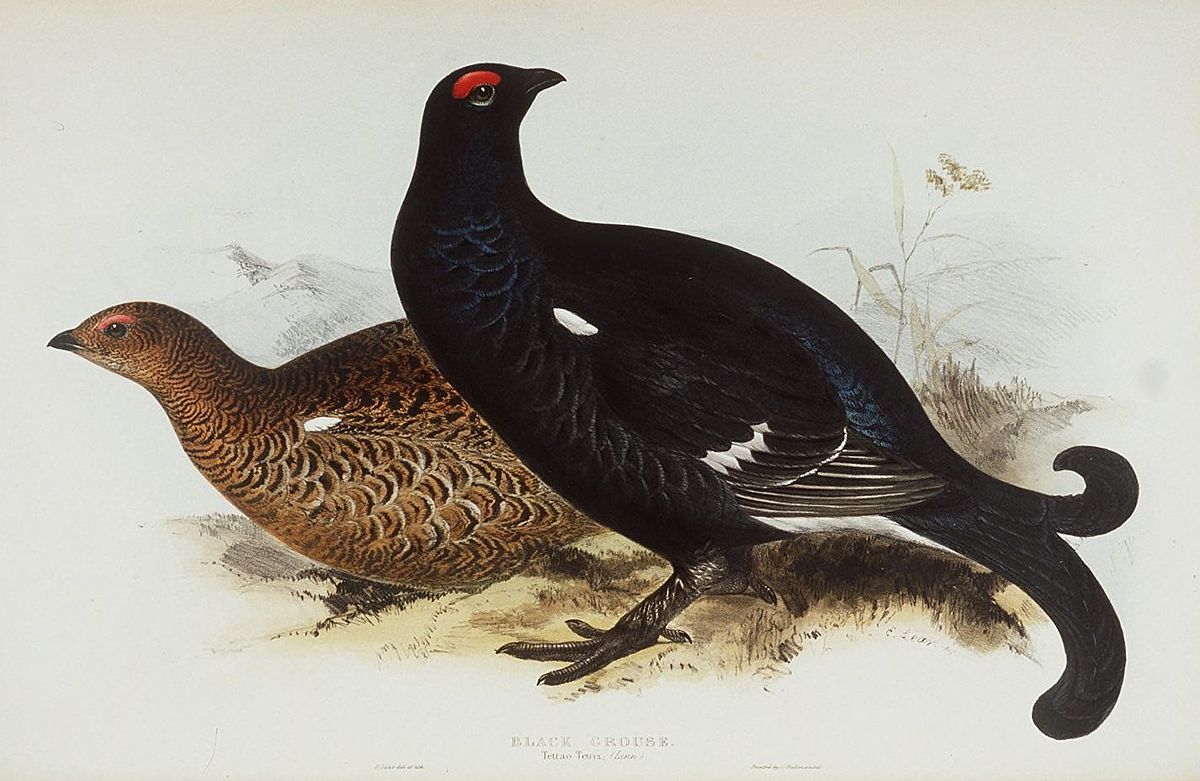
Wikipedia: Black grouse Quelle: WIKIPEDIA
1200px-Black_Grouse.jpg
🔍
Never observed (yet!)
Beschreibung
Allgemein: Deutschland: Brut-, Jahresvogel RL 2Persönlich gemerkt: Rolf hat einen auf dem Amdener Höhenweg Mai 2023 gesehen, würde den gerne sehen!
Saisonales Verhalten
Jahresvogel Brut: 05-21 - 07-10Weitere Infos at Vogelwarte.ch
Weitere Infos
Habitate: BergVokalisierung
Gesang: Song can be a rapid dove-like cooing that goes up, then repeats. Gesang Eigenschaften: Melody: einfach rhythmisch, langsam, Frequency: 0-1 KHz♫ Quelle: XENOCANTO XC731604 - Black Grouse - Lyrurus tetrix.mp3 (Gesang)

Vollprofil

MerlinBirdID sagt das sind Alpensegler die ich von der Ferienwohnung in Locarno gesehen habe. 2025-04-28 07:41:43 Locarno
Zuerst beobachtet in 🇨🇭 an 2020-06-20.
Beschreibung
Allgemein: Deutschland: Brut-, Zugvogel RL RSaisonales Verhalten
Präsenz: 04-01 - 09-25Weitere Infos
Habitate: SiedlungVokalisierung
Gesang: No details but a Xeno-Canto recording. Gesang Eigenschaften: Frequency:♫ 2020-06-20 12:18:16 Quelle: BirdNet 20200620_121816 birdnet 688 - Alpine swift.mp3 Luppmen (Gesang)
Vollprofil
Klassifikation nicht gefunden:
Allgemein: 1 Spezien nicht korrekt klassifiziertSchwarzmilan / Black kite (Milvus migrans)

Schwarzmilan. 2022-05-22 10:42:20 Leuk
Zuerst beobachtet in 🇨🇭 an 2021-04-03.
Beschreibung
Allgemein: This is on my list of birds to find, as it is supposed to be exist in this area,but I've never identified one. Their call (see Vogelwarte link) is a rapid sequence of whistles, and definitely distinct from that of the red kites. Visually they are harder to tell apart, but if you look closely, it should be clear: the black kite has less of a V in its tail and no big white patch at the wingtips. birdguides.com has a guide to distinguishing black and red kites, and says black are much rarer, but that is not true in Switzerland - Vogelwarte.ch says Switzerland has 2800–3500 red kites and 2000-3000 black kites.Allgemein: Tenatively identified one flying high over Lake Lugano at San Salvatore in Ticino.
Allgemein: Often near water.
Allgemein: Deutschland: Brut-, Zugvogel
Vokalisierung:
A piercing, first ascending then descending long "piuuu". Starting as a clear tone then gradually taking on a vibrating character that differs from Red Kite. Also a sharp "kieee -ki- ki-ki". More vocal than Red Kite. [Link]
Saisonales Verhalten
Präsenz: 02-20 - 10-07 Brut: 04-01 - 07-20 Migration rein: 02-20 - 05-21 Migration raus: 07-20 - 10-07Weitere Infos at Vogelwarte.ch
Weitere Infos
Physikalische Details
Körperlich: Länge=55-60 cm, Flügelspanne=160-180 cm, Gewicht=630-941 gHabitate: Landwirtschaft
Vokalisierung
Gesang: No details but a Xeno-Canto recording. Gesang Eigenschaften: Frequency:♫ 2021-08-14 09:32:55 Quelle: BirdNet 20210814_093255 birdnet 1932 - Wild guess was once black kite, check - Not analyzed - Volketswil.mp3 (Gesang)
Drei fallende Noten
XC884100 - Black Kite - Milvus migrans - flight call.
♫ Quelle: XENOCANTO XC884100 - Black Kite - Milvus migrans - flight call.mp3 (Flugruf)

Ruf Eigenschaften: Flugruf Ruf Melodie: einfach rhythmisch, langsam, Frequenz: medium (1-5 KHz), Spezielle Klänge: absteigend.
Vollprofil