Feuchtgebiet Vögel (plus einige Limikolen, die man momentan am Flachsee beobachtet) in taxonomischer Hierarchie
Graureiher / Grey heron (Ardea cinerea)
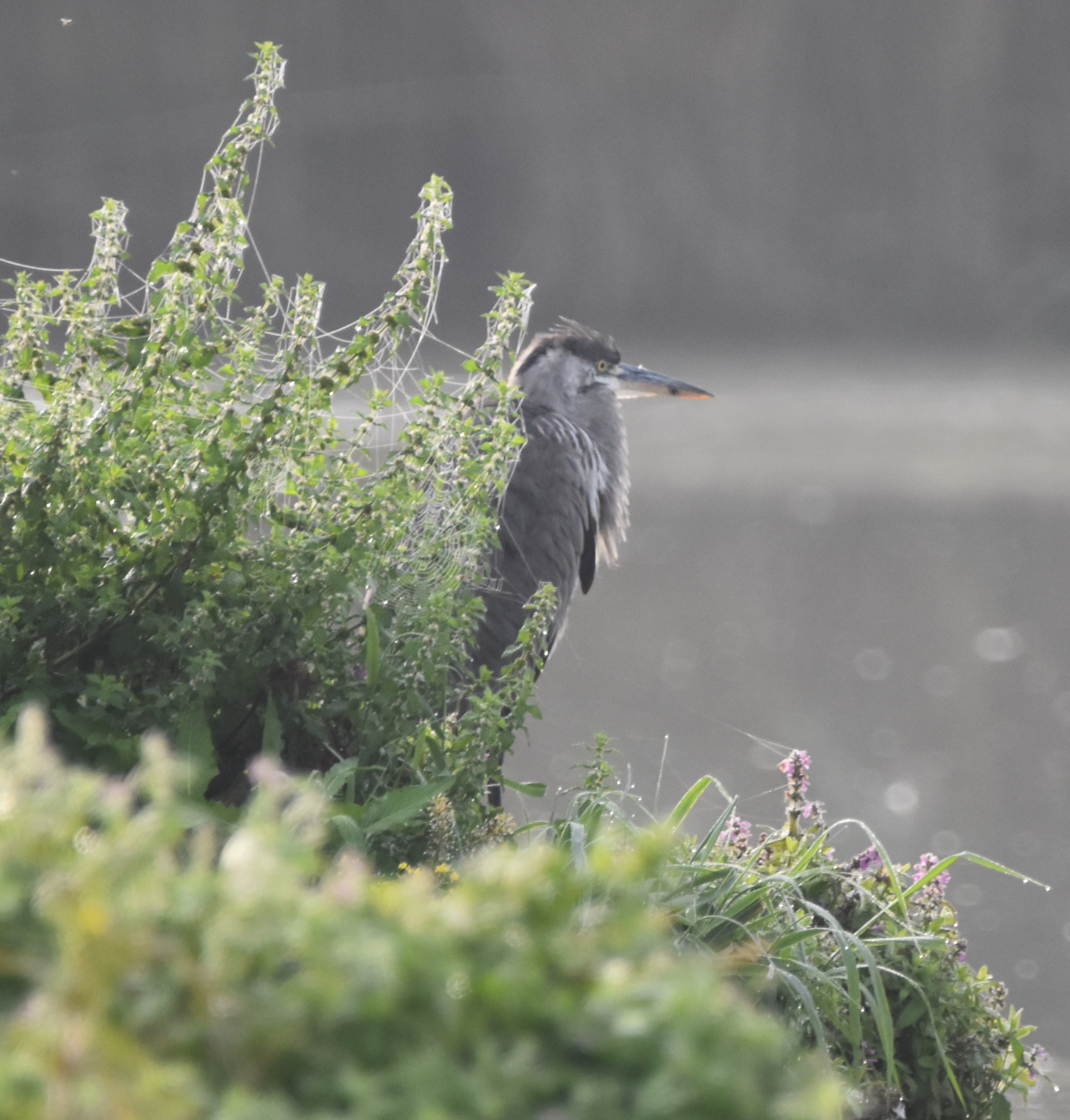
Graureiher auf der Insel, Neeracherried. 2022-09-04 08:03:50 Neeracherried
Zuerst beobachtet in 🇨🇭 an 2019-11-22.
Beschreibung
Allgemein: Ein häufiger Besucher in Fehraltorf. Auch Fischreiher genannt.Allgemein: Zumeist auf den Feldern (wo er Wühlmäuser und Molche frisst) oder am Bach
Allgemein: Deutschland: Brut-, Jahres-, Zugvogel, Wintergast
Vokalisierung:
 Quite vocal. At breeding ground a varied repertoire of harsh and clattering sounds. [Link]
Saisonales Verhalten
Jahresvogel Brut: 02-01 - 08-29 Migration rein: 02-01 - 04-11 Migration raus: 07-10 - 10-27 Weitere Infos at Vogelwarte.ch
Weitere Infos
Physikalische Details
Körperlich: Länge=90-98 cm, Flügelspanne=175-195 cm, Gewicht=1020-2073 gHabitate: Nassgebiet
Vokalisierung
Gesang: No details but a Xeno-Canto recording. Gesang Eigenschaften: Frequency:♫ 2024-11-01 08:26:54 Quelle: BIRDWEATHER 20241101_082654-Birdweather-Gray_Heron call.mp3 Greater Fehraltorf (Ruf)
Rufe:
Most common call a short, far reaching and extremely harsh, rasping sound. [Link]
General: Mechanical-sounding sort-of-a-quackCall:
Quite vocal. Most common call a short, far reaching and extremely harsh, rasping sound. At breeding ground a varied repertoire of harsh and clattering sounds. [Link]
XC876171 - Grey Heron - Ardea cinerea - call - Manyeleti Game Reserve, South Africa.
♫ Quelle: XENOCANTO XC876171 - Grey Heron - Ardea cinerea - call - Manyeleti Game Reserve, South Africa.mp3 (Ruf)

Ruf Eigenschaften: Ruf Melodie: nicht musikalisch, langsam, Frequenz: low (1-3 KHz), Spezielle Klänge: Raspel.
Vollprofil
Silberreiher / Great egret (Ardea alba)

Silberreiher in Deutschland, von WikiCommons Von Andreas Eichler, CC BY-SA 4.0, https://commons.wikimedia.org/w/index.php?curid=59954907 Quelle: OTHER
Wikicommons 2016.10.30--Silberreiher.jpg
Zuerst beobachtet in 🇨🇭 an 2021-02-24.
Beschreibung
Geographie: Dieser Vogel erscheint jenseits grossen Meere in Kontinenten : Europa, Nordamerika, Südamerika, Afrika, Asien.Allgemein: Auf dem Heimweg von Schwanden haben wir bei Benken ganz weisse Reiher gesehen. Laut ornitho.ch waren sie Silberreiher.
Allgemein: Bei den meisten Quellen heisst es, sie sind in der Schweiz nur Durchzüger oder Wintergäste. Aber laut Balzari und Gygax, brüten auch einige Vögel am Lac Neuchatel seit 2013.
Allgemein: Deutschland: Zugvogel, Wintergast
Vokalisierung:
Silent outside breeding ground. [Link]
Saisonales Verhalten
Jahresvogel Migration rein: 03-01 - 05-31 Migration raus: 08-09 - 11-15Weitere Infos at Vogelwarte.ch
Weitere Infos
Physikalische Details
Körperlich: Länge=85-102 cm, Flügelspanne=140-170 cm, Gewicht=960-1030 gHabitate: Nassgebiet
Vokalisierung
Rufe:In colonies various harsh calls like a dry, and mechanical "kerrrrrrr", and a very nasal "geet" or "ga-geet ga-geet" are heard. [Link]
1:
Partly an awkward quack: uck uck. Rattles. Deep-toned urrr. Higher-toned trill.
2: No details but a Xeno-Canto recording.
XC751146 - Great Egret - Ardea alba - call and flight call - Shanghai, China.
♫ Quelle: XENOCANTO XC751146 - Great Egret - Ardea alba - call and flight call - Shanghai, China.mp3 (Flugruf)

Ruf Eigenschaften: Ruf Melodie: nicht musikalisch, langsam, Frequenz: low (1-3 KHz),
Vollprofil
Purpurreiher / Purple heron (Ardea purpurea)
Profil Wikipedia Vogelwarte BirdLife ZH ornitho.ch Xeno-Canto BirdID NABU YouTube

Purple heron, Phnom Krom. 2024-03-03 06:13:38 Phnom Krom
Zuerst beobachtet in Phnom Krom an 2024-03-03.
Beschreibung
Allgemein: Deutschland: Brutvogel, seltener Zugvogel RL RVokalisierung:
Quite similar to Grey Heron, but not so vocal. [Link]
Saisonales Verhalten
Präsenz: 03-23 - 10-18 Brut: 04-20 - 07-29 Migration rein: 09-17 - 10-18 Migration raus: 09-17 - 09-25Weitere Infos at Vogelwarte.ch
Weitere Infos
Physikalische Details
Körperlich: Länge=78-90 cm, Flügelspanne=120-150 cm, Gewicht=525-1218 gHabitate: Nassgebiet
Vokalisierung
Rufe:Pitch slightly higher and remains stable throughout the short call. Volume muffled and timbre drier. [Link]
No details but a Xeno-Canto recording.
XC878038 - Purple Heron - Ardea purpurea manilensis - flight call - Nonthaburi, Thailand.
♫ Quelle: XENOCANTO XC878038 - Purple Heron - Ardea purpurea manilensis - flight call - Nonthaburi, Thailand.mp3 Thailand (Flugruf)

Ruf Eigenschaften: Flugruf Frequenz: ,
Vollprofil
Nachtreiher / Black-crowned night-heron (Nycticorax nycticorax)

Nachtreiher in Camargue - the only bird I've been able to identify so far looking back on those old photos. 1991-07-15 12:41:47 Camargue
Zuerst beobachtet in Camargue an 1991-07-15.
Beschreibung
Geographie: Dieser Vogel erscheint jenseits grossen Meere in Kontinenten : Europa, Nordamerika, Südamerika, Afrika, Asien.Allgemein: Deutschland: Brutvogel, seltener Zugvogel RL 1
Saisonales Verhalten
Präsenz: 03-23 - 09-28 Migration rein: 09-07 - 09-14 Migration raus: 09-07 - 09-28Weitere Infos at Vogelwarte.ch
Weitere Infos
Physikalische Details
Körperlich: Länge=58-65 cm, Flügelspanne=105-112 cm, Gewicht=500-800 gHabitate: Nassgebiet Vollprofil
Seidenreiher / Little egret (Egretta garzetta)
Profil Wikipedia Vogelwarte BirdLife ZH ornitho.ch Xeno-Canto BirdID NABU YouTube
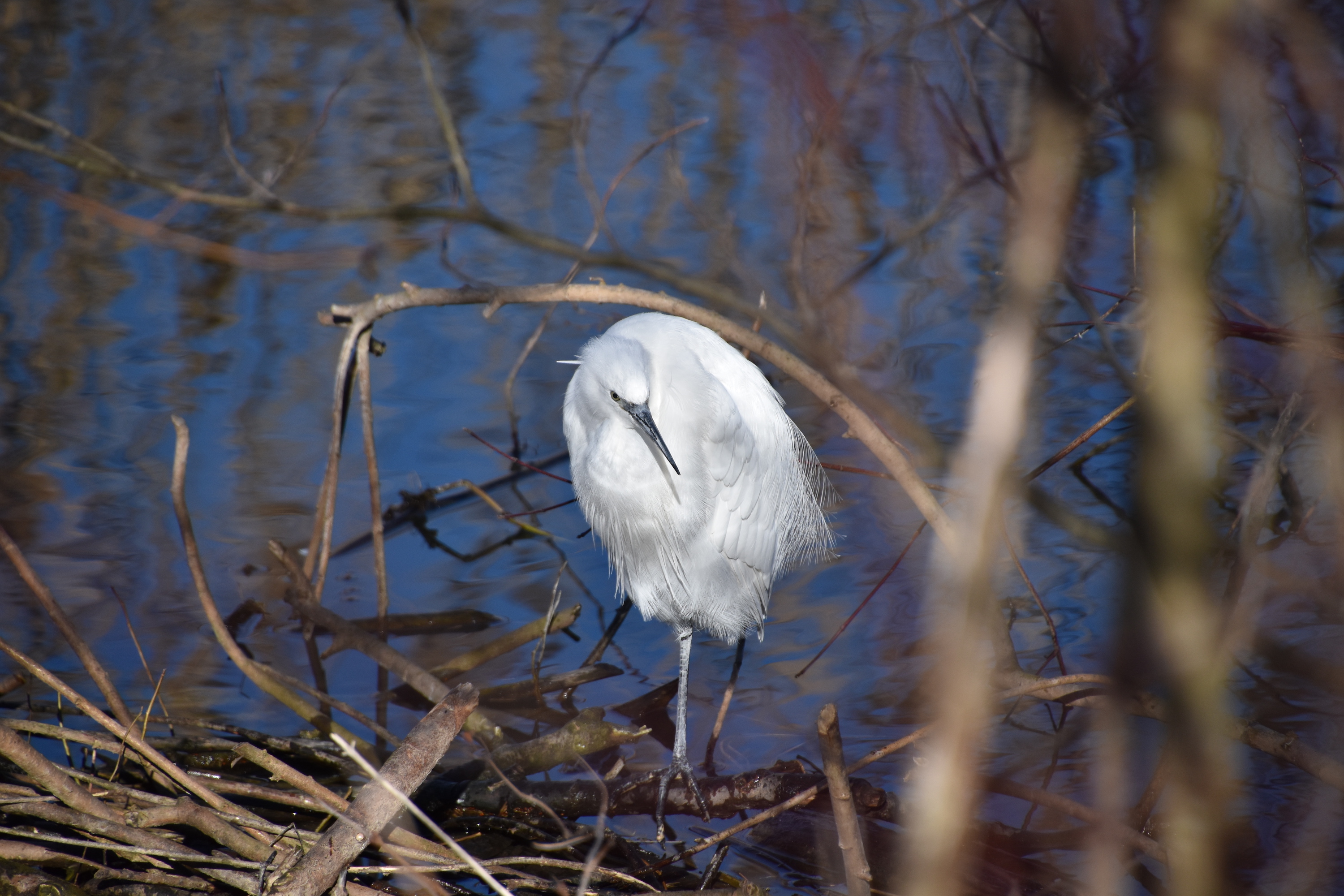
Seidenreiher. 2022-02-05 11:42:26 Klingnauer Stausee
Zuerst beobachtet in 🇨🇭 an 2019-11-22.
Beschreibung
Allgemein: ERROR null testAussehen und Identifizierung: Der Seidenreiher hat gelbe Füsse aber dunklgraue Beine und Schnabel
Vokalisierung:
Sometimes utters a dry, rasping "kerrr" when flushed, but is mostly silent away from breeding ground. In colonies a peculiar gurgling and vibrating sound is heard; "ghala-la-la-la". [Link]
Saisonales Verhalten
Jahresvogel Migration rein: 09-28 - 10-07 Migration raus: 09-28 - 10-05Weitere Infos at Vogelwarte.ch
Weitere Infos
Physikalische Details
Körperlich: Länge=55-65 cm, Flügelspanne=88-95 cm, Gewicht=350-550 gHabitate: Nassgebiet
Vokalisierung
Gesang: No details but a Xeno-Canto recording. Gesang Eigenschaften: Frequency:♫ Quelle: XENOCANTO XC799679 - Little Egret - Egretta garzetta - call that sounds like its vomiting - Catalunya, Spain.mp3 Spanien (Ruf)

Sort of a quack, brighter and higher than grey heron, with a bit of wawa.
Ruf Eigenschaften: Ruf Melodie: nicht musikalisch, langsam, Frequenz: low (1-3 KHz),
Vollprofil
Rohrdommel / Great bittern (Botaurus stellaris)

Rohrdommel - ausgestopft - von Silberweide Naturzentrum. 2021-10-30 13:24:28 Quelle: OTHER
20211030_132428-DSC_0583 Rohrdommel - ausgestopft - von Silberweide Naturzentrum. Vielen Dank, dass sie es draussen aufgestellt haben, damit ich ein schoeneres Foto habe machen koennen!.JPG
Greifensee
Zuerst beobachtet in 🇨🇭 an 2021-10-30.
Beschreibung
Allgemein: Die Rohrdommel (Botaurus stellaris) ist ein Vogel aus der Familie der Reiher (Ardeidae). Im Frühjahr geben die Männchen dumpfe Balzrufe von sich, die kilometerweit zu hören sind und der Rohrdommel früher die volkstümlichen Bezeichnungen Moorochse, Wasserochse, Riedochse und Mooskuh eingetragen haben (). In der Abgrenzung zur Zwergdommel wird sie teilweise auch als Große Rohrdommel bezeichnet. Die Rohrdommel lebt verborgen in ausgedehnten Röhrichten.
[mehr]
Die Rohrdommel (Botaurus stellaris) ist ein Vogel aus der Familie der Reiher (Ardeidae). Im Frühjahr geben die Männchen dumpfe Balzrufe von sich, die kilometerweit zu hören sind und der Rohrdommel früher die volkstümlichen Bezeichnungen Moorochse, Wasserochse, Riedochse und Mooskuh eingetragen haben (). In der Abgrenzung zur Zwergdommel wird sie teilweise auch als Große Rohrdommel bezeichnet. Die Rohrdommel lebt verborgen in ausgedehnten Röhrichten.
[mehr]

Deutschland: Brut-, Jahres-, Zugvogel, Wintergast RL 2
Etymologie:
[13] Most of these were onomatopoeic colloquial names for the bird; the call was described as "bumping"[14] or "booming". [Link]
Saisonales Verhalten
Jahresvogel Migration rein: 02-01 - 05-10 Migration raus: 08-09 - 12-31Weitere Infos at Vogelwarte.ch
Weitere Infos
Physikalische Details
Körperlich: Länge=70-80 cm, Flügelspanne=125-135 cm, Gewicht=867-1940 gHabitate: Nassgebiet
Vokalisierung
Rufe:Flight call a deep croaking "graat". [Link]
A little buzz/beep that sounds more like an appliance or app.
Ruf Eigenschaften: Ruf Melodie: nicht musikalisch, langsam, Frequenz: low (1-3 KHz),
Vollprofil
Zwergdommel / Little bittern (Ixobrychus minutus)
Profil Wikipedia Vogelwarte BirdLife ZH ornitho.ch bird-song.ch Xeno-Canto NABU YouTube
, Neeracherried.JPG)
Zwergdommel Weibchen (gestreift), Neeracherried. 2022-09-04 09:00:22 Neeracherried
Zuerst beobachtet in 🇨🇭 an 2022-09-04.
Beschreibung
Allgemein:Die Zwergdommel (Ixobrychus minutus) ist ein verborgen lebender Vogel ausgedehnter Röhrichte aus der Familie der Reiher (Ardeidae).
[mehr]
Deutschland: Brut-, Zugvogel RL 1
Vokalisierung:
Mostly silent except in breeding season. [Link]
Saisonales Verhalten
Präsenz: 04-20 - 09-28 Brut: 05-10 - 08-09 Migration rein: 04-20 - 06-09 Migration raus: 07-20 - 09-28Weitere Infos at Vogelwarte.ch
Weitere Infos
Physikalische Details
Körperlich: Länge=33-38 cm, Flügelspanne=52-58 cm, Gewicht=140-150 gHabitate: Nassgebiet
Vokalisierung
Rufe:Flight-call a sharp "ki-ke-ke" or a nasal "ke". [Link]
Almost a bark, low-pitched, little treble.
Ruf Eigenschaften: Ruf Melodie: nicht musikalisch, langsam, Frequenz: low (1-3 KHz),
Vollprofil

Schilfrohrsänger. 2022-06-04 11:48:08 Kaltbrunner-Riet
Zuerst beobachtet in 🇨🇭 an 2020-05-20.
Beschreibung
Allgemein: Brütet hier nicht, darum eher selten, Durchzügler.Allgemein: Deutschland: Brut-, Zugvogel seit 2016 nicht mehr auf der Vorwarnliste
Saisonales Verhalten
Präsenz: 03-23 - 10-27 Brut: 05-01 - 07-29 Migration rein: 03-23 - 05-31 Migration raus: 07-10 - 10-27Weitere Infos at Vogelwarte.ch
Weitere Infos
Physikalische Details
Körperlich: Länge=13 cm, Flügelspanne=17-21 cm, Gewicht=9-15 gHabitate: Nassgebiet
Vokalisierung
Gesang: Das Beispiel auf vogelwarte.ch ist eher ein knarren und trillern, ähnlicher Rhythmus und Klänge wie der Teichrohrsänger. Gesang: Gesang sehr ähnlich dem Teichrohrsänger. Aber nicht so im Takt. Bevorzugte Tongebilde werden mehrmals wiederholt. Des öftern Singflug über dem Schilf.
[Link]
Song vigorous and varied. [Link]
Gesang Eigenschaften:
Melody: singt 20 Sekunden oder länger, langsam, Frequency: medium (1-5 KHz) Special sounds: Mimikry
Gesang sehr ähnlich dem Teichrohrsänger. Aber nicht so im Takt. Bevorzugte Tongebilde werden mehrmals wiederholt. Des öftern Singflug über dem Schilf.
[Link]
Song vigorous and varied. [Link]
Gesang Eigenschaften:
Melody: singt 20 Sekunden oder länger, langsam, Frequency: medium (1-5 KHz) Special sounds: Mimikry
♫ Quelle: XENOCANTO XC661577 - Sedge Warbler - Acrocephalus schoenobaenus - song.mp3 (Gesang)

Vollprofil

Teichrohrsänger. 2024-05-20 08:58:41 Klingnauer Stausee
Zuerst beobachtet in 🇨🇭 an 2020-04-27.
Beschreibung
Allgemein: 2-5 repetitions of each sound. Is the tone a bit lower than the other reed warblers?Allgemein: Deutschland: Brut-, Zugvogel
Saisonales Verhalten
Präsenz: 04-11 - 10-18 Brut: 05-10 - 08-18 Migration rein: 04-11 - 05-31 Migration raus: 07-29 - 10-18Weitere Infos at Vogelwarte.ch
Weitere Infos
Physikalische Details
Körperlich: Länge=13 cm, Flügelspanne=17-21 cm, Gewicht=10-16 gHabitate: Nassgebiet
Vokalisierung
Gesang: Weird, squeaky, urgent. Slower than Sumpfrohrsaenger. Gesang:Gleichmässiges Tempo! Man kann den Takt schlagen dazu.(Metronomsänger) Oft 2-3x wiederholte kurze Motive. Viele schnarrende Töne.
[Link]
By far easiest to identify by song: Characteristic, almost metric and even rhythm, very different from Sedge Warbler. Squeaky timbre with many, almost bizarre, harmonics. Phrases generally repeated 2-3 times. [Link]
Gesang Eigenschaften:
Melody: singt 20 Sekunden oder länger, schnell, Frequency: medium (1-5 KHz) Special sounds: komisch
♫ Quelle: XENOCANTO XC653035 - Eurasian Reed Warbler - Acrocephalus scirpaceus - song.mp3 (Gesang)

Vollprofil

Sumpfrohrsänger wahrscheinlich. 2021-05-04 08:12:50 Flachsee am Reuss
Zuerst beobachtet in 🇨🇭 an 2021-05-04.
Beschreibung
Allgemein: Deutschland: Brut-, ZugvogelAussehen und Identifizierung: Sumpfis und Teichis im Feld optisch zu unterscheiden ist nicht ganz trivial, noch schwieriger auf Fotos. Am besten sind die beiden am Gesang auseinander zu dividieren. Teichrohrsänger haben manchmal einen klaren Kontrast zw. Krallen und Bein. Wenn man die Viecher in der Hand hat, wirken Teichrohrsänger oft etwas rötlich [oft nicht klar auf Fotos]. Last but not least ist die Wahrscheinlichkeit einen Sumpfi zu sehen einfach höher. Gruß & GB Heinrich [Link]
Saisonales Verhalten
Präsenz: 05-01 - 09-28 Brut: 05-01 - 07-29 Migration rein: 05-01 - 06-29 Migration raus: 07-10 - 09-28Weitere Infos at Vogelwarte.ch
Weitere Infos
Physikalische Details
Körperlich: Länge=13 cm, Flügelspanne=18-21 cm, Gewicht=10-15 gHabitate: Nassgebiet
Vokalisierung
Gesang: Rival Teichrohrsänger hat eher Wiederholungen, Sumpfrohrsänger auch Kohlmeise-tschurrende-Rufe und andere Geräusche und kurze Melodien von 2-5 Noten. Gesang:Der Virtuose unter den Rohrsängern! Meisterhafter Imitator anderer Vogelstimmen. Viele wirbelnde und zwirlende Laute, wenig schnarrende. Variable Tempi.
[Link]
Song extremely varied and full of mimicry of both European and African species. Up to 75 species imitated by the same bird. Phrases often repeated 2-4 times, and different phrases may overlap. Nevertheless, clearly defined phrases with marked pauses. Sometimes more flowing streams of notes, but less so than Icterine Warbler. Most similar to Icterine and Blyth's Reed Warbler. Softer timbre than Icterine, and not so loud. [Link]
Gesang Eigenschaften:
Melody: singt 20 Sekunden oder länger, schnell, Frequency: medium (1-5 KHz) Special sounds: Mimikry, komisch
♫ Quelle: XENOCANTO XC728884 - Marsh Warbler - Acrocephalus palustris - song.mp3 (Gesang)

Vollprofil

Drosselrohrsänger, Leukerfeld. 2022-05-21 10:39:42 Leuk
Zuerst beobachtet in 🇨🇭 an 2020-05-20.
Beschreibung
Allgemein: Deutschland: Brut-, Zugvogel seit 2016 nicht mehr auf der VorwarnlistePersönlich gemerkt: Zuerst in Bolle Magadino gesehen und gehört.
Aussehen und Identifizierung: 50% grösser als der ähnlich aussehende Teichrohrsänger
Verhalten:
 In der Sonntagszeitung von 23. Mai 2021 wurde über neue Erkenntnisse zum Zug von Drosselrohrsängern geschrieben. Durch neue, leichte Messgeräte konnte man sehen, dass die Vögel in der Nacht auf 2 km Höhe fliegen, beim Sonnenaufgang über eine Stunde hoch bis 5.5 km fliegen. Da sie das Mittlemeer und die Saharawüste überfliegen, wo sie nicht landen können, fliegen sie bis 34 Stunden non-stop. Das Fliegen erzeugt viel Körperwärme und die Höhe hilft ihnen abzukühlen. [(Abo erforderlich)]
Saisonales Verhalten
Präsenz: 04-20 - 09-28 Brut: 05-10 - 08-18 Migration rein: 04-20 - 05-31 Migration raus: 07-20 - 09-28Weitere Infos at Vogelwarte.ch
Weitere Infos
Physikalische Details
Körperlich: Länge=19-20 cm, Flügelspanne=24-29 cm, Gewicht=29-36 gHabitate: Nassgebiet
Vokalisierung
Gesang: General: Klingt für mich wie krächz pieps pieps. Vogelarten der Schweiz sieht das anders: 'Laute und auffällig knarrende, rau tönende Strophe ''karre-kiet karre karre-keit.'' 'Song:
In Vergleich zu Teichrohrsänger langsamer und lauter. [Link]
Gesang: Gesang ähnlich Teichrohrsänger, aber viel lauter, Tonhöhenunterschiede 2-3 Oktaven. Karre-Kit-Sänger.. Sehr taktmässig.
[Link]
Song similar to Reed Warbler in timbre, but much deeper and slower. [Link]
Gesang Eigenschaften:
Melody: singt 20 Sekunden oder länger, langsam, Frequency: medium (1-5 KHz) Special sounds: Raspel
♫ Quelle: XENOCANTO XC661392 - Great Reed Warbler - Acrocephalus arundinaceus - song.mp3 (Gesang)

Vollprofil
Profil Wikipedia Vogelwarte BirdLife ZH ornitho.ch bird-song.ch Xeno-Canto BirdID NABU YouTube

Wikipedia: Bearded reedling Quelle: WIKIPEDIA
Bartmeise%28Cropped%29_by_Wolfram_Riech.jpg
Zuerst beobachtet in 🇨🇭 an 2024-08-24.
Beschreibung
Allgemein:Die Bartmeise (Panurus biarmicus) ist eine Vogelart und wird heute meist als einzige Art der damit monotypischen Familie Panuridae betrachtet. Sie ist ein meisenartiger, langschwänziger Bewohner großer Schilfflächen.
[mehr]
Deutschland: Brut-, Jahres-, Zugvogel
Vokalisierung:
More often heard than seen. [Link]
Saisonales Verhalten
Jahresvogel Brut: 03-12 - 08-09Weitere Infos at Vogelwarte.ch
Weitere Infos
Physikalische Details
Körperlich: Länge=12 cm, Flügelspanne=16-18 cm, Gewicht=12-18 gHabitate: Nassgebiet
Vokalisierung
Gesang: No details but a Xeno-Canto recording. Gesang:Song a primitive, 3-syllable phrase, consisting of contact call-like sounds. [Link]
Gesang Eigenschaften:
Frequency:
♫ 2024-09-14 09:21:00 Fanel/Chablais de Cudrefin und La Sauge (Ruf)
Rufe:
Usually identified by contact call; a ringing, explosive "tschin" with a characteristic "dirty" timbre. Also a hard and very short "pit", often mixed with the previous. [Link]
Chirping
XC765306 - Bearded Reedling - Panurus biarmicus - two types of calls, one-note and two-note.
♫ Quelle: XENOCANTO XC765306 - Bearded Reedling - Panurus biarmicus - two types of calls, one-note and two-note.mp3 (Gesang)

Ruf Eigenschaften: Melody: einfach rhythmisch, schnell, Frequency: 3-7 KHz
Vollprofil

Bank swallow. 2024-01-26 15:58:58 Thailand
Zuerst beobachtet in Thailand an 2024-01-26.
Beschreibung
Geographie: Dieser Vogel erscheint jenseits grossen Meere in Kontinenten : Europa, Nordamerika, Südamerika, Afrika, Asien.Allgemein:
Die Uferschwalbe (Riparia riparia), auch Rheinschwalbe genannt, ist eine Vogelart aus der Familie der Schwalben (Hirundinidae). Es werden mehrere Unterarten unterschieden.
[mehr]
Deutschland: Brut-, Zugvogel RL V
Saisonales Verhalten
Präsenz: 03-23 - 10-18 Brut: 05-01 - 09-07 Migration rein: 03-23 - 06-09 Migration raus: 07-10 - 10-18Weitere Infos at Vogelwarte.ch
Weitere Infos
Physikalische Details
Körperlich: Länge=12 cm, Flügelspanne=26-29 cm, Gewicht=11-16 gHabitate: Nassgebiet
Vokalisierung
Gesang: Fast raspy one-noter. Gesang:Song a primitive improvisation on the contact call. [Link]
Gesang Eigenschaften:
Melody: nicht musikalisch, schnell, Frequency: 1-7 KHz Special sounds: Raspel
♫ Quelle: XENOCANTO XC344092 - Sand Martin - Riparia riparia - raspy song but note, does not sing often.mp3 (Gesang)

Rufe:
Contact call a mono- or disyllabic "trrrrt". Similar to House Martin but more raucous and less crisp, with less rolling r's, and with stable pitch throughout. Alarm call similar to House Martin; a sharp plaintive "tseep", but somewhat purer and more drawn. [Link]
No details but a Xeno-Canto recording.
XC659747 - Sand Martin - Riparia riparia - noisy call recorded in Sweden.
♫ Quelle: XENOCANTO XC659747 - Sand Martin - Riparia riparia - noisy call recorded in Sweden.mp3 (Ruf)

Ruf Eigenschaften: Gesang Frequenz: ,
Vollprofil

Wikipedia: Common grasshopper warbler Quelle: WIKIPEDIA
Grashoppsangare-070512.jpg
🔍
Never observed (yet!)
Beschreibung
Allgemein:Der Feldschwirl (Locustella naevia) ist ein Singvogel aus der Gattung der Schwirle (Locustella) und der Familie der Grassänger (Locustellidae). In Mitteleuropa ist diese Art ein verbreiteter und lokal häufiger Brut- und Sommervogel.
[mehr]
Deutschland: Brut-, Zugvogel RL 3
Saisonales Verhalten
Präsenz: 04-11 - 10-07 Brut: 05-01 - 07-29 Migration rein: 04-11 - 06-09 Migration raus: 07-29 - 10-07Weitere Infos at Vogelwarte.ch
Weitere Infos
Physikalische Details
Körperlich: Länge=12-13 cm, Flügelspanne=15-19 cm, Gewicht=11-16 gHabitate: Nassgebiet
Ähnliche Arten
Gesang oder Rüfe ähnlich wie: Rohrschwirl.Vokalisierung
Gesang: Buzzing like an insect or machinery. BirdLife Schweiz says like a grasshopper (which is after all the English name). Gesang:Sehr lang anhaltendes Schwirren. Die einzelnen Schlage noch zu erkennen. Der Klang erinnert etwas an Heuschreckenzirpen (alter Name Heuschreckenrohrsänger, langer Name, lange Strophe) und klingt etwas blechern., d.h. Mit Oberton. (fast wie ein Wecker bei dem man den Finger etwas auf die Glocke hält)
[Link]
Song insect-like and high-pitched. A monotonous stream of even clicks similar to a running fishing line. Maintained for seemingly endless periods, and often hard to locate. Song most similar to Savi's Warbler but is slower (each click more separated), and higher pitched with a metallic, ringing quality. Short sequences of song also functions as contact call. Also a Robin-like "tick". [Link]
Gesang Eigenschaften:
Melody: einfach rhythmisch, schnell, Frequency: 5-8 KHz
Vollprofil

Wikipedia - Rohrschwirl Chiemgau. Quelle: WIKIPEDIA
Wikipedia - Rohrschwirl_Chiemgau.jpg
Zuerst beobachtet in 🇨🇭 an 2022-06-04.
Beschreibung
Allgemein:Der Rohrschwirl (Locustella luscinioides) ist ein Singvogel aus der Familie der Grassänger (Locustellidae). Es werden drei Unterarten unterschieden.
[mehr]
Deutschland: Brut-, Zugvogel
Saisonales Verhalten
Präsenz: 04-01 - 08-29 Brut: 05-01 - 08-09 Migration rein: 04-01 - 05-31 Migration raus: 07-29 - 08-29Weitere Infos at Vogelwarte.ch
Weitere Infos
Physikalische Details
Körperlich: Länge=14 cm, Flügelspanne=18-21 cm, Gewicht=14-16 gHabitate: Nassgebiet
Ähnliche Arten
Gesang oder Rüfe ähnlich wie: Feldschwirl, Ziegenmelker.Vokalisierung
Gesang: Endless buzzing like an insect or machinery. Lower tone than Feldschwirl. Gesang:Gesang ähnlich obiger Art [Feldschwirl]. Tiefere Tonlage, höhere Frequenz. Strophen meist kürzer
[Link]
Song insect-like and high-pitched. A monotonous stream of even clicks similar to the whirring of a sewing machine. Song most similar to Grasshopper Warbler but faster (each click hard to distinguish), and lower pitched with less, ringing quality, due to less prominent high frequencies. At closer range a Robin-like, accelerating ticking is heard, introducing the actual song. [Link]
Gesang Eigenschaften:
Melody: einfach rhythmisch, schnell, Frequency: 3-5 KHz
♫ Quelle: XENOCANTO XC710242 - Savi's Warbler - Locustella luscinioides - song.mp3 (Gesang)

Vollprofil

Wikipedia: Common rosefinch Quelle: WIKIPEDIA
Common_Rosefinch_Neora_Valley_National_Park_Darjeeling_West_Bengal_India_30.04.2016.jpg
🔍
Never observed (yet!)
Beschreibung
Allgemein:The common rosefinch (Carpodacus erythrinus) or scarlet rosefinch is the most widespread and common rosefinch of Asia and Europe.
[mehr]
Deutschland: Brut-, Zugvogel
Saisonales Verhalten
Präsenz: 05-10 - 10-18 Brut: 05-21 - 07-20 Migration rein: 05-10 - 06-09 Migration raus: 07-29 - 10-18Weitere Infos at Vogelwarte.ch
Weitere Infos
Physikalische Details
Körperlich: Länge=14-15 cm, Flügelspanne=24-26 cm, Gewicht=19-27 gHabitate: Nassgebiet
Vokalisierung
Gesang:Einfacher, flötender Gesang: variations on a slurring hHmML. [Link]
Gesang: Song very characteristic. A melodious, pure and short whistle, often rendered as "pleased to meet you". Each note with a smooth gliding change of pitch. Number of syllables may vary. [Link]
Gesang Eigenschaften:
Melody: stereotypisch melodisch, schnell, Frequency: 2-6 KHz
Vollprofil

Rohrammer von Fanel-Platform aus. 2024-05-22 18:08:53 Fanel/Chablais de Cudrefin und La Sauge
Zuerst beobachtet in 🇨🇭 an 2020-04-27.
Beschreibung
Allgemein: Deutschland: Brut-, Zugvogel, WintergastAussehen und Identifizierung:
 A bit like General Burnsides: white sideburns, here curling back around a black head. [Link]
Saisonales Verhalten
Jahresvogel Brut: 04-20 - 07-29 Migration rein: 02-10 - 04-20 Migration raus: 09-17 - 11-26Weitere Infos at Vogelwarte.ch
Weitere Infos
Physikalische Details
Körperlich: Länge=15-16 cm, Flügelspanne=21-28 cm, Gewicht=16-25 gHabitate: Nassgebiet
Ähnliche Arten
Sieht ähnlich aus wie: Haussperling.Vokalisierung
Gesang: General: At Fanel I heard sequences of whistles and trills (buzzes?), just a few notes, but wandering up and down: m h lll, or l m hhh m. Listen to recording of 2022-06-25 13.37.28Song:
Oft 4 Noten: mlhl [Link]BirdID: A short sequence of 3-5 brittle and buzzing sounds, repeated consistently with marked pauses. Last sound in phrase often has a conclusive feel, but not always. [Link]
Gesang: Song variable between individuals and breeding status: A short sequence of 3-5 brittle and buzzing sounds, repeated consistently with marked pauses. Last sound in phrase often has a conclusive feel, but not always. Paired males sing slower than unpaired. Unpaired male song also more contracted, making the pauses between each phrase stand out. [Link]
Gesang Eigenschaften:
Melody: stereotypisch melodisch (mllllm), langsam, Frequency: 3-7 KHz Special sounds: Triller
♫ Quelle: XENOCANTO XC723277 - Common Reed Bunting - Emberiza schoeniclus - song.mp3 (Gesang)

♫ 2022-06-25 13:37:28 Quelle: BirdNet 20220625_133728 birdnet - Rohrammer - Rohrammer - Neuchâtel.mp3 La Sauge (Gesang)
♫ Quelle: XENOCANTO XC665288 - Common Reed Bunting - Emberiza schoeniclus schoeniclus - song.mp3 (Gesang)

♫ Quelle: XENOCANTO XC694863 - Common Reed Bunting - Emberiza schoeniclus - song.mp3 (Gesang)

♫ Quelle: XENOCANTO XC719864 - Common Reed Bunting - Emberiza schoeniclus - song.mp3 (Gesang)

♫ Quelle: XENOCANTO XC656275 - Common Reed Bunting - Emberiza schoeniclus - song.mp3 (Gesang)

♫ Quelle: XENOCANTO XC572969 - Common Reed Bunting - Emberiza schoeniclus - song.mp3 (Gesang)

Rufe:
Contact call a sharp, descending and drawn "tseeeoo". A bit similar to Yellow Wagtail, but not as sharp and explosive. In migration a thick, and unmusical "chong" is often heard. [Link]
No details but a Xeno-Canto recording.
XC884544 - Common Reed Bunting - Emberiza schöniclus - swooping call.
♫ Quelle: XENOCANTO XC884544 - Common Reed Bunting - Emberiza schoeniclus - swooping call.mp3 (Ruf)

Ruf Eigenschaften: Gesang Frequenz: ,
Vollprofil

Schafstelze, Albufera. 2022-04-12 14:59:06
Zuerst beobachtet in Mallorca an 2022-04-12.
Beschreibung
Allgemein: Yellow, gray head, white mask.Allgemein: Deutschland: Brut-, Zugvogel
Saisonales Verhalten
Präsenz: 03-23 - 10-27 Brut: 05-10 - 07-29 Migration rein: 03-23 - 05-31 Migration raus: 08-09 - 10-27Weitere Infos at Vogelwarte.ch
Weitere Infos
Physikalische Details
Körperlich: Länge=17 cm, Flügelspanne=23-27 cm, Gewicht=14-21 gHabitate: Nassgebiet
Ähnliche Arten
Sieht ähnlich aus wie: Brachpieper.Vokalisierung
Gesang: Just a few notes, call seems to be common but song rare. Very short chirp of ~ 1 sec, long pause of 3 secs. At Wauwilermoos it seemed to be 'Twee tweetwee (higher note:) twee!' Gesang:Song primitive and less striking. Beware differences in calls and songs between different subspecies. [Link]
Gesang Eigenschaften:
Melody: stereotypisch melodisch, langsam, Frequency: 3-9 KHz
♫ Quelle: XENOCANTO XC721189 - Western Yellow Wagtail - Motacilla flava cinereocapilla - song.mp3 (Gesang)

Rufe:
Contact call characteristic and widely used; a sharp, drawn out "pseeeoo" with an accented ending falling in pitch. A variable phrase with two or three notes resembling the contact call in timbre. [Link]
General: Single note repeatedSong:
sperling ähnliches lh lh lh. Dachte die wären melodisch?? Nein. BL chirpy ml ml [Link]
XC653784 - Western Yellow Wagtail - Motacilla flava flavissima - call.
♫ Quelle: XENOCANTO XC653784 - Western Yellow Wagtail - Motacilla flava flavissima - call.mp3 (Ruf)

Ruf Eigenschaften: Ruf Melodie: einnotig, langsam, Frequenz: 3-9 KHz, Spezielle Klänge: absteigend.
Vollprofil

Gebirgsstelze am Bach beim Klingnauer Stausee. 2022-02-05 14:16:30 Klingnauer Stausee
Zuerst beobachtet in 🇨🇭 an 2022-02-05.
Beschreibung
Allgemein: Yellow breast and butt end, white belly, light grey head and back, white eye stripe and stripe above black beard, dark wings with 3 white V's, long tail.Allgemein: Deutschland: Brut-, Jahres-, Zugvogel, Wintergast
Saisonales Verhalten
Jahresvogel Brut: 03-23 - 08-29 Migration rein: 02-20 - 04-01 Migration raus: 08-18 - 10-27Weitere Infos at Vogelwarte.ch
Weitere Infos
Physikalische Details
Körperlich: Länge=18-19 cm, Flügelspanne=25-27 cm, Gewicht=14-22 gHabitate: Nassgebiet
Vokalisierung
Gesang:BirdID says Song simple but variable. I hear trills up to 2 seconds long and chirps. Another description says a series of calls, not very melodic. I noted zwitx3, sometimes hhhhhll. [Link]
Gesang: Song simple but variable. Sometimes with more elaborate song-flight like White Wagtail. [Link]
Gesang Eigenschaften:
Melody: stereotypisch melodisch, schnell, Frequency: high (3-9 KHz) Special sounds: Triller
♫ Quelle: XENOCANTO XC767550 - Grey Wagtail - Motacilla cinerea - song with trills and a cheek-cheek.mp3 (Gesang)

♫ Quelle: XENOCANTO XC757193 - Grey Wagtail - Motacilla cinerea - one-note song recorded in Germany.mp3 (Gesang)

Rufe:
Contact call short, metallic and with a clipped ending. Often disyllabic, "tzeet-tzeet", with each syllable more separated than in White Wagtail, and timbre more "dirty". Often starts with the contact call, followed by short melodic phrases. [Link]
1:
Birdweather hat ein-Noter aufgenommen.
XC854585 - Grey Wagtail - Motacilla cinerea - 2-note call.
♫ Quelle: XENOCANTO XC854585 - Grey Wagtail - Motacilla cinerea - 2-note call.mp3 (Ruf)

2: Ich habe zwei-noter lh lhhh notiert, wahrscheinlich von Birdweather?
3: No details but a Xeno-Canto recording. - but really OWN
Gebirgsstelze bei 5 minuten durch geflogen, evtl Flugruf.
♫ 2024-09-09 08:24:00 Greater Fehraltorf (Flugruf)
Gebirgsstelze bei letzen 30 Sekunden durch geflogen, evtl Flugruf.
♫ 2024-09-09 08:24:00 Greater Fehraltorf (Flugruf)
Ruf Eigenschaften: Ruf Melodie: einnotig, langsam, Frequenz: medium (1-5 KHz),
Vollprofil
Beutelmeise / Eurasian penduline-tit (Remiz pendulinus)

Wikipedia: Eurasian penduline-tit Quelle: WIKIPEDIA
Remiz_pendulinus_%28Marek_Szczepanek%29_zoom.jpg
Zuerst beobachtet in 🇨🇭 an 2026-05-14.
Beschreibung
Allgemein: Deutschland: Brut-, ZugvogelSaisonal:
Regelmässiger Durchzügler [Link]
Saisonales Verhalten
Präsenz: 03-12 - 11-15 Brut: 05-01 - 07-10 Migration rein: 03-12 - 05-10 Migration raus: 07-20 - 11-15Weitere Infos at Vogelwarte.ch
Weitere Infos
Physikalische Details
Körperlich: Länge=11 cm, Flügelspanne=16-17 cm, Gewicht=8-10 gHabitate: Nassgebiet
Vokalisierung
Gesang: Nabu: In den Gesang werden viele Pausen, Triller und Rufe eingebaut. [Link] Gesang Eigenschaften: Melody: singt 5-19 Sekunden, schnell, Frequency: 1-8 KHzRufe:
Call a sharp clear high pitched whistle "pju-eee-uu", with the middle part accented and with a raised pitch Or just an all descending whistle "pjuuuuuuu". [Link]
1:
No details but a Xeno-Canto recording.
XC760787 - Eurasian Penduline Tit - Remiz pendulinus - call, one-second swoop, one-second pause.
♫ Quelle: XENOCANTO XC760787 - Eurasian Penduline Tit - Remiz pendulinus - call, one-second swoop, one-second pause.mp3 (Ruf)

2: No details but a Xeno-Canto recording. - but really OWN_VIA_ZOOM
Beutelmeise Bettelrufe sind etwa am 5kHz und höher, im Vordergrund singt ein Amsel viel tiefer.
♫ 2026-05-14 19:19:54
 Quelle: Zoom H2n Schweiz (Bettelruf)
Ruf Eigenschaften: Gesang Frequenz: ,
Vollprofil
Blaukehlchen / Bluethroat (Luscinia svecica)

I had an ID via app for an immature or female bluethroat - which has no blue throat, but long legs and a relatively short tail in comparison - could be this. 2024-02-17 07:02:22 Laos
Zuerst beobachtet in Laos an 2024-02-17.
Beschreibung
Allgemein: Gesucht in Kaltbrunnenriet - in Juni 2022 nicht gefunden.Allgemein: Deutschland: Brut-, Zugvogel seit 2016 nicht mehr auf der Vorwarnliste
Aussehen und Identifizierung: Sparrow-brown head, then strong blue, orange-brown, blue,dark brown, orange-brown, ending in a white belly!
Saisonales Verhalten
Präsenz: 03-12 - 10-07 Brut: 05-01 - 07-29 Migration rein: 03-12 - 05-01 Migration raus: 08-09 - 10-07Weitere Infos at Vogelwarte.ch
Weitere Infos
Physikalische Details
Körperlich: Länge=14 cm, Flügelspanne=20-22 cm, Gewicht=15-25 gHabitate: Nassgebiet
Vokalisierung
Gesang: Often one little phrase or even a single note repeated, a bit like a nightingale? Occasional figaro? Gesang:Song: Structure slightly similar to Nightingale, but tone much thinner and less full-bodied. A good impersonator and various imitations are interwoven among metallic, ringing sounds to form a complex, intriguing song. [Link]
Gesang Eigenschaften:
Melody: improvisiert melodisch, schnell, Frequency: 3-8 KHz Special sounds: Triller
Vollprofil
Nachtigall / Common nightingale (Luscinia megarhynchos)
Profil Wikipedia Vogelwarte BirdLife ZH ornitho.ch bird-song.ch Xeno-Canto BirdID NABU YouTube

Common nightingales - das erste Mal das ich sie gesehen habe und direkt beim Haus in Fehraltorf. 2020-04-19 07:41:56 Fehraltorf
Zuerst beobachtet in 🇨🇭 an 2020-04-19.
Beschreibung
Allgemein:Die Nachtigall (Luscinia megarhynchos) ist eine Vogelart aus der Ordnung der Sperlingsvögel (Passeriformes), Unterordnung Singvögel (Passeres). Nach neueren molekularbiologischen Erkenntnissen zur Phylogenese der Singvögel wird sie heute meist zur Familie der Fliegenschnäpper (Muscicapidae) gestellt. Manchmal findet man sie aber auch heute noch bei den Drosseln (Turdidae) eingeordnet. Die nordöstliche Schwesterart der Nachtigall ist der Sprosser.
[mehr]
Deutschland: Brut-, Zugvogel
Vokalisierung:
It consists of extremely resonant, full-bodied notes and lacks the, dry, rolling, rattling sounds of T.N. Most distinct species specific sound is the interwoven series of slightly ascending, plaintive notes (0.04 - 0.10 in recording). May mimic Thrush Nightningale!. [Link]
Saisonales Verhalten
Präsenz: 04-01 - 09-28 Brut: 05-01 - 07-20 Migration rein: 04-01 - 05-21 Migration raus: 07-20 - 09-28Weitere Infos at Vogelwarte.ch
Weitere Infos
Physikalische Details
Körperlich: Länge=16 cm, Flügelspanne=23-26 cm, Gewicht=17-24 gHabitate: Nassgebiet
Vokalisierung
Gesang: Can be a sequence of unrelated weird but musical sounds - trills, churrs, human-like whistles - very amusing. Gesang:The song is the best characteristic to separate it from T. Nightingale. [Link]
Gesang Eigenschaften:
Melody: improvisiert melodisch, langsam, Frequency: medium (1-5 KHz) Special sounds: Triller, aufsteigend, komisch Singing season: 04-15 - 06-30
♫ Quelle: XENOCANTO XC505897 - Common Nightingale - Luscinia megarhynchos - song, recorded in Spain.mp3 Spanien (Gesang)

Vollprofil
Steinschmätzer / Northern wheatear (Oenanthe oenanthe)
Profil Wikipedia Vogelwarte BirdLife ZH ornitho.ch Audubon AllAboutBirds Xeno-Canto NABU YouTube

Male northern wheatear, photo by Andreas Trepte - Own work, CC BY-SA 2.5 Quelle: WIKIPEDIA
Wikimedia Steinschmaetzer_Northern_wheatear_male.jpg
Zuerst beobachtet in 🇨🇭 an 2021-07-29.
Beschreibung
Geographie: Dieser Vogel erscheint jenseits grossen Meere in Kontinenten : Europa, Nordamerika, Afrika, Asien.General: I thought after seeing these at over 2700 meters that they must be a typical mountain bird (and in the FOK Zurich materials they were in the mountain section), however Wikipedia explains that such a stony landscape is the key, whether that is high or not:
Geography:
The northern wheatear is a migratory insectivorous species breeding in open stony country in Europe and east across the Palearctic with footholds in northeastern Canada and Greenland as well as in northwestern Canada and Alaska. It nests in rock crevices and rabbit burrows. All birds spend most of their winter in Africa. ... Miniature tracking devices have recently shown that the northern wheatear has one of the longest migratory flights known - 30,000 km (18,640 miles), from sub-Saharan Africa to their Arctic breeding grounds.[15] [Link]Strangely the residence and migration maps differ greatly by source: in Wikipedia the northern wheatear spends winter in subsaharan Africa, while the authoratitive Kosmos-Vogelführer shows some in northern Africa like Morocco. Most other sources agree with Wikipedia and Sub-Saharan Africa.
Allgemein: Deutschland: Brut-, Zugvogel RL 1
Etymologie: I thought the German name Steinschmätzer, presumably stone kisser (no one explains it, oddly enough) to be much more logical than the English northern wheatear. I was greatly amused to look it up and find it to be a 'folk etymology of "white" and "arse"' (Wikipedia).
Etymologie:
The genus name Oenanthe is derived from the Greek oenos (οίνος) "wine" and anthos (ανθός) "flower". It refers to the northern wheatear's return to Greece in the spring just as the grapevines blossom. [Link]
Aussehen und Identifizierung: Hat einen böse aussehenden schwarzen Augenstreifen wie ein Red-backed shrike (den Nici Baiker im FOK Feldornithologiekurs als Zorro-look beschrieben hat). Auf Muottas Muragl habe ich beim Fliegen den typischen runden grauen Oval umgeben bei dunklen Federn gesehen, und bin so auf Steinschmätzer gekommen. Ich habe das schwarze T-Muster nicht gesehen, die überall erwähnt wird aber nie gezeigt - ich habe ein Foto erst über Google gefunden.
Geographie: In den FOK Unterlagen werden die Zugrouten von Alaska und von nordosten Kanada gezeigt, die beide für Winter nach Afrika ziehen. Die aus Alaska fliegen über Asien unglaubliche 15000 Kilometer! Die in Kanada haben es auch nicht leicht, da sie zuerst über den Atlantik nach Spanien fliegen!
Verhalten:
 Herbert Steffny schreibt auch jetzt Anfang Mai wo die Neuntöter aus Afrika zureuckgekehrt sind, muss man nicht früh aufstehen um sie zu beobachten, weil sie selber warten bis es warm genug ist für die (leckeren) Insekten aktiv zu werden! [Link]
Vokalisierung:
Each phrase is often introduced by the "weet" sound, then followed by hastened, creaking, rattling and warbling sounds of 1-2 seconds duration. [Link]
Saisonales Verhalten
Präsenz: 03-23 - 10-27 Brut: 05-10 - 08-09 Migration rein: 03-23 - 05-31 Migration raus: 08-09 - 10-27Weitere Infos at Vogelwarte.ch
Weitere Infos
Physikalische Details
Körperlich: Länge=14-15 cm, Flügelspanne=26-32 cm, Gewicht=18-29 gHabitate: Berg
Ähnliche Arten
Sieht ähnlich aus wie: Neuntöter.Vokalisierung
Gesang:The Wheatear song consists of short phrases with marked pauses. Each phrase is often introduced by the "weet" sound, then followed by hastened, creaking, rattling and warbling sounds of 1-2 seconds duration. The "check" sound is also often included in the song. [Link]
General: I thought after seeing these at over 2700 meters that they must be a typical mountain bird (and in the FOK Zurich materials they were in the mountain section), however Wikipedia explains that such a stony landscape is the key, whether that is high or not: Geography:
The northern wheatear is a migratory insectivorous species breeding in open stony country in Europe and east across the Palearctic with footholds in northeastern Canada and Greenland as well as in northwestern Canada and Alaska. It nests in rock crevices and rabbit burrows. All birds spend most of their winter in Africa. ... Miniature tracking devices have recently shown that the northern wheatear has one of the longest migratory flights known - 30,000 km (18,640 miles), from sub-Saharan Africa to their Arctic breeding grounds.[15] [Link]Strangely the residence and migration maps differ greatly by source: in Wikipedia the northern wheatear spends winter in subsaharan Africa, while the authoratitive Kosmos-Vogelführer shows some in northern Africa like Morocco. Most other sources agree with Wikipedia and Sub-Saharan Africa.
Gesang:
Kurze, wechselvolle Strophe mit vielen unreinen Tönen. Meist von erhöhter Warte aus oder in kurzem Singflug vorgetragen.
[Link]
The Wheatear song consists of short phrases with marked pauses. The "check" sound is also often included in the song. [Link]
Gesang Eigenschaften:
Melody: improvisiert melodisch, schnell, Frequency: 2-6 KHz Special sounds: Raspel, rasseln
♫ Quelle: XENOCANTO XC730221 - Northern Wheatear - Oenanthe oenanthe - song recorded in France, just 2-3 notes, then long pause.mp3 (Gesang)

♫ Quelle: XENOCANTO XC764932 - Northern Wheatear - Oenanthe oenanthe - song recorded in Sweden with lots of whoops and swoops, about 2 seconds long, then 3-4 seconds pause.mp3 (Gesang)

♫ Quelle: XENOCANTO XC319898 - Northern Wheatear - Oenanthe oenanthe - song recorded in Scotland and includes creaking or rattling mentioned at Nord U BirdID.mp3 Schottland (Gesang)

♫ Quelle: XENOCANTO XC769228 - Northern Wheatear - Oenanthe oenanthe - song recorded in the Netherlands.mp3 (Gesang)

Vollprofil
Wasseramsel / White-throated dipper (Cinclus cinclus)
Profil Wikipedia Vogelwarte BirdLife ZH ornitho.ch bird-song.ch Xeno-Canto BirdID NABU YouTube
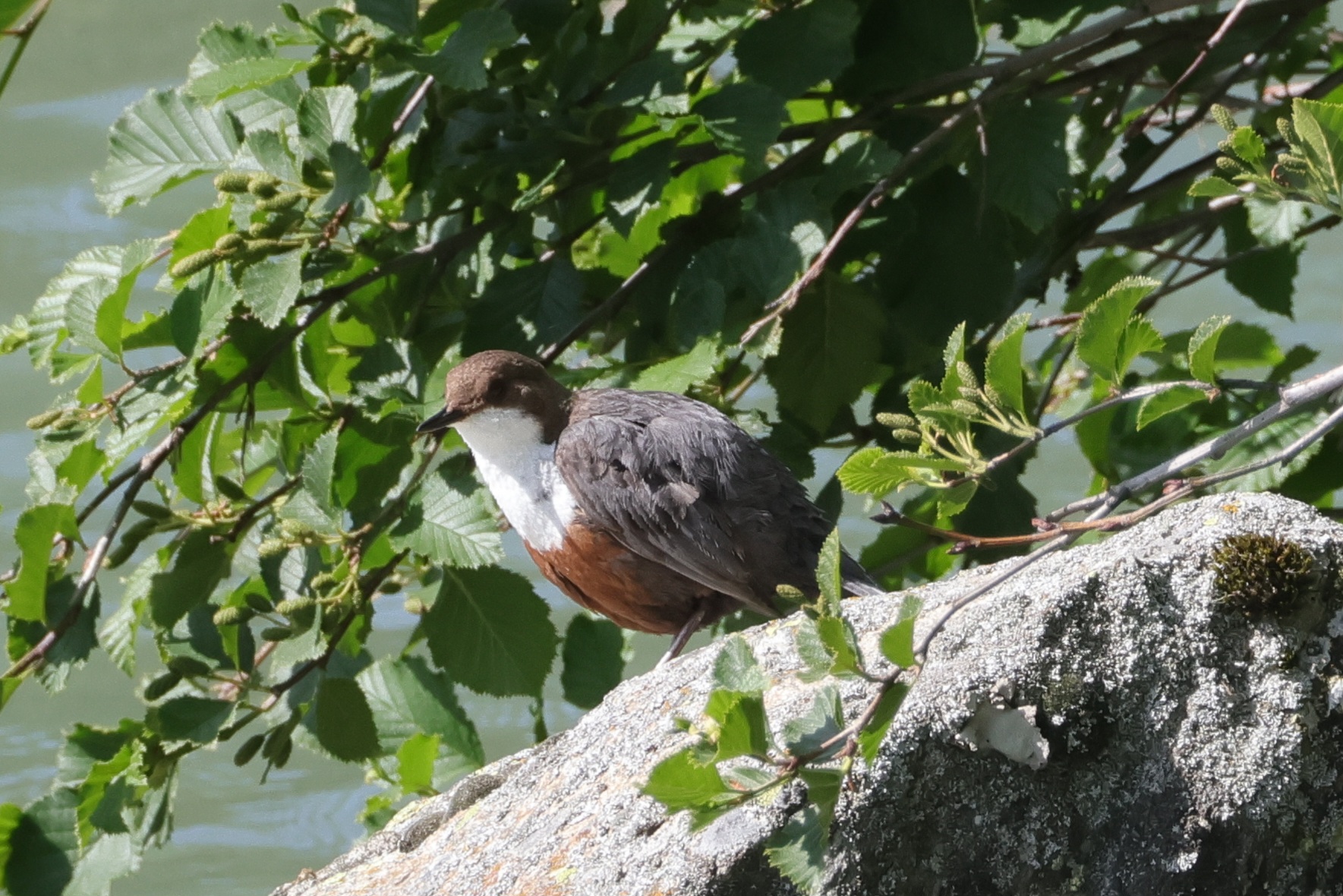
Wasseramsel in Andermatt. 2025-06-14 10:07:13 Andermatt
Zuerst beobachtet in 🇨🇭 an 2024-04-27.
Beschreibung
Allgemein: I saw a bird in Meride, Ticino in October 2020 on a tree limb that showed three bands of strong colors that I recall as black, white and red-brown. Unfortunately I discovered that my camera battery was dead, so I can only rely on a very shaky memory. I've speculatively identified it as a White-throated Dipper (German Wasseramsel), which are present in that area, though are most expected at water (there's a river nearby though). At least I'll have this bird on my radar now.Allgemein: Expected near rivers and streams.
Allgemein: Deutschland: Brut-, Jahresvogel, Wintergast
Saisonales Verhalten
Jahresvogel Brut: 02-20 - 07-20 Migration rein: 02-01 - 04-01 Migration raus: 07-10 - 10-27Weitere Infos at Vogelwarte.ch
Weitere Infos
Physikalische Details
Körperlich: Länge=18 cm, Flügelspanne=25-30 cm, Gewicht=49-84 gHabitate: Nassgebiet
Vokalisierung
Gesang: Wonderfully weird sequence of chirps, cheeps, growls. Elements often repeated twice. In a quiz, I mistook it for a starling. This recording reminds me of other water songbirds like the Marsh warbler and various reed warblers. Gesang:Song a mid tempo, staccato improvisation on contact call-like sounds. Not unlike a budgerigar. Both sexes sing, the female less melodic and more staccato than the male. [Link]
Gesang Eigenschaften:
Melody: improvisiert melodisch, schnell, Frequency: 1-7 KHz Special sounds: Raspel, komisch
Rufe:
Contact call a short, metallic and explosive "zrreet", often betraying its presence perched among boulders or when flying up and down a stream. [Link]
Chirp repeated 1-2s.
XC883371 - White-throated Dipper - Cinclus cinclus - squeaky, rhythmic call.
♫ Quelle: XENOCANTO XC883371 - White-throated Dipper - Cinclus cinclus - squeaky, rhythmic call.mp3 (Ruf)
Ruf Eigenschaften: Ruf Melodie: einnotig, langsam, Frequenz: 4-7 KHz,
Vollprofil
Kiebitz / Northern lapwing (Vanellus vanellus)
Profil Wikipedia Vogelwarte BirdLife ZH ornitho.ch bird-song.ch Xeno-Canto NABU YouTube
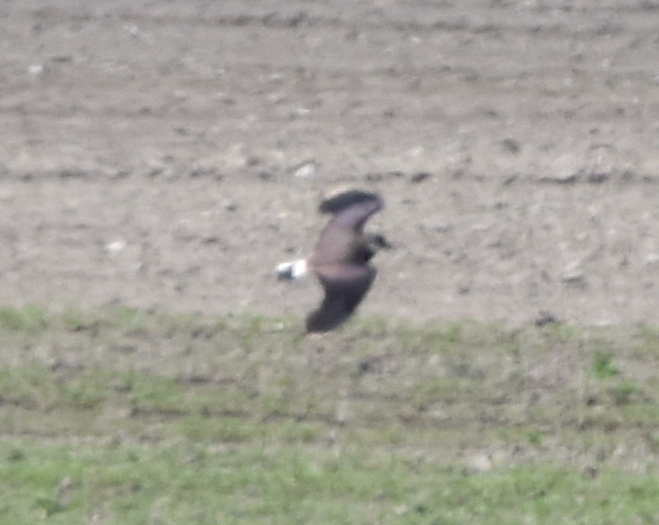
Kiebitz im Flug, Wauwilermoos. 2022-06-22 15:07:12 Wauwilermoos
Zuerst beobachtet in 🇨🇭 an 2021-02-24.
Beschreibung
Allgemein: Deutschland: Brut-, Zugvogel RL 2Etymologie:
The name lapwing has been variously attributed to the "lapping" sound its wings make in flight, from the irregular progress in flight due to its large wings (the Oxford English Dictionary derives this from an Old English word meaning "to totter"),[4] or from its habit of drawing potential predators away from its nest by trailing a wing as if broken. [Link]
The names peewit, pewit, tuit or tew-it are onomatopoeic and refer to the bird's characteristic call. [Link]
Vokalisierung:
Quite vocal, especially in flight at breeding ground. [Link]
Saisonales Verhalten
Jahresvogel Brut: 03-12 - 06-29 Migration rein: 05-01 - 06-29 Migration raus: 02-01 - 04-11Weitere Infos at Vogelwarte.ch
Weitere Infos
Physikalische Details
Körperlich: Länge=28-31 cm, Flügelspanne=82-87 cm, Gewicht=140-320 gHabitate: Nassgebiet
Vokalisierung
Gesang: No details but a Xeno-Canto recording. Gesang Eigenschaften: Frequency:♫ 2025-05-16 19:34:00 Schweiz (Gesang)
Rufe:
Ruf ist entweder mhhhh oder Bogen-artiges hoch und runter. [Link]
Territorial call: Dry, introductory phrases followed by drawn-out mewing sounds; "wyrrr-peeeoo-weeep". Alarm call "pee-wit". [Link]
No details but a Xeno-Canto recording.
XC801017 - Northern Lapwing - Vanellus vanellus - bizarre-sounding call.
♫ Quelle: XENOCANTO XC801017 - Northern Lapwing - Vanellus vanellus - bizarre-sounding call.mp3 (Ruf)

Ruf Eigenschaften: Gesang Frequenz: ,
Vollprofil
Flussregenpfeifer / Little ringed plover (Charadrius dubius)
Profil Wikipedia Vogelwarte BirdLife ZH ornitho.ch Xeno-Canto NABU YouTube

Stelzenläufer mit kleinem Flussregenpfeifer. 2022-04-12 14:25:34
Zuerst beobachtet in Mallorca an 2022-04-10.
Beschreibung
Allgemein: Deutschland: Brut-, ZugvogelVokalisierung:
Quite different from Ringed Plover. Sharper sounding, lacking Ringed's soft tone. Often starts with a rolling "r". [Link]
Saisonales Verhalten
Präsenz: 03-01 - 10-18 Brut: 04-20 - 07-20 Migration rein: 03-01 - 05-31 Migration raus: 06-29 - 10-18Weitere Infos at Vogelwarte.ch
Weitere Infos
Physikalische Details
Körperlich: Länge=14-15 cm, Flügelspanne=42-48 cm, Gewicht=32-48 gHabitate: Nassgebiet
Vokalisierung
Gesang: No details but a Xeno-Canto recording. Gesang Eigenschaften: Frequency:♫ 2022-04-10 11:10:23 Quelle: BirdNet 20220410_111023 birdnet - Flussregenpfeifer - Flussregenpfeifer - Felanitx.mp3 (Gesang)
Vollprofil
Kampfläufer / Ruff (Calidris pugnax)

MerlinBirdId sagt, das mit dem rotbraunen Rücken mit vielen Punkten war ein Kampfläufer - in dem Fall meine erste Besichtigung - und der dunkle wo wir nur den Arschsehen wären Dunkelwasserläufer - auf dem Klingnauerstausee. 2024-08-24 18:17:54 Klingnauer Stausee
Zuerst beobachtet in 🇨🇭 an 2024-08-24.
Beschreibung
Geographie: Dieser Vogel erscheint jenseits grossen Meere in Kontinenten : Europa, Nordamerika, Südamerika, Afrika, Asien.Allgemein: Deutschland: Brut-, Zugvogel RL 1
Etymologie: Nabu: Der Name leitet sich vom Balzverhalten der Männchen ab: In Balzarenen tragen sie „Turniere“ aus, um die Weibchen zu beeindrucken, dabei herrscht eine komplizierte Rollenverteilung. [Link]
Vokalisierung:
Generally silent. Short, muted, nasal, mono or disyllabic grunts sometimes heard. [Link]
Saisonales Verhalten
Präsenz: 02-20 - 11-06 Migration rein: 05-21 - 05-31 Migration raus: 05-21 - 05-28Weitere Infos at Vogelwarte.ch
Weitere Infos
Physikalische Details
Körperlich: Länge=26-30 cm, Flügelspanne=54-58 cm, Gewicht=75-230 gHabitate: Nassgebiet Vollprofil
Bekassine / Common snipe (Gallinago gallinago)

Wahrscheinlich Bekassine mit dem langen Schnabel, Klingnauerstausee. 2022-02-05 11:54:14 Klingnauer Stausee
Zuerst beobachtet in 🇨🇭 an 2021-10-24.
Beschreibung
Geographie: Dieser Vogel erscheint jenseits grossen Meere in Kontinenten : Europa, Nordamerika, Afrika, Asien.Allgemein:
Die Bekassine (Gallinago gallinago) ist eine sehr langschnäbelige, mittelgroße Art aus der Familie der Schnepfenvögel. Sie ist über große Teile der Paläarktis verbreitet und überwintert überwiegend in den Subtropen und Tropen der Alten Welt. Sie besiedelt zur Brutzeit Moore, Feuchtgrünland und Wiesen; zur Zugzeit ist sie wie die meisten Watvögel auf schlammigen Flächen an Binnengewässern und Küsten zu finden. Charakteristisch ist der Balzflug, bei dem der Vogel sich aus großer Höhe senkrecht herabfallen lässt und mit abgespreizten, äußeren Steuerfedern ein „wummerndes“ Geräusch erzeugt.
[mehr]
Deutschland: Brut-, Zugvogel, Wintergast RL 1
Vokalisierung:
Quite vocal, especially at breeding ground. [Link]
Saisonales Verhalten
Jahresvogel Migration rein: 01-01 - 05-21 Migration raus: 07-20 - 12-31Weitere Infos at Vogelwarte.ch
Weitere Infos
Physikalische Details
Körperlich: Länge=25-27 cm, Flügelspanne=44-47 cm, Gewicht=80-140 gHabitate: Nassgebiet
Vokalisierung
Gesang: No details but a Xeno-Canto recording. Gesang:Song an unmistakable bleating, drumming sound produced by vibrating tail feathers in sky-dives. [Link]
Gesang Eigenschaften:
Frequency:
♫ Quelle: XENOCANTO XC812599 - Common Snipe song, one note, 4x per sec - Gallinago gallinago.mp3 (Gesang)

Rufe:
Almost always give diagnostic hoarse and nasal "kaaat" call when flushed. Another territorial call is a rhythmic, mechanical and sharp "tika-tika-tka", or "ika-ka-ka". [Link]
XC947581 - Common Snipe flight call - Gallinago gallinago.
♫ Quelle: XENOCANTO XC947581 - Common Snipe flight call - Gallinago gallinago.mp3 (Flugruf)

Ruf Eigenschaften: Flugruf Ruf Melodie: einnotig, langsam, Frequenz: medium (1-5 KHz), Spezielle Klänge: quaken.
Vollprofil
Bruchwasserläufer / Wood sandpiper (Tringa glareola)
Profil Wikipedia Vogelwarte BirdLife ZH ornitho.ch Audubon AllAboutBirds Xeno-Canto BirdID NABU YouTube

Bruchwasserläufer. 2024-08-24 18:24:00 Klingnauer Stausee
Zuerst beobachtet in 🇨🇭 an 2021-08-19.
Beschreibung
Geographie: Dieser Vogel erscheint jenseits grossen Meere in Kontinenten : Europa, Nordamerika, Afrika, Asien.Allgemein: Deutschland: ehemaliger Brutvogel, Zugvogel RL 1
Vokalisierung:
Totally different from Green Sandpiper. [Link]
Weitere Infos
Physikalische Details
Körperlich: Länge=19-21 cm, Flügelspanne=56-57 cm, Gewicht=50-80 gHabitate: Nassgebiet
Vokalisierung
Gesang: No details but a Xeno-Canto recording. Gesang Eigenschaften: Frequency:♫ 2021-08-19 08:26:04 Quelle: BirdNet 20210819_082604 birdnet 1940 - Wood Sandpiper, saw a bird flying, check reports in Ornitho - Wood Sandpiper - Uznach.mp3 Uznach (Gesang)
Vollprofil
Grünschenkel / Common greenshank (Tringa nebularia)
Profil Wikipedia Vogelwarte BirdLife ZH ornitho.ch Audubon AllAboutBirds Xeno-Canto BirdID NABU YouTube

MerlinBirdID says common greenshank, probably non-breeding adult. 2022-04-12 14:52:08
Zuerst beobachtet in Mallorca an 2022-04-12.
Beschreibung
Geographie: Dieser Vogel erscheint jenseits grossen Meere in Kontinenten : Europa, Nordamerika, Afrika, Asien.Allgemein: Deutschland: ausnahmsweise Brutvogel, Zugvogel
Vokalisierung:
Most heard is a characteristic, trisyllabic "tew-tew-tew" (sometimes two or four syllables). Can resemble redshank, but pitch more stable, and not falling notably. Each syllable is clearly separated and equally emphasized. [Link]
Weitere Infos
Physikalische Details
Körperlich: Länge=30-33 cm, Flügelspanne=68-70 cm, Gewicht=130-270 gHabitate: Nassgebiet Vollprofil
Familie Burhinidae (Triele, Haematopodidae – Austernfischer und Recurvirostridae – Säbelschnäblerverwandte):
Stelzenläufer / Black-winged stilt (Himantopus himantopus)
Profil Wikipedia Vogelwarte BirdLife ZH ornitho.ch Xeno-Canto BirdID NABU YouTube
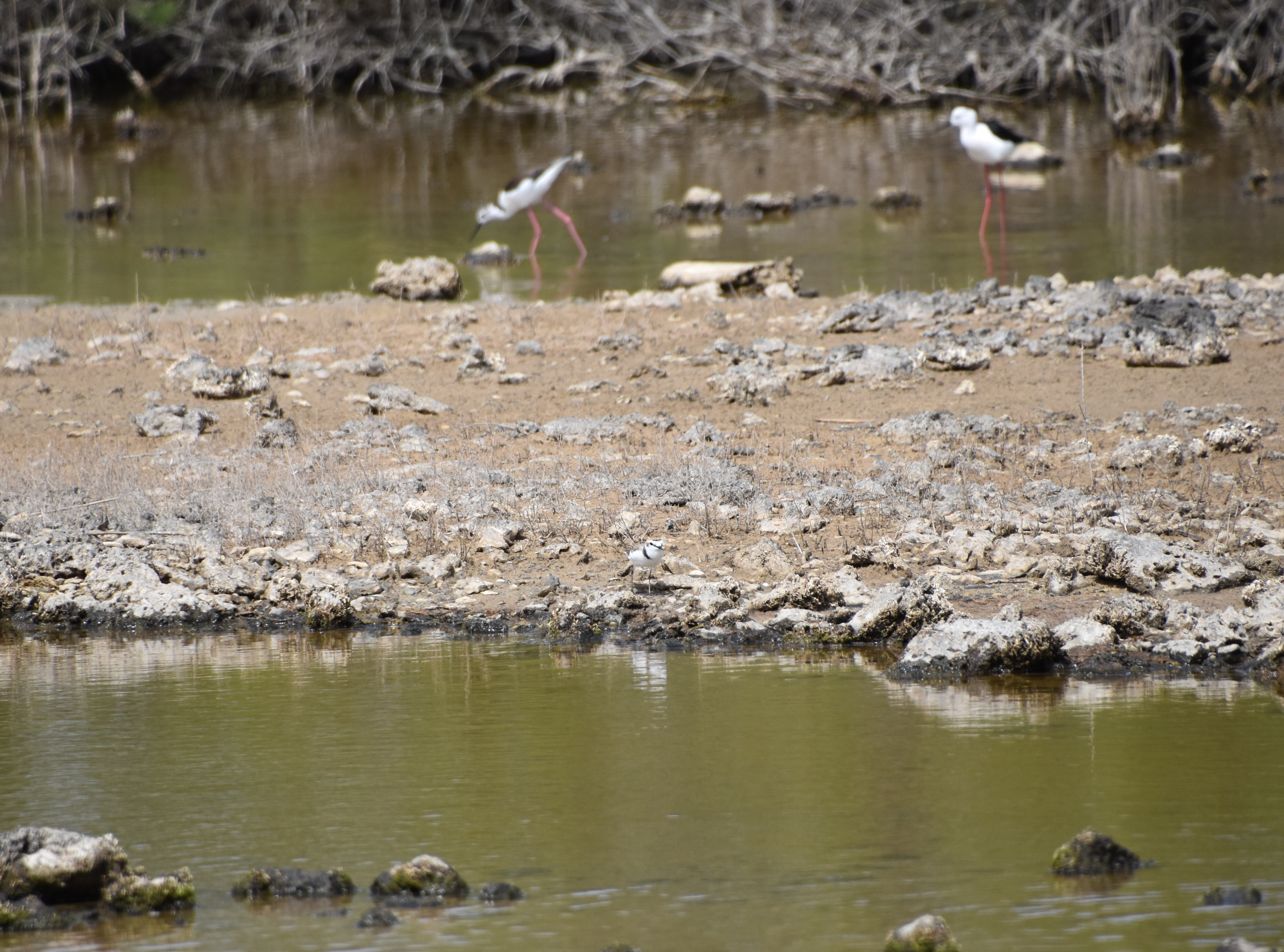
Es ist lang gegangen bis ich den Regenflusspfeifer vor den Stelzenläufern gesehen habe. 2022-04-12 13:59:42
Zuerst beobachtet in Morocco an 2019-11-22.
Beschreibung
Allgemein: Deutschland: ausnahmsweise Brutvogel, seltener ZugvogelVokalisierung:
Most vocal at breeding ground. Various short,sharp "kyp" may resemble both Avocet, Coot and Spur-winged Lapwing (Vanellus spinosus). While a tern-like "kee-arr" is more distinct. [Link]
Saisonales Verhalten
Präsenz: 04-11 - 08-18 Migration rein: 05-21 - 05-28 Migration raus: 07-10 - 08-18Weitere Infos at Vogelwarte.ch
Weitere Infos
Physikalische Details
Körperlich: Länge=35-40 cm, Flügelspanne=0 cm, Gewicht=150-210 gHabitate: Nassgebiet
Vokalisierung
Rufe:Note that immature birds have a different contact call closely resembling Wood Sandpiper, but do not utter it in series. [Link]
No details but a Xeno-Canto recording.
XC863470 - Black-winged Stilt - Himantopus himantopus - flight call, a squeaky yapping - Camargue, France.
♫ Quelle: XENOCANTO XC863470 - Black-winged Stilt - Himantopus himantopus - flight call, a squeaky yapping - Camargue, France.mp3 Camargue (Flugruf)

Ruf Eigenschaften: Flugruf Frequenz: ,
Vollprofil
Wasserralle / Water rail (Rallus aquaticus)

Irgendwo etwa 3m weg, gab's eine Wasserralle, immer noch nicht gesehen. 2025-10-31 15:14:35 Wildert
Zuerst beobachtet in 🇨🇭 an 2021-02-15.
Beschreibung
Allgemein: Im Schilf an einem See.Allgemein: Deutschland: Brut-, Jahres-, Zugvogel, Wintergast RL V
Aussehen und Identifizierung:
Die Wasserralle hat einen kurzen Schwanz und einen leicht nach unten gebogenen, rötlichen Schnabel. Kopfseiten, Kehle, Hals und Brust sind schiefergrau bis graublau. Die Augen sind rötlich und die mittellangen Beine mit den recht langen Zehen sind fleischfarbig gefärbt. Das Gefieder am Bauch, an der Brust und im Gesicht ist hellblau. Der Rücken ist dunkelbraun mit schwarzen Streifen gekennzeichnet. An den Seiten ist eine schwarz-weiße Musterung zu finden. Männchen und Weibchen haben die gleiche Färbung.
[Link]
Verhalten:
 Shy but generally not uncommon, this reclusive marsh bird is more often heard than seen: listen for its varied piglike squeals and grunts coming from dense vegetation. Favors fresh marshes and ponds with taller vegetation, especially reeds and rushes [Link]
Vokalisierung:
Varied but distinct. [Link]
Saisonales Verhalten
Jahresvogel Brut: 04-20 - 07-29 Migration rein: 02-20 - 05-10 Migration raus: 07-29 - 11-15Weitere Infos at Vogelwarte.ch
Weitere Infos
Physikalische Details
Körperlich: Länge=23-28 cm, Flügelspanne=38-45 cm, Gewicht=80-180 gHabitate: Nassgebiet
Vokalisierung
Gesang: No details but a Xeno-Canto recording. Gesang:Most heard is the territorial song consisting of short, nasal, sharp grunts "tuck- tuck-tuck", ending with a drawn-out trill rising and falling in pitch "kiiiieeerrrr". [Link]
Gesang Eigenschaften:
Frequency:
♫ Quelle: XENOCANTO XC943956 - Water Rail - Rallus aquaticus - squeaky call.mp3 (Ruf)

Rufe:
Another diagnostic call is heard from excited birds; a longer pig-like shrilling squeal, with waning repetitions. A bit like someone squeezing a rubber toy. Also short and sharp calls "kvii". [Link]
Alle sagen, sie klingen wie Schweine!
Ruf Eigenschaften: Ruf Melodie: einnotig, langsam, Frequenz: medium (1-5 KHz), Spezielle Klänge: komisch.
Vollprofil
Teichhuhn / Common moorhen (Gallinula chloropus)

Teichhuhn am Greifensee. 2022-01-27 14:06:40 Greifensee
Zuerst beobachtet in 🇨🇭 an 2021-02-12.
Beschreibung
Geographie: Dieser Vogel erscheint jenseits grossen Meere in Kontinenten : Europa, Nordamerika, Afrika, Asien.Allgemein: Gesehen auf dem Weg am Pfäffikersee nahe Wetzikon, als einer vom Schilf zu Schilf gelaufen ist. Später hat eine Praktikantin vom Naturzentrum dies als Teichhuhn identifiziert. Da unser Vogel den farbigen Schnabel nicht hatte, hat sie gemeint, es war wahrscheinlich ein Jungvogel. Ich hätte gesagt, die Beine waren kürzer, aber der Teichhuhn hat auf jeden Fall auch der kurze aufrecht gehaltene Schwanz den wir gesehen haben.
Allgemein: Deutschland: Brut-, Jahres-, Zugvogel, Wintergast RL V
Habitat:
Teichhühner nisten am liebsten im Dickicht am Rand von Teichen, Seen oder Flüssen und verraten sich meist nur durch ihre gutturalen Rufe. Im Winter sind sie leichter zu beobachten, da sie ihren deckungsreichen Lebensraum verlassen und auf Wiesen, in Parks oder an offenen Gewässern erscheinen. [Link]
Saisonales Verhalten
Jahresvogel Brut: 04-20 - 08-09 Migration rein: 03-01 - 05-01 Migration raus: 09-07 - 12-16Weitere Infos at Vogelwarte.ch
Weitere Infos
Physikalische Details
Körperlich: Länge=32-35 cm, Flügelspanne=50-55 cm, Gewicht=240-420 gHabitate: Nassgebiet
Vokalisierung
Gesang: No details but a Xeno-Canto recording. Gesang:Most typical is the territorial call (song); a sharp, loud and resonant "krrrr-ook" or "krrrk". [Link]
Gesang Eigenschaften:
Frequency:
♫ Quelle: XENOCANTO XC946631 - Common Moorhen call, like a quack - Gallinula chloropus.mp3 (Ruf)

Rufe:
Rich repertoire of loud calls and softer sounds. Other calls; a sharp, three or four-syllable "kekeke", and a soft "wep" sometimes drawn-out in a more mewing version. [Link]
Ruf Eigenschaften: Ruf Melodie: einnotig, langsam, Frequenz: medium (1-5 KHz), Spezielle Klänge: quaken.
Vollprofil
Tüpfelsumpfhuhn / Spotted crake (Porzana porzana)
Profil Wikipedia Vogelwarte BirdLife ZH ornitho.ch Xeno-Canto BirdID NABU YouTube

Wikipedia: Spotted crake Quelle: WIKIPEDIA
Porzana_porzana_6_%28Marek_Szczepanek%29.jpg
🔍
Never observed (yet!)
Beschreibung
Allgemein: Deutschland: Brut-, Zugvogel RL 1Saisonales Verhalten
Präsenz: 03-23 - 10-27 Brut: 05-10 - 08-09 Migration rein: 07-22 - 07-29 Migration raus: 07-29 - 09-28Weitere Infos at Vogelwarte.ch
Weitere Infos
Physikalische Details
Körperlich: Länge=22-24 cm, Flügelspanne=37-42 cm, Gewicht=70-110 gHabitate: Nassgebiet Vollprofil

Weissstorch auf dem Feld bei Mesikon, mit Canon EOS R7 + 20-240mm zoom fotografiert. 2024-05-04 14:54:34 Mesikon
Zuerst beobachtet in Morocco an 2016-03-27.
Beschreibung
Allgemein: New as frequent visitor in Fehraltorf area in the 2010's. It actually died out in Switzerland in the 1950's, but has reestablished itself.Allgemein: Either in the fields looking for food, or on a high output like a lamppost (the soccer field has especially high ones) or the chimneys at the RAV/Electrosuisse building or occasinally a rooftop.
Allgemein: Deutschland: Brut-, Zugvogel, seltener Jahresvogel RL 3
Vokalisierung:
Mostly silent. Loud, modulated bill-clattering from both sexes is heard during courtship/display. [Link]
Saisonales Verhalten
Jahresvogel Brut: 03-12 - 07-29 Migration rein: 02-20 - 06-09 Migration raus: 07-10 - 10-18Weitere Infos at Vogelwarte.ch
Weitere Infos
Physikalische Details
Körperlich: Länge=100-115 cm, Flügelspanne=155-165 cm, Gewicht=2275-4400 gHabitate: Nassgebiet
Vokalisierung
Gesang: Das berühmte Klappern. Im FOK-Kurs hat man erwähnt, dass dies ein Beispiel von einem 'Instrumentallaut' ist. Gesang Eigenschaften: Melody: nicht musikalisch, langsam, Frequency: low (1-3 KHz) Special sounds: rasselnNo details but a Xeno-Canto recording.
XC878183 - White Stork - Ciconia ciconia ciconia - call, auf Deutsch Klappern.
♫ Quelle: XENOCANTO XC878183 - White Stork - Ciconia ciconia ciconia - call, auf Deutsch Klappern.mp3 (Ruf)

Ruf Eigenschaften: Gesang Frequenz: ,
Vollprofil
Profil Wikipedia Vogelwarte BirdLife ZH ornitho.ch Xeno-Canto BirdID NABU YouTube

Schwarzstorch zum ersten Mal gesehen bei Degersheim! 2024-04-27 10:50:00 Schachen, Tobel Wissbach till Degersheim
Zuerst beobachtet in 🇨🇭 an 2024-04-27.
Beschreibung
Allgemein: Deutschland: Brut-, Zugvogel RL 3Vokalisierung:
Thin, disyllabic "ahhh-li" heard at nest and when courting. One syllable sounds like gasping intake of air, the other is a thin, piping sound. A bit like a cheap, manual, air-mattress pump. Bill-clattering used by juveniles in alarm. [Link]
Saisonales Verhalten
Präsenz: 03-12 - 10-27 Migration rein: 03-12 - 06-09 Migration raus: 07-20 - 10-27Weitere Infos at Vogelwarte.ch
Weitere Infos
Physikalische Details
Körperlich: Länge=95-100 cm, Flügelspanne=145-155 cm, Gewicht=3000 gHabitate: Nassgebiet Vollprofil

Endlich wieder ein Eisvogel gesehen. 2024-08-17 08:53:53 Greater Fehraltorf
Zuerst beobachtet in 🇨🇭 an 2020-10-08.
Beschreibung
Allgemein: Dies ist ein beliebter Vogel, weil es einerseits sehr bunt und aktiv ist, anderseits relativ selten - vergleiche die 400-500 Brutpaare mit 400'000-550'000 bei den KohlmeisenAllgemein: An apprentice for the nature center on Lake Pfäffikon told us a bit about the kingfishers that hunt on a waterway that feeds into the lake. She said they spend the breeding season elsewhere in sandy areas and return to the lake in fall. I've read elsewhere that they watch for fish from convenient waterside branches. A classic motif for a picture is a branch sticking out of the water, and one photographer said he has actually placed a branch there, knowing the kingfisher would not be able to resist.
Allgemein: Deutschland: Brut-, Jahres-, Zugvogel, Wintergast
Etymologie: Nabu: Ob der Name des Eisvogels (Alcedo atthis) tatsächlich mit Eis zu tun hat oder das eisblaue Rückengefieder Pate stand, ist strittig. Manche Deutungen leiten den Namen vom althochdeutschen „eisan“ für „schillern“ oder „glänzen“ ab. Der „Schillervogel“ wäre eine gute Beschreibung für das flirrende Farbenspiel, das der Eisvogel im Sitzen und erst recht im Flug bietet. Wieder andere Autoren interpretieren den „Eisvogel“ als „Eisenvogel“ und vermuten einen Bezug auf das stahlblaue Rücken- oder das rostfarbene Bauchgefieder des Eisvogels. [Link]
Saisonal:
Status (in CH): regelmässiger, spärlicher Brutvogel, Durchzügler und Wintergast. [Link]
Saisonales Verhalten
Jahresvogel Brut: 04-01 - 08-09Weitere Infos at Vogelwarte.ch
Weitere Infos
Physikalische Details
Körperlich: Länge=16-17 cm, Flügelspanne=24-26 cm, Gewicht=34-46 gHabitate: Nassgebiet
Vokalisierung
Gesang: No details but a Xeno-Canto recording. Gesang Eigenschaften: Frequency:♫ Quelle: XENOCANTO XC839045 - Common Kingfisher - Alcedo atthis - song - Viana do Castelo, Portugal.mp3 (Gesang)

Rufe:
Wikipedia says 'The common kingfisher has no song.
The flight call is a short, sharp whistle chee repeated two or three times. Anxious birds emit a harsh, shrit-it-it and nestlings call for food with a churring noise.'
The NABU app only has calls,
which seems to confirm this. Therefore I'm classifying all recordings as calls,
even though some say Song at Xeno-Canto. [Link]
Most heard is the thin and penetrating contact call: A short "tzee", or disyllabic "tzee-tzu", with a ringing metallic quality. In excitement it is often alternated with ringing trills "tzeerrrrrrrrrr". [Link]
Common kingfisher call from Xeno-Canto, similar to one from NABU app. Fairly high pitched single chirps or occasional high-low pairs.
♫ Quelle: XENOCANTO XC511677 Common kingfisher call similar to one from NABU app.mp3 (Ruf)

Ruf Eigenschaften: Ruf Melodie: einnotig, langsam, Frequenz: 5-7 KHz,
Vollprofil