Vögel zu suchen in Engdain neben dem festival da jazz
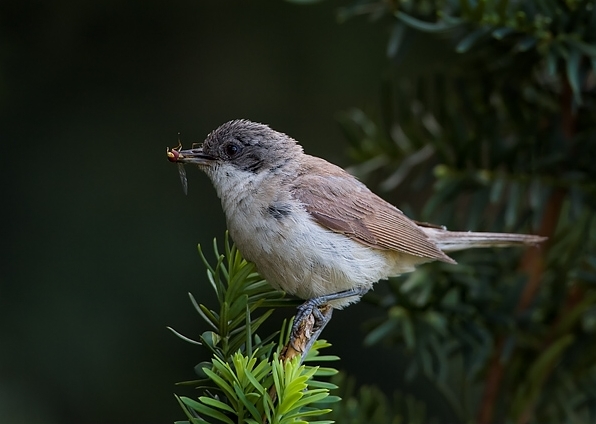
Wikipedia: Lesser whitethroat Quelle: WIKIPEDIA
Sylvia_curruca_1_%28Martin_Mecnarowski%29.jpg
Zuerst beobachtet in 🇨🇭 an 2023-05-27.
Beschreibung
Allgemein: Wollte diese in Klettgau suchen 2023, bin darüber gestolpert bei Bad Vilbel, Deutschland.Allgemein: Deutschland: Brut-, Zugvogel
Saisonal:
 Nach ihrer Ankunft im April oder Mai verrät sich diese rastlose und geschickt durch das Geäst hüpfende Grasmücke am ehesten durch ihren Gesang. Das eintönige Klappern ist weithin hörbar und hat ihr den deutschen Artnamen eingebracht. Das Männchen versucht, ein im Revier erscheinendes Weibchen durch Vorausfliegen zu einem Wahlnest zu locken. [Link]
Saisonales Verhalten
Präsenz: 04-01 - 10-07 Brut: 05-21 - 08-09 Migration rein: 04-01 - 05-31 Migration raus: 07-29 - 10-07Weitere Infos at Vogelwarte.ch
Weitere Infos
Physikalische Details
Körperlich: Länge=12-13 cm, Flügelspanne=16-20 cm, Gewicht=10-14 gHabitate: Landwirtschaft
Vokalisierung
Gesang: Song typically consists of two parts. An indistinct chattering and warbling, subsong-like part similar to [common] Whitethroat, which is usually followed by a dry, fast and rattling trill. The trill carries much further than the chattering part. May be difficult to identify if trill is omitted. [Link]
Gesang:
Song typically consists of two parts. An indistinct chattering and warbling, subsong-like part similar to [common] Whitethroat, which is usually followed by a dry, fast and rattling trill. The trill carries much further than the chattering part. May be difficult to identify if trill is omitted. [Link]
Gesang:  Klappernd. (Müllerchen) An Berglaubsänger erinnernd. Klappertöne (5-8) Aber oft mit leisem schwatzendem Vorgesang, der fehlen kann. Kann auch an Sumpfmeise erinnern, doch sind bei dieser die Klappertöne mehr von oben her angeschlagen.
[Link]
Song typically consists of two parts. An indistinct chattering and warbling, subsong-like part similar to Whitethroat, which is usually followed by a dry, fast and rattling trill. The trill carries much further than the chattering part. May be difficult to identify if trill is omitted. [Link]
Gesang Eigenschaften:
Melody: einfach rhythmisch, langsam, Frequency: 3-5 KHz Special sounds: Triller
Klappernd. (Müllerchen) An Berglaubsänger erinnernd. Klappertöne (5-8) Aber oft mit leisem schwatzendem Vorgesang, der fehlen kann. Kann auch an Sumpfmeise erinnern, doch sind bei dieser die Klappertöne mehr von oben her angeschlagen.
[Link]
Song typically consists of two parts. An indistinct chattering and warbling, subsong-like part similar to Whitethroat, which is usually followed by a dry, fast and rattling trill. The trill carries much further than the chattering part. May be difficult to identify if trill is omitted. [Link]
Gesang Eigenschaften:
Melody: einfach rhythmisch, langsam, Frequency: 3-5 KHz Special sounds: Triller
♫ Quelle: XENOCANTO XC652419 - Lesser Whitethroat - Sylvia curruca - song.mp3 (Gesang)

Rufe:
„tze“ oder „tett“
[Link]
Warning call a hard "check" similar to Blackcap but slightly softer. [Link]
BirdID says: Warning call a hard "check" similar to Blackcap but slightly softer
♫ Quelle: OTHER 575779 (Ruf)
Ruf Eigenschaften: Ruf Melodie: einnotig, langsam, Frequenz: 2-7 KHz, Spezielle Klänge: stottern/kieseln.
Vollprofil

6 von einige weitere Felsenschwalben in Verona. 2025-09-22 13:04:32 Quelle: OTHER
20250922_130432 6 von einige weitere Felsenschwalben in Verona.jpg
Verona
Zuerst beobachtet in Verona an 2025-09-22.
Beschreibung
Allgemein: Deutschland: Brut-, Zugvogel RL RVokalisierung:
Most heard is a House Martin-like, but less rolling, "prit" or "check". Other contact sounds include a plaintive "peeuuu". [Link]
Saisonales Verhalten
Jahresvogel Brut: 05-10 - 09-28 Migration rein: 02-10 - 04-20 Migration raus: 08-29 - 11-06Weitere Infos at Vogelwarte.ch
Weitere Infos
Physikalische Details
Körperlich: Länge=14 cm, Flügelspanne=32-34 cm, Gewicht=17-30 gHabitate: Berg Vollprofil

Feldlerche auf einer Sonnenblume, Neunkirch. 2023-07-16 10:19:38 Neunkirch, Schaffhausen
Zuerst beobachtet in 🇨🇭 an 2022-06-25.
Beschreibung
Geographie: Dieser Vogel erscheint jenseits grossen Meere in Kontinenten : Europa, Nordamerika (introduced), Afrika, Australien.Allgemein: Deutschland: Brut-, Jahres-, Zugvogel, Wintergast RL 3
Gut zu wissen:
Aus dem Kurzjahresbericht BirdLife Schweiz 2022: Die Feldlerche, Vogel des Jahres 2022..., ist eihne dieser bredrohten Arten, welche durch die Industrialisierung der Landwirtschaft ausgerottet wird. [Link]
Aussehen und Identifizierung:
 Somewhat like a house sparrow but 18-19 cm long, not 14-15, kleiner als Star. Ruffled head feathers. NABU says streaks on breast contrast with white belly. [Link]
Geographie:
 Introduced population in North America is gradually declining. [Link]
Habitat: Stark gefährdet durch Verlust von geeignetem Lebensraum. Eine Massnahme ist die Erstellung von Lerchenfenstern auf den Feldern - eine kleine Fläche mitten im Feld, die nicht bepflanzt oder gemäht wird. So was sieht man bei uns, z.B. zwischen Freudwil und Gutenswil, wobei ich nicht genau weiss, ob Feldlerchen das Ziel davon sind. Die Infos habe ich vom FOK Kurs 2021-2022 von Christina Ebneter.
Saisonales Verhalten
Jahresvogel Brut: 04-11 - 08-18 Migration rein: 02-01 - 04-01 Migration raus: 09-17 - 11-15Weitere Infos at Vogelwarte.ch
Weitere Infos
Physikalische Details
Körperlich: Länge=18-19 cm, Flügelspanne=30-36 cm, Gewicht=26-50 gHabitate: Landwirtschaft
Vokalisierung
Gesang: Fast chirpy improvization without a break, not very high, reminds me of a nightingale or a Eurasian reed warbler/Teichrohrsänger with the exact rhythm, but most likely sung in a cornfield. Or a Singdrossel that repeats its elements longer that that guy. Repeats elements 1-8 times. Sometimes buzzy/trilly. Can go on for minutes at a time. Ich habe es auch mit einem Amsel verwechselt, da er lang und melodisch, fast wie Amsel aber hört nicht auf. Gesang:Song a pleasing energetic stream of chirping, merry trills, interspersed with mimicry. Trills quite resonant with fairly full tone. Song usually given in flight high in the air. Less characteristic, shorter, weaker and more varied song when given from ground. [Link]
Gesang Eigenschaften:
Melody: singt 20 Sekunden oder länger, langsam, Frequency: 2-6 KHz Special sounds: Mimikry
♫ Quelle: XENOCANTO XC685846 - Eurasian Skylark - Alauda arvensis - song, recorded in France.mp3 (Gesang)

Rufe:
Most typical flight call a short trilling "chirrup", with the end note noticeably lower pitched than the start. Also several other more cryptic calls. [Link]
This quickly-written call archetype may need review/enhancement.
♫ Quelle: XENOCANTO XC772869 - Eurasian Skylark - Alauda arvensis - flight call.mp3 (Flugruf)
 XC772869 - Eurasian Skylark - Alauda arvensis - flight call.
♫ Quelle: XENOCANTO XC772869 - Eurasian Skylark - Alauda arvensis - flight call.mp3 (Flugruf)
XC946652 - Eurasian Skylark one-note swooping flight call - Alauda arvensis.
♫ Quelle: XENOCANTO XC946652 - Eurasian Skylark one-note swooping flight call - Alauda arvensis.mp3 (Flugruf)

Ruf Eigenschaften: Flugruf Frequenz: ,
Vollprofil

Wikipedia: Alpine accentor Quelle: WIKIPEDIA
Prunella_collaris.jpg
🔍
Never observed (yet!)
Beschreibung
Allgemein: Die Alpenbraunelle (Prunella collaris) ist eine im Hochgebirge vorkommende Vogelart aus der Familie der Braunellen (Prunellidae). Die wissenschaftliche Artbezeichnung collaris weist auf die kräftig schwarz gefleckte Kehle hin.[1]
[mehr]
Die Alpenbraunelle (Prunella collaris) ist eine im Hochgebirge vorkommende Vogelart aus der Familie der Braunellen (Prunellidae). Die wissenschaftliche Artbezeichnung collaris weist auf die kräftig schwarz gefleckte Kehle hin.[1]
[mehr]
Deutschland: Brut-, Jahres-, Zugvogel RL R
Saisonales Verhalten
Jahresvogel Brut: 05-01 - 08-09Weitere Infos at Vogelwarte.ch
Weitere Infos
Physikalische Details
Körperlich: Länge=18 cm, Flügelspanne=30-32 cm, Gewicht=37-43 gHabitate: Berg
Vokalisierung
Gesang: Fast, long, chirpy Gesang:Song is a varied stream of melodious and chattering notes, more resembling skylark than the much higher pitched Dunnock. [Link]
Gesang Eigenschaften:
Melody: singt 20 Sekunden oder länger, schnell, Frequency: 1-8 KHz
♫ Quelle: XENOCANTO XC688398 - Alpine Accentor - Prunella collaris - long song recorded in France.mp3 (Gesang)

Vollprofil
Profil Wikipedia Vogelwarte BirdLife ZH ornitho.ch bird-song.ch Xeno-Canto BirdID NABU YouTube

Heckenbraunelle singt auf Baumspitze - nicht in der Hecke. 2024-06-25 07:33:46 Mettmenalp, GL
Zuerst beobachtet in 🇨🇭 an 2020-04-16.
Beschreibung
Allgemein: Heard at Hungerseeli and near Lendikon according to BirdNET. Finally seen near Amden 2023, Mettmenalp 2024.Allgemein: Deutschland: Brut-, Jahres-, Zugvogel, Wintergast
Saisonales Verhalten
Jahresvogel Brut: 04-20 - 08-18 Migration rein: 03-01 - 05-01 Migration raus: 08-18 - 10-27Weitere Infos at Vogelwarte.ch
Weitere Infos
Physikalische Details
Körperlich: Länge=14 cm, Flügelspanne=19-21 cm, Gewicht=16-25 gHabitate: Wald
Vokalisierung
Gesang: General: High-pitched, repetitive but complex little tune, 3 seconds long with about 15 notes rising and falling, falling at the end, then 3 second pause.Song:
Melodisch, slowly rising, roughly like black-cap warbler, which I guessed in the bird-song.ch quiz. [Link]Schnell wie ein Rotkehlchen aber nicht herunter plätschernd, hoch und runter zwischen 3 und 7 kHz. [Link]
Gesang: Singt schon im Vorfrühling. Klangfarbe ähnlich Gartenbaumläufer. Aufbau ähnlich Zaunkönig, aber ohne Triller. Viel leiser und dünner.
[Link]
Song a fast and evenly paced, high pitched stream of clear notes. No consistent phrasing. Similar in timbre to Robin, but does not vary tempo or pitch nearly as much. Often compared to the sound of a squeaky wheelbarrow. [Link]
Gesang Eigenschaften:
Melody: stereotypisch melodisch, schnell, Frequency: 4-8 KHz Singing season: 02-15 - 07-31 Dawn chorus start: 45 minutes before dawn.
Rufe:
Hohe „zi“ „tsi“. Auf dem Zug „zieht“. Etwas absinkend..
[Link]
Contact call a dry, thick trill "trrr", and a short King Fisher-like, high-pitched "zeep". [Link]
Swooping staccato call 0.5 seconds long heard near Lendikon. Repeated irregularly after 1-3.5 seconds.
XC594397 - Dunnock - Prunella modularis modularis - call recorded in Poland.
♫ Quelle: XENOCANTO XC594397 - Dunnock - Prunella modularis modularis - call recorded in Poland.mp3 (Ruf)

Ruf Eigenschaften: Ruf Melodie: einnotig, schnell, Frequenz: 5-7 KHz, Spezielle Klänge: absteigend.
Vollprofil

Eine Seltenheit - ein Birkenzeisig im Baum bei Binario 3 in Fehraltorf. 2025-12-04 12:09:03 Ich habe den Vogel weit weg im Baum bei Binario 3 gesehen, und war neugierig (wie immer) und habe mein 200-800mm Telefoto geschnappt. Ohne das hätte ich es nicht identifizieren können. Beim ersten Blick auf die Fotos habe ich gedacht, es könnte ein Sperling sein, aber sie sind meistens sehr sozial, und hier war nur ein Vogel hoch in dem Baum. Und vor allen die kleinen Streifen auf dem Bauch haben nicht gepasst. Das wäre eher ein Drossel. "Die Vogel App!" hat 18 Möglichkeit gefunden, aber ich bin nicht schlauer geworden. Dann habe ich MerlinBirdID gefragt, was im besten Foto erscheint, und es hat gesagt Birkenzeisig. Das war (weil es alphabetisch geordnet ist) die erste Art in der Vogel App Liste. Und bisher hatte ich einen nur einmal einen Birkenzeisig gesehen in Andermatt auf einem FOK3 Ausflug. Übrigens, bei ornitho.ch wird es Alpenbirkenzeisig genannt. Ich habe dort geschaut, ob andere in Kanton Zürich einen Birkenzeisig gesehen haben, und in den letzen Tagen ja in Winterthur, Chatzenseen und Wädenswil. Fehraltorf
Zuerst beobachtet in 🇨🇭 an 2025-06-14.
Beschreibung
Geographie: Dieser Vogel erscheint jenseits grossen Meere in Kontinenten : Europa, Nordamerika, Australien.Allgemein: Es gibt Streit um den Namen, vor allem ob der Alpenbirkenzeisig eine Underart oder eingene Art ist. Wikipedia sagt das erste, ornitho das zweite, usw. Ich habe das Problem für mich gelöst, indem ich die Mehrheit respektiere; wenn Alpenbirkenzeisig erwähnt wird, wird es hier as Birkenzeisig gezeigt.
Allgemein: Deutschland: Zugvogel, Wintergast
Etymologie: Nachdem ich bei uns in 2025 einen Birkenzeisig gesehen, wurde ich neugierig wegen dem Namen. Der deutsche Name kommt von westschlavischen Sprachen. Google AI fasst so zusammen: Der Name "Zeisig" stammt aus dem Westslawischen abäleitet von Wörtern wie tschechisch "čížek" oder polnisch "czyżyk" (kleiner Zeisig) und wurde im 13./14. Jahrhundert ins Deutsche entlehnt, ursprünglich als "zīse" im Mittelhochdeutschen. ... Die ursprüngliche slawische Form "čižb" (Zeisig) und die Diminutivform "čižbkb" (kleiner Zeisig) sind lautmalerischen Ursprungs und spiegeln möglicherweise den Ruf des Vogels wider ähnlich dem ukrainischen "unù Bu?" (wer seid ihr?).
Etymologie: The ‘poll’ part of the English name ‘Redpoll’ refers to a old word for ‘head’. [Link]
Aussehen und Identifizierung: roter Punkt auf Kopf, sonst weiss+braun, teilweise hell-rot auf brust.
Verhalten:
Trotz Ihrer roten Abzeichen sind die bräunlich-weiss gestreiften Vögel wenig auffällig, und wenn sie nicht gerade rufen, bleiben sie meist unentdeckt. Oft fliegen sie unvermittelt auf, drehen im Schwarm eine Runde und fallen wieder ein. [Link]
Saisonales Verhalten
Selten hier gesehen Jahresvogel Brut: 05-21 - 08-18 Migration rein: 03-01 - 05-01 Migration raus: 08-29 - 10-27Weitere Infos at Vogelwarte.ch
Weitere Infos
Physikalische Details
Körperlich: Länge=11-14 cm, Flügelspanne=20-25 cm, Gewicht=9-16 gHabitate: Berg
Vokalisierung
Gesang: A few chirps and a trill, then repeat. Gesang:Song an improvised chattering on various contact calls with no apparent phrasing. [Link]
Gesang Eigenschaften:
Melody: einfach rhythmisch, schnell, Frequency: 2-6 KHz Special sounds: Triller
Vollprofil

Fichtenkreuzschnabel. 2025-10-16 14:46:49 Engadin
Zuerst beobachtet in 🇨🇭 an 2020-06-13.
Beschreibung
Geographie: Dieser Vogel erscheint jenseits grossen Meere in Kontinenten : Europa, Nordamerika, Afrika.Allgemein: Fichten- und Tannenwälder. Manche verbringen den Winter in der Schweiz, andere sind ganzjährig hier.
Allgemein: Deutschland: Brut-, Jahres-, Zugvogel, Wintergast
Aussehen und Identifizierung:
Nabu.de: das Männchen schon von weitem durch seine ziegelrote Farbe auf. Das Weibchen dagegen ist unscheinbar graugrün gefärbt.Größe: 15 bis 17 Zentimeter
Zugtyp: Teilzieher
Beobachtungszeitraum: Oktober bis April, im Mittelgebirge und Alpenraum ganzjährig. [Link]
New research suggests that there may be as many as eight different full species of Red Crossbills on [North America]. [Link]
Verhalten:
Wikipedia: Eine Vogelart aus der Familie der Finken (Fringillidae).Das klassische Habitat stellen insbesondere während der Brutzeit Nadelwaldgebiete bis zur Baumgrenze in den Alpen dar. [Link]
Saisonales Verhalten
Jahresvogel Brut: 01-01 - 12-31 Migration rein: 01-01 - 12-31Weitere Infos at Vogelwarte.ch
Weitere Infos
Physikalische Details
Körperlich: Länge=16 cm, Flügelspanne=27-30 cm, Gewicht=35-50 gHabitate: Wald
Vokalisierung
Gesang: Repeated hi-low pattern...well, doesn't always sound like that. The very short beginning of my Stazersee recording before the static sets in does, as well as a song found online. One recording reminds me of cicada sounds. Gesang:The song consist of improvised, resonant twittering, and series of contact calls with no apparent phrases. It is generally faster, with less marked pauses than in Parrot Crossbill, and the phrasing seems more random. [Link]
Gesang Eigenschaften:
Melody: stereotypisch melodisch, langsam, Frequency: 2-10 KHz
Rufe:
Contact call similar to Parroy Crossbill's "tupp", but is on average higher and less powerful, with a "cut-off" ending. In sum: Parrot Crossbill; hard attack, soft ending, Crossbill: softer attack, cut-off ending. Beware regional variations and overlap in pitch of calls with Parrot. [Link]
No details but a Xeno-Canto recording.
- but really
OWN
Fichtenkreuzschnabel Rufe bei Bever.
♫ 2025-10-16 14:45:00 Schweiz (Ruf)
Ruf Eigenschaften: Gesang Frequenz: ,
Vollprofil
Profil Wikipedia Vogelwarte BirdLife ZH ornitho.ch Xeno-Canto NABU YouTube
 Rock bunting, Aetna.JPG)
Rock bunting, Aetna. 2025-03-01 11:17:04 Lanzarote
Zuerst beobachtet in Lanzarote an 2025-03-01.
Beschreibung
Allgemein: Das erste mal auf Lanzarote gesehen, dann bei Etna noch einmal 2-3 Monate später!Allgemein: Deutschland: Brut-, Jahres-, Zugvogel RL 1
Saisonales Verhalten
Jahresvogel Brut: 05-01 - 09-07 Migration rein: 03-01 - 05-01 Migration raus: 09-28 - 11-26Weitere Infos at Vogelwarte.ch
Weitere Infos
Physikalische Details
Körperlich: Länge=16 cm, Flügelspanne=21-27 cm, Gewicht=21-29 gHabitate: Berg
Vokalisierung
Gesang: AppearanceAndIdentification: orange-brauner bauch, weisse brust+kopf mit 3 schwarzen streifen am kopf (unter/am/über Augen), braun+dunkelbraun auf Flügeln; aber Weibchen eher braunSong: Notes from 2022: Short song, relatively long pause, repeated with slight variation? Has a very short triller of just 3 notes.
May have heard and seen one walking parallel to the Aa on the way to Pfaeffikersee today, though the visual ID is very uncertain; the Xeno-Canto song here sounds different than my 2022 description - musical like a chaffinch but rising, not falling. Gesang:
Song variable, but usually distinct. [Link]
Gesang Eigenschaften:
Melody: stereotypisch melodisch, schnell, Frequency: 2-9 KHz Special sounds: Triller, Mimikry
♫ Quelle: XENOCANTO XC653755 - Rock Bunting - Emberiza cia - song, recorded in Spain.mp3 Spanien (Gesang)

Vollprofil
, Jura, Scotland.JPG)
MerlinBirdID says Tree pipit (Baumpieper), Jura, Scotland. 2023-08-13 10:51:12 Schottland
Zuerst beobachtet in 🇨🇭 an 2020-06-12.
Beschreibung
Allgemein: Sieht aus wie ein DrosselAllgemein: Deutschland: Brut-, Zugvogel RL V
Saisonales Verhalten
Präsenz: 04-01 - 10-07 Brut: 04-20 - 08-09 Migration rein: 04-01 - 05-21 Migration raus: 08-09 - 10-07Weitere Infos at Vogelwarte.ch
Weitere Infos
Physikalische Details
Körperlich: Länge=15 cm, Flügelspanne=25-27 cm, Gewicht=18-29 gHabitate: Berg
Ähnliche Arten
Gesang oder Rüfe ähnlich wie: Grünfink.Vokalisierung
Gesang: Reminds me of a greenfinch - series of trills, whoops and other sounds with a long pause Gesang:Mehrere unterschiedliche Tonreihen aneinandergefügt. Zuletzt „zia zia zia ziah“. Zuerst auf Baum sitzend, dann im Singflug, Zia-Rufe während Gleitflug (Fallschirmvogel) [Link]
Song characteristic. Starts with a series of Chaffinch-like "che-che-che" which gives way to long, descending, "ricocheting" whistling notes (especially at the end of song-flight). [Link]
Gesang Eigenschaften:
Melody: einfach rhythmisch, langsam, Frequency: medium (1-5 KHz) Special sounds: Triller, aufsteigend
♫ Quelle: XENOCANTO XC570506 - Tree Pipit - Anthus trivialis - song.mp3 (Gesang)

♫ Quelle: XENOCANTO XC649035 - Tree Pipit - Anthus trivialis - song.mp3 (Gesang)

Rufe:
“psiet“ etwas nach unten gezogen. Auch „zieh“
[Link]
Flight call a short buzzing "tzzzeet". Given at even pitch, and in a fuller tone than Red-Throated Pipit. [Link]
1:
Sounds like 1-note to me. Have also heard two high notes, then dann hlhlhl
2: No details but a Xeno-Canto recording.
XC917776 - Tree Pipit alarm call, one note, repeated every second - Anthus trivialis.
♫ Quelle: XENOCANTO XC917776 - Tree Pipit alarm call, one note, repeated every second - Anthus trivialis.mp3 (Alarmruf)

Ruf Eigenschaften: Ruf Melodie: einnotig, langsam, Frequenz: medium (1-5 KHz),
Vollprofil
Profil Wikipedia Vogelwarte BirdLife ZH ornitho.ch bird-song.ch Xeno-Canto BirdID NABU YouTube
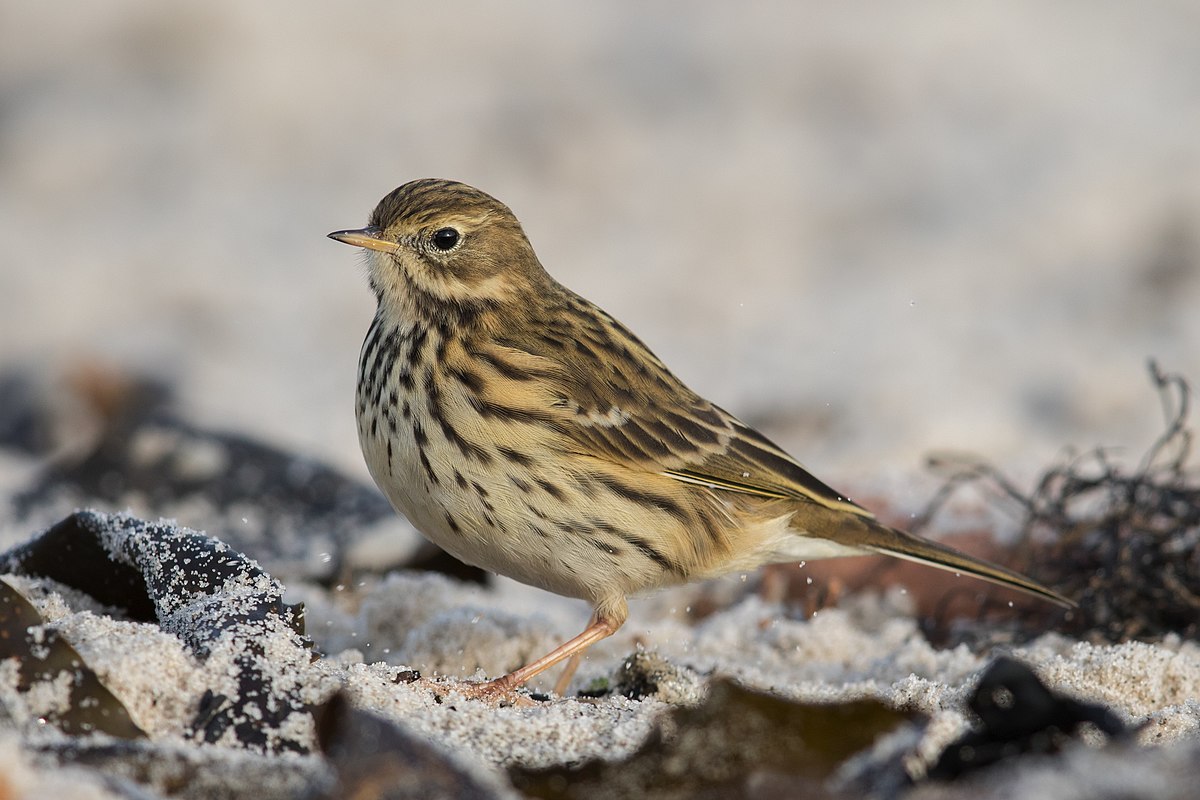
Wikipedia: Meadow pipit Quelle: WIKIPEDIA
1200px-Wiesenpieper_Meadow_pipit.jpg
Zuerst beobachtet in 🇨🇭 an 2021-06-27.
Beschreibung
Allgemein: Looks like MisteldrosselAllgemein: Deutschland: Brut, Zugvogel, Wintergast RL V
Etymologie:
[9] The name "pipit", first documented by Thomas Pennant in 1768, is onomatopoeic, from the call note of this species. [Link]
Saisonal:
Meadow Pipits can often be observed in large numbers when they gather on fields during migration. They like to stay in meadows with high grass or on arable land and only fly up when disturbed or when a bird of prey appears, which is why they are often overlooked. [Link]
Saisonales Verhalten
Jahresvogel Brut: 04-01 - 07-29 Migration rein: 02-20 - 05-10 Migration raus: 09-17 - 11-06Weitere Infos at Vogelwarte.ch
Weitere Infos
Physikalische Details
Körperlich: Länge=14 cm, Flügelspanne=22-25 cm, Gewicht=15-22 gHabitate: Berg
Ähnliche Arten
Sieht ähnlich aus wie: Misteldrossel.Vokalisierung
Gesang: Single note, possibly rising at the end. (Or: long 4 second phrases, gradually louder then softer; swoopy or whoopy.) Sings in flight. BirdID: Song very similar to Rock Pipit, but tone less full and more brittle. Lacks Rock Pipit's closing trill, and beginning is less "hammering". - but what does a rock pipit sound like? Gesang:Ähnlich Baumpieper, aber ohne Zia-Rufe. Vollständiger Gesang nur in flatterndem Singflug. Lange Strophen. Mittelstück meist zart und hoch [Link]
Song very similar to Rock Pipit, but tone less full and more brittle. Lacks Rock Pipit's closing trill, and beginning is less "hammering". [Link]
Gesang Eigenschaften:
Melody: einnotig, schnell, Frequency: medium (1-5 KHz)
♫ Quelle: XENOCANTO XC722919 - Meadow Pipit - Anthus pratensis - song.mp3 (Gesang)

Rufe:
fast tonlos „ist, ist.“
[Link]
Contact call a short "eest". Similar to Rock Pipit but shorter,cleaner and most often in quick series. Warning call a sharp, high pitched "tzeet". Also a rattling "trrrrt". [Link]
No details but a Xeno-Canto recording.
XC930459 - Meadow Pipit flight call - Anthus pratensis.
♫ Quelle: XENOCANTO XC930459 - Meadow Pipit flight call - Anthus pratensis.mp3 (Flugruf)

Ruf Eigenschaften: Flugruf Frequenz: ,
Vollprofil
Haubenmeise / European crested tit (Lophophanes cristatus)

Haubenmeise am Stazersee bei St Mortiz hebt ab. 2023-02-05 15:48:04 Engadin
Zuerst beobachtet in 🇨🇭 an 2020-07-31.
Beschreibung
Allgemein: Für mich sind es eher Vögel, die man in den Bergen oder Engadin sieht, aber im Winter werden sie auch bei uns in Fehraltorf gehört (ich probiere noch eins zu sehen oder fotografieren!Allgemein: Gesehen nah bei Pragelpasshöhe, zusammen mit Tannenmeisen, Haubenmeisen und Sommergoldhähnchen
Allgemein: Deutschland: Brut-, Jahresvogel
Saisonales Verhalten
Jahresvogel Brut: 04-01 - 07-20Weitere Infos at Vogelwarte.ch
Weitere Infos
Physikalische Details
Körperlich: Länge=11 cm, Flügelspanne=17-20 cm, Gewicht=10-13 gHabitate: Wald
Vokalisierung
Gesang: Higher-pitched than great tit - how distinguish from coal tit, etc? Gesang:Song: an improvisation over previously described calls. [Link]
Gesang Eigenschaften:
Melody: einfach rhythmisch (lhlhhh), schnell, Frequency: high (3-9 KHz) Special sounds: lallen
♫ 2025-09-06 11:13:00 Hirzli (Ruf)
Rufe:
Call a characteristic vibrating rolling trill "Trrrrurrrurrrit", with last syllable emphasized and ending with ascending pitch. Often preceded by a couple of introductory "tzi tzi". [Link]
5 oder mehr schnelle, aufsteigende Noten. Erinnert mich an die Blaumeise.
XC926922 - European Crested Tit - Lophophanes cristatus - 1x4-10 call recorded in Sweden.
♫ Quelle: XENOCANTO XC926922 - European Crested Tit - Lophophanes cristatus - 1x4-10 call recorded in Sweden.mp3 (Ruf)
 Hier von Merlin gehört.
♫ 2024-11-27 11:27:00 (Gesang?)
Ruf Eigenschaften: Ruf Melodie: stereotypisch melodisch, langsam, Frequenz: medium (1-5 KHz),
Vollprofil
Weidenmeise / Willow tit (Poecile montanus)

Tannenmeise oder weidenmeise , Sils-Maria. 2020-06-10 10:59:58 Sils
Zuerst beobachtet in 🇨🇭 an 2020-04-25.
Beschreibung
Allgemein: Vogelwarte.ch says, Two forms of Poecile montanus exist in Switzerland: the Willow Tit occurs in the Jura, the Pre-Alps and locally on the Central Plateau, while the Alpine Tit is confined to the Alps. The two forms have a distinct song as well as different ecological requirements, and could evolve into two species over time. Since I've heard them in St. Moritz, they're more properly alpine tits than willow tits. I should verify the audio recordings vs xenocanto, etc, as it was BirdNet that identified them as willow tits, and it is not infallible.Allgemein: Deutschland: Brut-, Jahresvogel
Vokalisierung:
Other sounds: high pitced "zi zi" similar to other tits. [Link]
Saisonales Verhalten
Jahresvogel Brut: 04-20 - 08-18Weitere Infos at Vogelwarte.ch
Weitere Infos
Physikalische Details
Körperlich: Länge=11 cm, Flügelspanne=17-20 cm, Gewicht=8-14 gHabitate: Wald
Vokalisierung
Gesang: Songs I've heard alternate two notes and look like a sine wave on the sonogram. Vogelwarte.ch: Apart from minor differences in diet and size, Alpine Tit and Willow Tit can only be identified by their song. The Willow Tit utters a series of long, descending notes («tyoo tyoo tyoo tyoo»), whereas the Alpine Tit’s territorial song consists of short notes on an even pitch («dee dee dee dee dee»). See more here. Gesang:1.Gesangstyp: „ziü ziü ziü „ etwas wehmütig, die einzelnen Töne leicht absinkend, nicht klappernd. Bei Unterart Alpenmeise auf gleicher Höhe bleibend. 2.Gesangstyp: variable, schwätzende, helle Folge m. trillerndem Schluss. [Link]
Song: One or two soft, clear, melancholic notes repeated in a slow, even rhythm. At first rising slightly in pitch, then gradually falling. In some areas song is evenly pitched. [Link]
Gesang Eigenschaften:
Melody: einfach rhythmisch, langsam, Frequency: 3-7 KHz
♫ Quelle: OTHER 509229 (Gesang)
Vollprofil
Ringdrossel / Ring ouzel (Turdus torquatus)
Profil Wikipedia Vogelwarte BirdLife ZH ornitho.ch bird-song.ch Xeno-Canto BirdID NABU YouTube
Ringdrossel - ich wollte unbedingt einen fotografieren, und dieser hat sicher frei. 2024-06-25 09:14:04 Mettmenalp, GL
Zuerst beobachtet in 🇨🇭 an 2021-06-27.
Beschreibung
Allgemein: Deutschland: Brut-, ZugvogelSaisonales Verhalten
Präsenz: 03-12 - 11-06 Brut: 04-20 - 07-20 Migration rein: 03-12 - 05-10 Migration raus: 08-29 - 11-06Weitere Infos at Vogelwarte.ch
Weitere Infos
Physikalische Details
Körperlich: Länge=23-24 cm, Flügelspanne=38-42 cm, Gewicht=92-138 gHabitate: Berg
Ähnliche Arten
Gesang oder Rüfe ähnlich wie: Buntspecht.Vokalisierung
Gesang: BirdID says Song a primitive, plaintive series of short phrases, often with only 1-2 syllables (I heard 2-3 in Amden, sometimes chirpy, sometimes less musical). Gesang:Habe mit dem Buntspecht verwechselt - Ringdrossel singt 2-3 Noten - hilft das? [Link]
Song a primitive, plaintive series of short phrases. Often with only one or two syllables. Interspersed with eerie, higher pitched sounds, reminiscent of Song Thrush. [Link]
Gesang Eigenschaften:
Eselsbrücke 3 Noten wie Ring-dross-el Melody: einfach rhythmisch, langsam, Frequency: 1-5 KHz
♫ Quelle: XENOCANTO XC721589 - Ring Ouzel - Turdus torquatus - song.mp3 (Gesang)

Rufe:
Alarm call a series of "chok-chok". Thicker and more resonant than Redwing. [Link]
No details but a Xeno-Canto recording.
XC942931 - Ring Ouzel - Turdus torquatus - clicky call.
♫ Quelle: XENOCANTO XC942931 - Ring Ouzel - Turdus torquatus - clicky call.mp3 (Ruf)

Ruf Eigenschaften: Gesang Frequenz: ,
Vollprofil
Braunkehlchen / Whinchat (Saxicola rubetra)
Profil Wikipedia Vogelwarte BirdLife ZH ornitho.ch bird-song.ch Xeno-Canto BirdID NABU YouTube
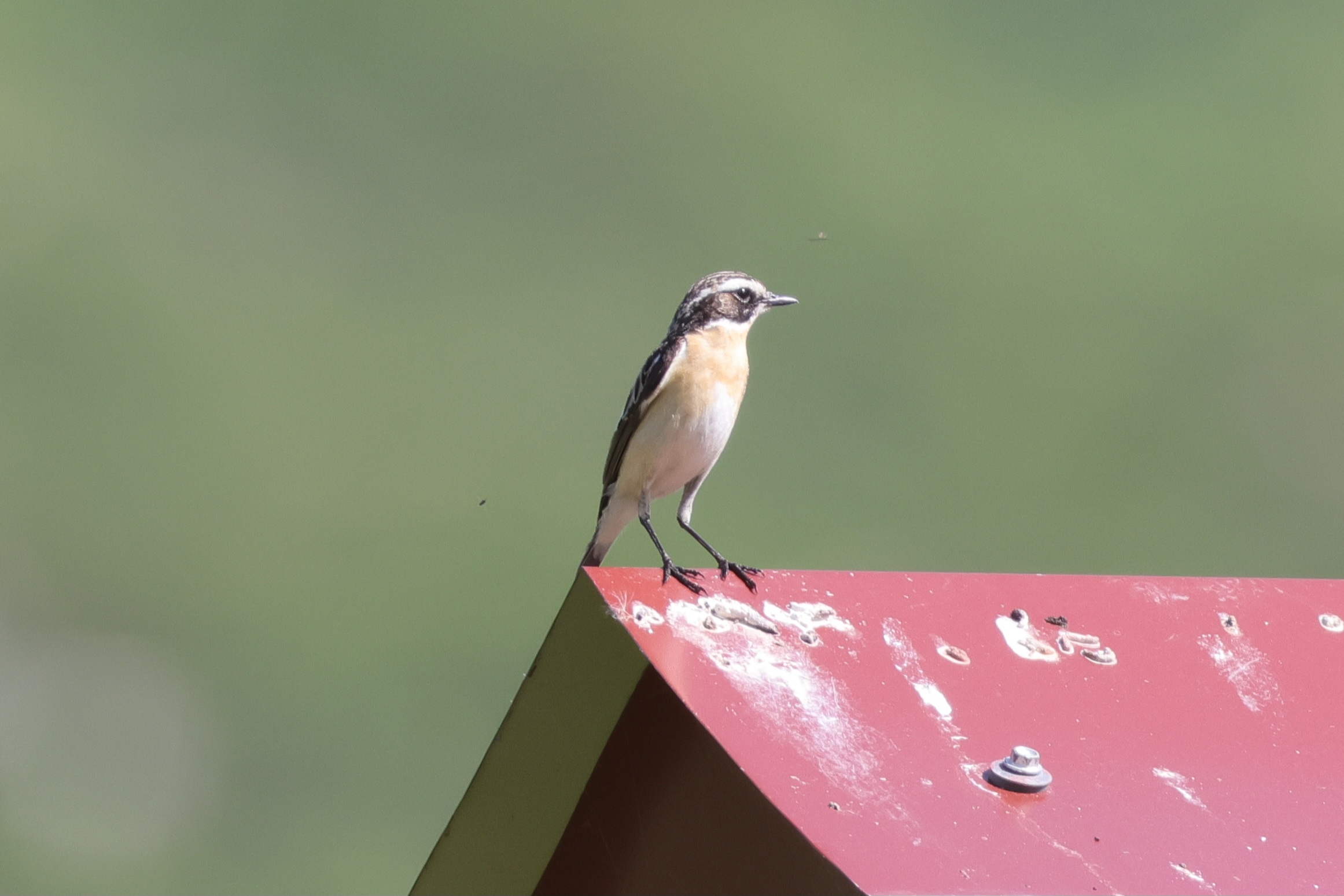
Whinchat aka Braunkehlchen in Andermatt. 2025-06-14 09:58:09 Andermatt
Zuerst beobachtet in 🇨🇭 an 2020-05-07.
Beschreibung
Allgemein: Die bauen ein Nest auf dem Boden auf einer Wiese oder Feld und brauchen relativ lang bis die Jungen flugge sind, darum hoffe ich, dass sie weitergezogen sind. Da Felder selten so lang ungestört bleiben im Mittelland, sind sie immer mehr in höheren Lagen zu finden.Allgemein: Deutschland: Brut-, Zugvogel RL 3
Persönlich gemerkt: Diesen Vogel haben wir paarweise in einem Rapsfeld entdeckt. Von weitem konnte man nur etwas orange Farbe entdecken. Ich habe ihn 2 Tage später im gleichen Feld gesucht und bin um das ganze Feld gelaufen. Erst am Ende habe ich ihn gesehen: am Anfang, sicher 100m von mit entfernt und um 2 Ecken. Da habe ich dieses Foto gemacht und in Büchern, Apps und Internet nach seiner Identität gesucht. Als ich ein sehr ähnliches Bild auf ornitho.ch gefunden habe, wo er auch auf einer Rapspflanze drauf sitzt, sah ich es als bestätigt, dass es ein Braunkelchen war.
Vokalisierung: The "peeu"-sound is depper and more resonant than similar sounds by Wheatear and Stonechat. [Link]
Saisonales Verhalten
Präsenz: 03-20 - 10-15 Brut: 05-10 - 08-10 Migration rein: 03-20 - 05-15 Migration raus: 07-20 - 10-15Weitere Infos at Vogelwarte.ch
Weitere Infos
Physikalische Details
Körperlich: Länge=12 cm, Flügelspanne=21-24 cm, Gewicht=14-19 gHabitate: Landwirtschaft
Vokalisierung
Gesang: General: Der Gesang (bei Vogelwarte.ch) klingt für mich ähnlich wie eine Mönchsgrasmücke, aber nur in sehr kurzen Phrasen.Song:
Gesang hat zwei Teile wie erster und dritter vom Hausrotschwanz. Steigend, fallend. [Link]
Gesang:
Gesang:
Kurzes (3-7 Töne) Liedchen mit 1-2 Kreischlauten, (ähnlich der Mittellaute b. Hausrotschwanz) variabel. Ahmt auch andere Vögel nach.
[Link]
Song variable with lots of mimicry. The short phrases starts with dry, rattling or sneering trills, followed by clear whistling notes and expert mimicry. More varied, both in tone and tempo, than both Stonechat and Wheatear. [Link]
Gesang Eigenschaften:
Melody: improvisiert melodisch, schnell, Frequency: high (3-9 KHz) Special sounds: Mimikry
Rufe:
„teck, teck“ (ähnlich wie wenn man zwei Steine zusammen schlägt)
[Link]
Contact call resembles many of it relatives. A short, soft "peeu", followed by a hard "check" (like hitting two rocks together). [Link]
No details but a Xeno-Canto recording.
XC732132 - Whinchat - Saxicola rubetra - call - chirp, click.
♫ Quelle: XENOCANTO XC732132 - Whinchat - Saxicola rubetra - call - chirp, click.mp3 (Ruf)

Ruf Eigenschaften: Gesang Frequenz: ,
Vollprofil
Steinschmätzer / Northern wheatear (Oenanthe oenanthe)
Profil Wikipedia Vogelwarte BirdLife ZH ornitho.ch Audubon AllAboutBirds Xeno-Canto NABU YouTube

Male northern wheatear, photo by Andreas Trepte - Own work, CC BY-SA 2.5 Quelle: WIKIPEDIA
Wikimedia Steinschmaetzer_Northern_wheatear_male.jpg
Zuerst beobachtet in 🇨🇭 an 2021-07-29.
Beschreibung
Geographie: Dieser Vogel erscheint jenseits grossen Meere in Kontinenten : Europa, Nordamerika, Afrika, Asien.General: I thought after seeing these at over 2700 meters that they must be a typical mountain bird (and in the FOK Zurich materials they were in the mountain section), however Wikipedia explains that such a stony landscape is the key, whether that is high or not:
Geography:
The northern wheatear is a migratory insectivorous species breeding in open stony country in Europe and east across the Palearctic with footholds in northeastern Canada and Greenland as well as in northwestern Canada and Alaska. It nests in rock crevices and rabbit burrows. All birds spend most of their winter in Africa. ... Miniature tracking devices have recently shown that the northern wheatear has one of the longest migratory flights known - 30,000 km (18,640 miles), from sub-Saharan Africa to their Arctic breeding grounds.[15] [Link]Strangely the residence and migration maps differ greatly by source: in Wikipedia the northern wheatear spends winter in subsaharan Africa, while the authoratitive Kosmos-Vogelführer shows some in northern Africa like Morocco. Most other sources agree with Wikipedia and Sub-Saharan Africa.
Allgemein: Deutschland: Brut-, Zugvogel RL 1
Etymologie: I thought the German name Steinschmätzer, presumably stone kisser (no one explains it, oddly enough) to be much more logical than the English northern wheatear. I was greatly amused to look it up and find it to be a 'folk etymology of "white" and "arse"' (Wikipedia).
Etymologie:
The genus name Oenanthe is derived from the Greek oenos (οίνος) "wine" and anthos (ανθός) "flower". It refers to the northern wheatear's return to Greece in the spring just as the grapevines blossom. [Link]
Aussehen und Identifizierung: Hat einen böse aussehenden schwarzen Augenstreifen wie ein Red-backed shrike (den Nici Baiker im FOK Feldornithologiekurs als Zorro-look beschrieben hat). Auf Muottas Muragl habe ich beim Fliegen den typischen runden grauen Oval umgeben bei dunklen Federn gesehen, und bin so auf Steinschmätzer gekommen. Ich habe das schwarze T-Muster nicht gesehen, die überall erwähnt wird aber nie gezeigt - ich habe ein Foto erst über Google gefunden.
Geographie: In den FOK Unterlagen werden die Zugrouten von Alaska und von nordosten Kanada gezeigt, die beide für Winter nach Afrika ziehen. Die aus Alaska fliegen über Asien unglaubliche 15000 Kilometer! Die in Kanada haben es auch nicht leicht, da sie zuerst über den Atlantik nach Spanien fliegen!
Verhalten:
 Herbert Steffny schreibt auch jetzt Anfang Mai wo die Neuntöter aus Afrika zureuckgekehrt sind, muss man nicht früh aufstehen um sie zu beobachten, weil sie selber warten bis es warm genug ist für die (leckeren) Insekten aktiv zu werden! [Link]
Vokalisierung:
Each phrase is often introduced by the "weet" sound, then followed by hastened, creaking, rattling and warbling sounds of 1-2 seconds duration. [Link]
Saisonales Verhalten
Präsenz: 03-23 - 10-27 Brut: 05-10 - 08-09 Migration rein: 03-23 - 05-31 Migration raus: 08-09 - 10-27Weitere Infos at Vogelwarte.ch
Weitere Infos
Physikalische Details
Körperlich: Länge=14-15 cm, Flügelspanne=26-32 cm, Gewicht=18-29 gHabitate: Berg
Ähnliche Arten
Sieht ähnlich aus wie: Neuntöter.Vokalisierung
Gesang:The Wheatear song consists of short phrases with marked pauses. Each phrase is often introduced by the "weet" sound, then followed by hastened, creaking, rattling and warbling sounds of 1-2 seconds duration. The "check" sound is also often included in the song. [Link]
General: I thought after seeing these at over 2700 meters that they must be a typical mountain bird (and in the FOK Zurich materials they were in the mountain section), however Wikipedia explains that such a stony landscape is the key, whether that is high or not: Geography:
The northern wheatear is a migratory insectivorous species breeding in open stony country in Europe and east across the Palearctic with footholds in northeastern Canada and Greenland as well as in northwestern Canada and Alaska. It nests in rock crevices and rabbit burrows. All birds spend most of their winter in Africa. ... Miniature tracking devices have recently shown that the northern wheatear has one of the longest migratory flights known - 30,000 km (18,640 miles), from sub-Saharan Africa to their Arctic breeding grounds.[15] [Link]Strangely the residence and migration maps differ greatly by source: in Wikipedia the northern wheatear spends winter in subsaharan Africa, while the authoratitive Kosmos-Vogelführer shows some in northern Africa like Morocco. Most other sources agree with Wikipedia and Sub-Saharan Africa.
Gesang:
Kurze, wechselvolle Strophe mit vielen unreinen Tönen. Meist von erhöhter Warte aus oder in kurzem Singflug vorgetragen.
[Link]
The Wheatear song consists of short phrases with marked pauses. The "check" sound is also often included in the song. [Link]
Gesang Eigenschaften:
Melody: improvisiert melodisch, schnell, Frequency: 2-6 KHz Special sounds: Raspel, rasseln
♫ Quelle: XENOCANTO XC730221 - Northern Wheatear - Oenanthe oenanthe - song recorded in France, just 2-3 notes, then long pause.mp3 (Gesang)

♫ Quelle: XENOCANTO XC764932 - Northern Wheatear - Oenanthe oenanthe - song recorded in Sweden with lots of whoops and swoops, about 2 seconds long, then 3-4 seconds pause.mp3 (Gesang)

♫ Quelle: XENOCANTO XC319898 - Northern Wheatear - Oenanthe oenanthe - song recorded in Scotland and includes creaking or rattling mentioned at Nord U BirdID.mp3 Schottland (Gesang)

♫ Quelle: XENOCANTO XC769228 - Northern Wheatear - Oenanthe oenanthe - song recorded in the Netherlands.mp3 (Gesang)

Vollprofil
Wasseramsel / White-throated dipper (Cinclus cinclus)
Profil Wikipedia Vogelwarte BirdLife ZH ornitho.ch bird-song.ch Xeno-Canto BirdID NABU YouTube
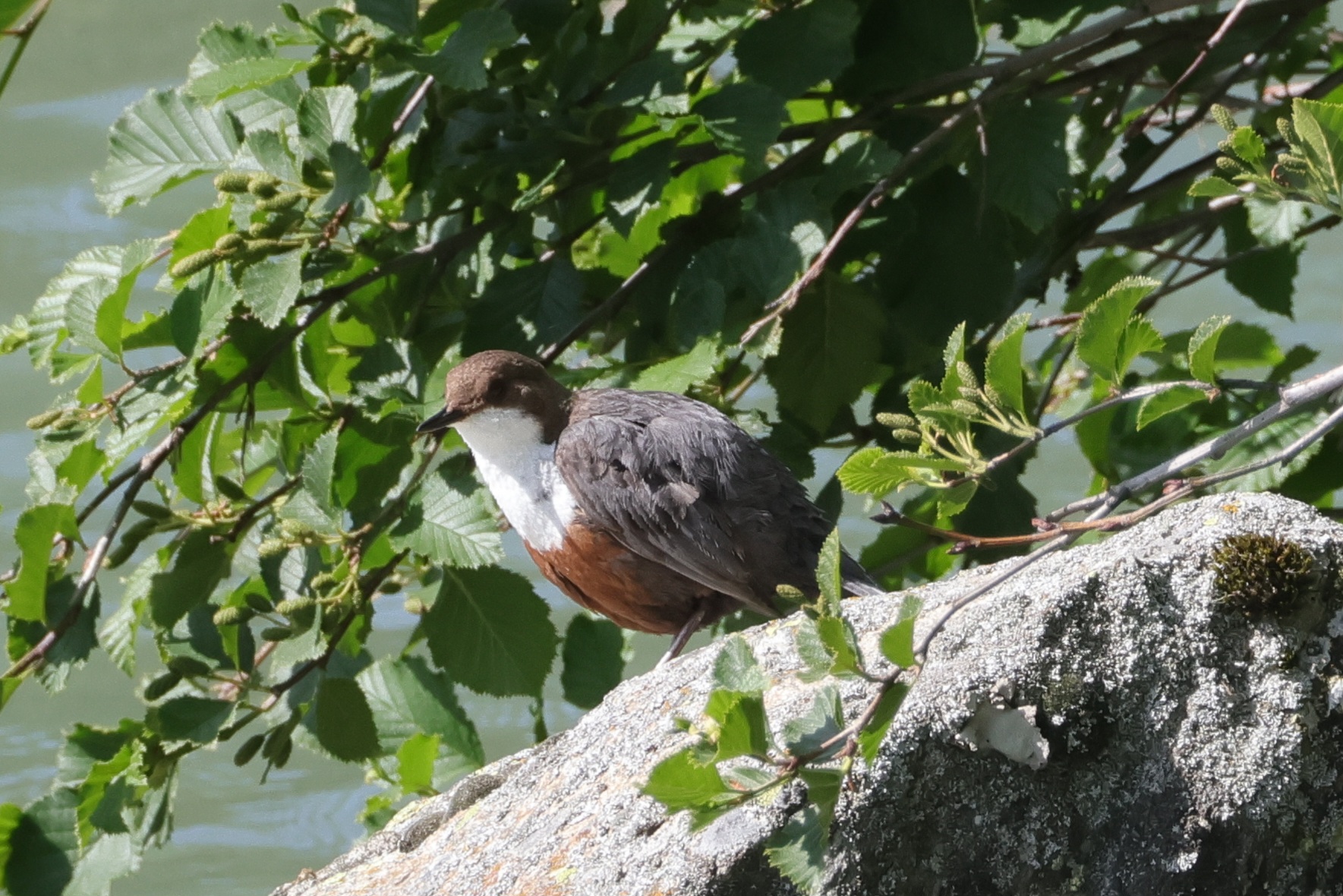
Wasseramsel in Andermatt. 2025-06-14 10:07:13 Andermatt
Zuerst beobachtet in 🇨🇭 an 2024-04-27.
Beschreibung
Allgemein: I saw a bird in Meride, Ticino in October 2020 on a tree limb that showed three bands of strong colors that I recall as black, white and red-brown. Unfortunately I discovered that my camera battery was dead, so I can only rely on a very shaky memory. I've speculatively identified it as a White-throated Dipper (German Wasseramsel), which are present in that area, though are most expected at water (there's a river nearby though). At least I'll have this bird on my radar now.Allgemein: Expected near rivers and streams.
Allgemein: Deutschland: Brut-, Jahresvogel, Wintergast
Saisonales Verhalten
Jahresvogel Brut: 02-20 - 07-20 Migration rein: 02-01 - 04-01 Migration raus: 07-10 - 10-27Weitere Infos at Vogelwarte.ch
Weitere Infos
Physikalische Details
Körperlich: Länge=18 cm, Flügelspanne=25-30 cm, Gewicht=49-84 gHabitate: Nassgebiet
Vokalisierung
Gesang: Wonderfully weird sequence of chirps, cheeps, growls. Elements often repeated twice. In a quiz, I mistook it for a starling. This recording reminds me of other water songbirds like the Marsh warbler and various reed warblers. Gesang:Song a mid tempo, staccato improvisation on contact call-like sounds. Not unlike a budgerigar. Both sexes sing, the female less melodic and more staccato than the male. [Link]
Gesang Eigenschaften:
Melody: improvisiert melodisch, schnell, Frequency: 1-7 KHz Special sounds: Raspel, komisch
Rufe:
Contact call a short, metallic and explosive "zrreet", often betraying its presence perched among boulders or when flying up and down a stream. [Link]
Chirp repeated 1-2s.
XC883371 - White-throated Dipper - Cinclus cinclus - squeaky, rhythmic call.
♫ Quelle: XENOCANTO XC883371 - White-throated Dipper - Cinclus cinclus - squeaky, rhythmic call.mp3 (Ruf)
Ruf Eigenschaften: Ruf Melodie: einnotig, langsam, Frequenz: 4-7 KHz,
Vollprofil

Tannenhäher - habe einen Specht gehört, in etwa dem Baum einen grossen Vogel gesehen, der aber von Ast zu Ast geflogen ist. 2021-07-20 15:32:10 Quelle: OTHER
20210720_153210-DSC_0457 XX Tannenhaeher - habe einen Specht gehört, in etwa dem Baum einen grossen Vogel gesehen, der aber von Ast zu Ast geflogen ist.JPG
Fehraltorf
Zuerst beobachtet in 🇨🇭 an 2020-06-10.
Beschreibung
Allgemein: Deutschland: Brut-, Jahres-, Zugvogel, WintergastAussehen und Identifizierung: Riesenschnabel, gefleckt wie Drossel/Star, laut wie Eichelhäher aber (glaube ich) etwas weicher
Vokalisierung:
Fairly silent. [Link]
Saisonales Verhalten
Jahresvogel Brut: 03-12 - 07-29Weitere Infos at Vogelwarte.ch
Weitere Infos
Physikalische Details
Körperlich: Länge=32-33 cm, Flügelspanne=52-58 cm, Gewicht=140-190 gHabitate: Berg
Vokalisierung
Gesang: Grehh, grehh, grehh!! Gesang:Song a quiet improvisation of whistling and clappering sounds, interspersed with mimicry of other birds. [Link]
Gesang Eigenschaften:
Melody: nicht musikalisch, langsam, Frequency: 1-10 KHz Special sounds: Krächzen, Mimikry
♫ Quelle: XENOCANTO XC641465 - Spotted Nutcracker - Nucifraga caryocatactes - song is a series of calls.mp3 (Gesang)

Rufe:
Warning call a characteristic dry and rasping "karrr karrr karr" in even pitch. [Link]
Like crow or its cousin the Eurasian jay (Eichelhaeher).
Ruf Eigenschaften: Alarmruf Ruf Melodie: einnotig, langsam, Frequenz: 1-10 KHz, Spezielle Klänge: Raspel.
Vollprofil
Familie Burhinidae (Triele, Haematopodidae – Austernfischer und Recurvirostridae – Säbelschnäblerverwandte):
Profil Wikipedia Vogelwarte BirdLife ZH ornitho.ch bird-song.ch Xeno-Canto BirdID NABU YouTube
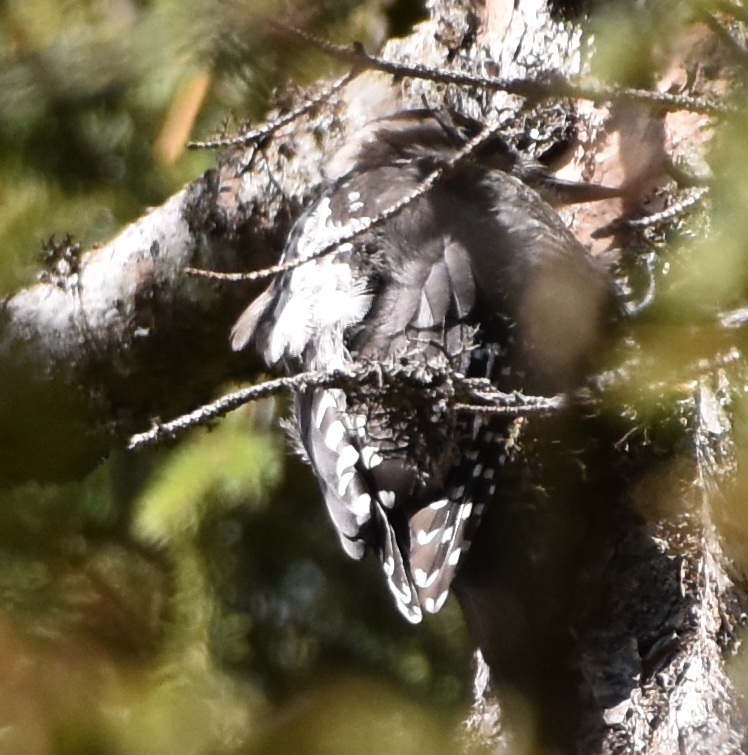
Wahrscheinlich Dreizehenspecht, Ammler Höhenweg. 2021-08-02 16:16:40 Ammler Höhenweg
Zuerst beobachtet in 🇨🇭 an 2021-08-02.
Beschreibung
Behavior:Der Borkenkäferspezialist bevorzugt ungepflegte Fichtenwälder mit reichlich Totholz. [Portrait]
Allgemein: Deutschland: Brut-, Jahresvogel, Wintergast RL 2
Verhalten:
Die Anwesenheit des heimlichen Dreizehenspechts wird oft übersehen. Er ist wenig scheu und fliegt kaum weg, wenn man sich ihm nähert. [Portrait]
Vokalisierung:
Drumming powerful and slow, with each beat clearly distinguishable. Most similar to Black Woodpecker but not as long (1 - 1.4 seconds). Accelerated ending (just the last few beats). [Link]
Saisonales Verhalten
Jahresvogel Brut: 05-10 - 07-20Weitere Infos at Vogelwarte.ch
Weitere Infos
Physikalische Details
Körperlich: Länge=21-22 cm, Flügelspanne=32-35 cm, Gewicht=57-74 gHabitate: Wald
Vokalisierung
Gesang: Fast drumming, constant volume, longer than great spotted woodpecker's. Behavior:Der Borkenkäferspezialist bevorzugt ungepflegte Fichtenwälder mit reichlich Totholz. [Portrait]
Gesang Eigenschaften:
Melody: einfach rhythmisch, schnell, Frequency: low (1-3 KHz) Special sounds: trommeln
♫ Quelle: XENOCANTO XC627431 dreizehenspecht drumming.mp3 (Trommeln)

Behavior:
Der Borkenkäferspezialist bevorzugt ungepflegte Fichtenwälder mit reichlich Totholz. [Portrait]
Rufe:
Contact call similar to Great Spotted, but deeper and softer. Not very vocal. [Link]
Behavior: Seine unauffälligen Rufe sind nicht laut und tönen ähnlich wie jene des Buntspechts. [Portrait]
XC498796 Dreizehenspecht call.
♫ Quelle: XENOCANTO XC498796 Dreizehenspecht call.mp3 (Ruf)

Ruf Eigenschaften: Trommeln Ruf Melodie: einfach rhythmisch, langsam, Frequenz: low (1-3 KHz),
Vollprofil
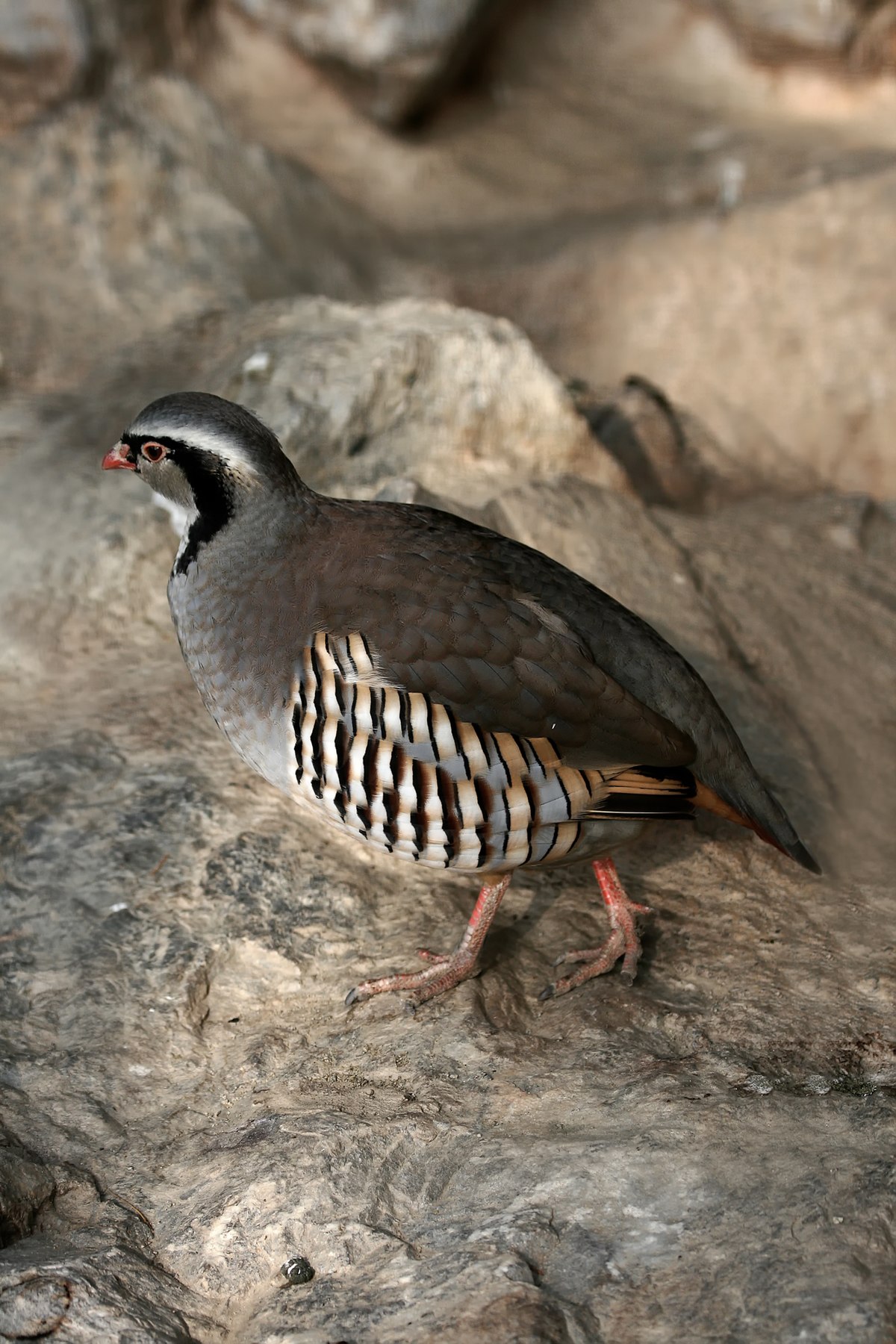
Wikipedia: Rock partridge Quelle: WIKIPEDIA
1200px-Steinhuhn_Alectoris_graeca.jpg
🔍
Never observed (yet!)
Beschreibung
Allgemein:Das Steinhuhn (Alectoris graeca) ist eine Vogelart aus der Familie der Fasanenartigen (Phasianidae), die zur Ordnung der Hühnervögel (Galliformes) gehört. Es ist ein scheuer Bodenvogel, der geschickt und ausdauernd läuft und das gesamte Jahr über an steinigen, grasbewachsenen sonnigen Berghängen zu beobachten ist (meidet Nordlagen)[1]. Während des Winterhalbjahrs hält er sich in tieferen Lagen auf.
[mehr]
Saisonales Verhalten
Jahresvogel Brut: 05-21 - 08-09Weitere Infos at Vogelwarte.ch